Category Technology/Electronics

Making the Strange Metal State in High Temperature Superconductors even Stranger

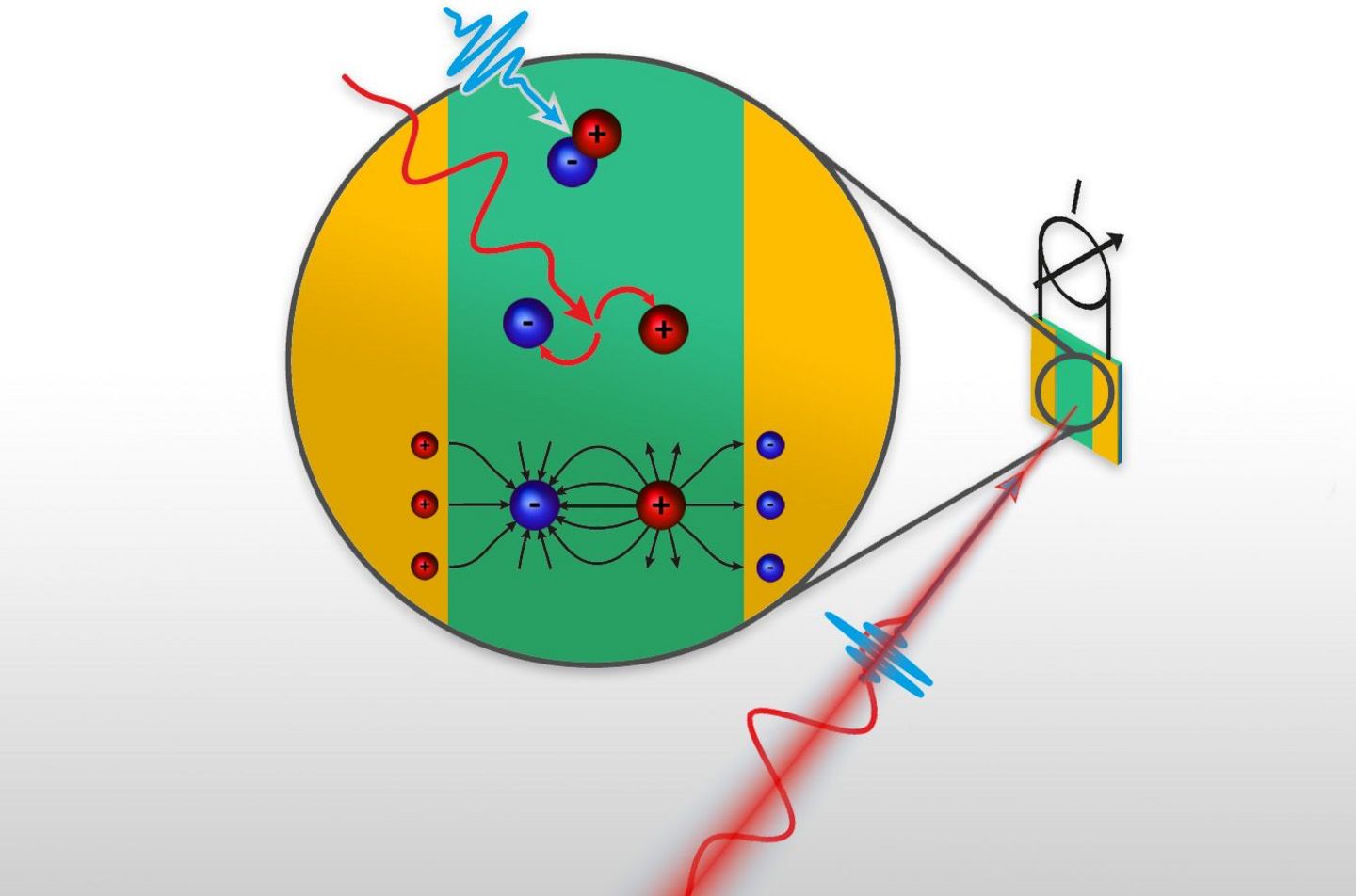
Researchers from Chalmers University of Technology, Sweden, have uncovered a striking new behavior of the ‘strange metal’ state of high temperature superconductors. The discovery represents an important piece of the puzzle for understanding these materials, and the findings have been published in the journal Science.

Superconductivity, where an electric current is transported without any losses, holds enormous potential for green technologies. For example, if it could be made to work at high enough temperatures, it could allow for lossless transport of renewable energy over great distances. Investigating this phenomenon is the aim of the research field of high temperature superconductivity...

Read More

Topological Valley Hall Edge Solitons in Photonics

Experimental setup for observing nonlinear valley Hall edge states
Experimental setup for observing nonlinear valley Hall edge states. Credit: H. Zhong, S. Xia, et al., doi 10.1117/1.AP.3.5.056001

A novel topological edge soliton developed for nonlinear photorefractive lattices enables robust light beams is promising for photonic technology. Diffraction is a natural property of light beams. It allows light to bend around obstacles. Because light serves as a carrier of information, some of the distorting effects of diffraction must be mitigated for many technological applications. Topological insulators, first unveiled in condensed matter physics, have attracted interest for over a decade. A photonic topological insulator can help ensure consistent propagation of a light beam along its edges...

Read More

Stretchy, Bendy, Flexible LEDs

They’re also cheaper, faster and fabricated with an inkjet printer.

Sure, you could attach two screens with a hinge and call a cell phone “foldable,” but what if you could roll it up and put it in your wallet? Or stretch it around your wrist to wear it as a watch?The next step in digital displays being developed at the McKelvey School of Engineering at Washington University in St. Louis could make that a reality.

First, there were light-emitting diodes, or LEDs. Then, organic LEDs, or OLEDs. Now, researchers in the lab of Chuan Wang, assistant professor in the Preston M. Green Department of Electrical & Systems Engineering, have developed a new material that has the best of both technologies and a novel way to fabricate it — using an inkjet printer.

The research was publis...

Read More

Controlling Light with a Material Three Atoms Thick

Controlling Light With a Material Three Atoms Thick

Thin structures made of black phosphorus can tune the properties of light, with implications for science and technology. Most of us control light all the time without even thinking about it, usually in mundane ways: we don a pair of sunglasses and put on sunscreen, and close — or open — our window blinds.

But the control of light can also come in high-tech forms. The screen of the computer, tablet, or phone on which you are reading this is one example. Another is telecommunications, which controls light to create signals that carry data along fiber-optic cables.

Scientists also use high-tech methods to control light in the laboratory, and now, thanks to a new breakthrough that uses a specialized material only three atoms thick, they can control light more precisely than ever bef...

Read More