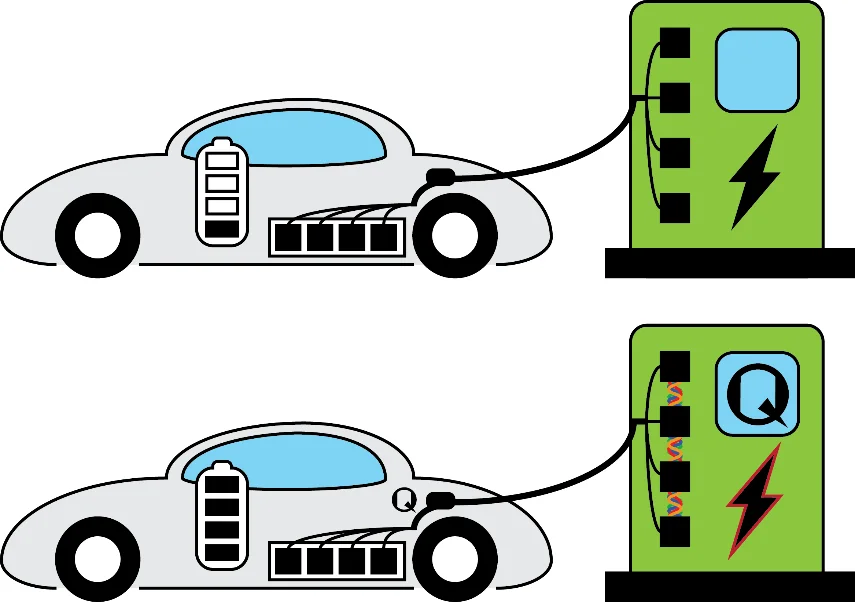
A pictorial illustration of today’s electric vehicle versus the future vehicle based on quantum battery technologies. Employing quantum charging would lead to a 200 times speedup in a typical EV, which means that the charging time would be cut from 10 hours to about 3 minutes (at home), or 30 minutes to 9 seconds at a charging station. Image Credit: Institute for Basic Science.
Whether it’s photovoltaics or fusion, sooner or later, human civilization must turn to renewable energies. This is deemed inevitable, considering the ever-growing energy demands of humanity and the finite nature of fossil fuels. Much research has been pursued in order to develop alternative sources of energy, most of which use electricity as the main energy carrier...
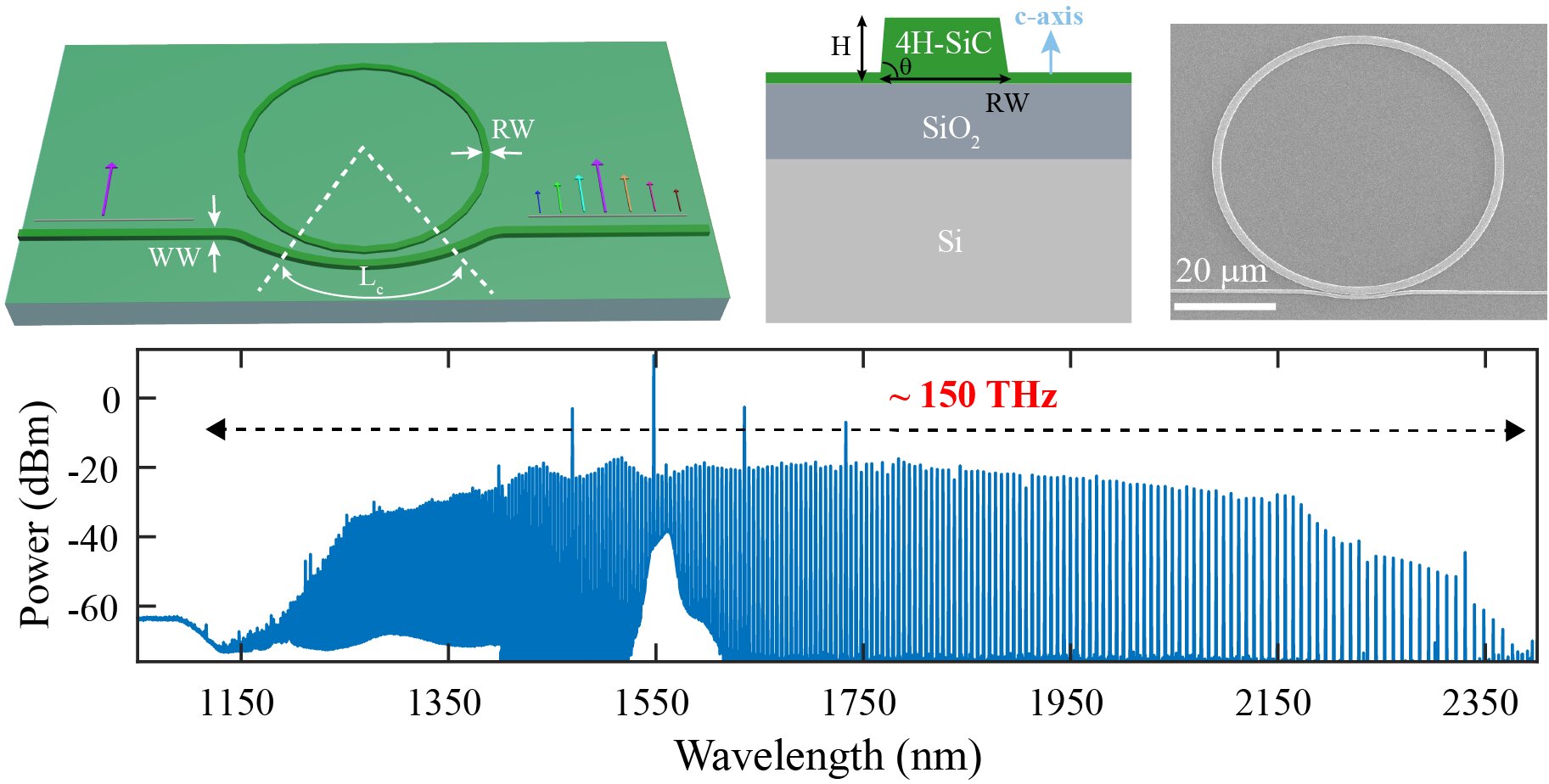
(a) Schematic top view (left) and cross section (right) of the 4H-silicon-carbide-on-insulator platform for frequency comb generation based on compact microring resonators. The sidewall angle (θ) is estimated near 80–85 deg in our nanofabrication. Dispersion engineering is carried out by varying the ring waveguide width (RW). In addition, efficient coupling is realized using the pulley structure where the access waveguide width and coupling length are adjusted to achieve phase matching to the desired resonant mode families. (b) Scanning electron micrograph of a 36-μm-radius SiC microring. In this work, the SiC thickness is fixed at 500 nm with a pedestal layer of 50 nm. (c) Simulated integrated dispersion [Dint; see its definition in Eq. (1)] for the fundamental transverse-electric (i.e...Read More
Caption:An MIT team has designed an “acoustic fabric,” woven with a fiber that is designed from a “piezoelectric” material that produces an electrical signal when bent or mechanically deformed, providing a means for the fabric to convert sound vibrations into electrical signals. Credits
Researchers have developed a new acoustic fabric converts audible sounds into electrical signals. They designed a fabric that works like a microphone, converting sound first into mechanical vibrations, then into electrical signals, similarly to how our ears hear.
Having trouble hearing? Just turn up your shirt. That’s the idea behind a new “acoustic fabric” developed by engineers at MIT and collaborators at Rhode Island School of Design.
All fabrics vibrate in response to audible sounds, th...
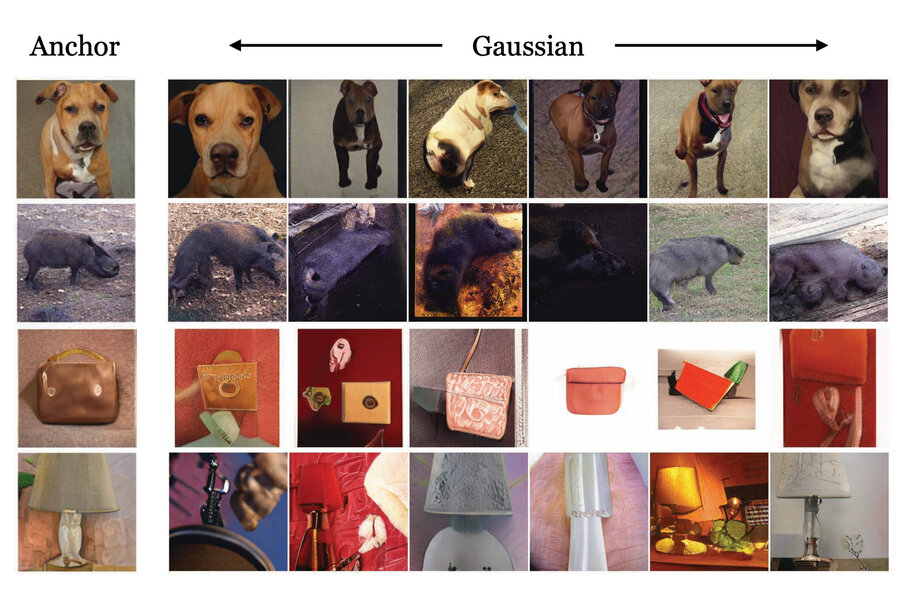
MIT researchers have demonstrated the use of a generative machine-learning model to create synthetic data, based on real data, that can be used to train another model for image classification. This image shows examples of the generative model’s transformation methods. Credit: Massachusetts Institute of Technology
Huge amounts of data are needed to train machine-learning models to perform image classification tasks, such as identifying damage in satellite photos following a natural disaster. However, these data are not always easy to come by. Datasets may cost millions of dollars to generate, if usable data exist in the first place, and even the best datasets often contain biases that negatively impact a model’s performance.
To circumvent some of the problems presented by datasets, M...






Recent Comments