Category Technology/Electronics

New Algorithm may help Autonomous Vehicles Navigate Narrow, crowded streets

A CMU team developed a algorithm that could help an autonomous vehicle safely and efficiently navigate narrow, crowded streets like this one.

Autonomous vehicle researchers have tackled navigating a crowded, narrow street, with cars parked on both sides, and not enough space for vehicles traveling in both directions to pass each other. It is a scenario familiar to anyone who has driven down a crowded, narrow street. Parked cars line both sides, and there isn’t enough space for vehicles traveling in both directions to pass each other. One has to duck into a gap in the parked cars or slow and pull over as far as possible for the other to squeeze by.

Drivers find a way to negotiate this, but not without close calls and frustration...

Read More

Air-powered Computer Memory helps Soft Robot Control Movements

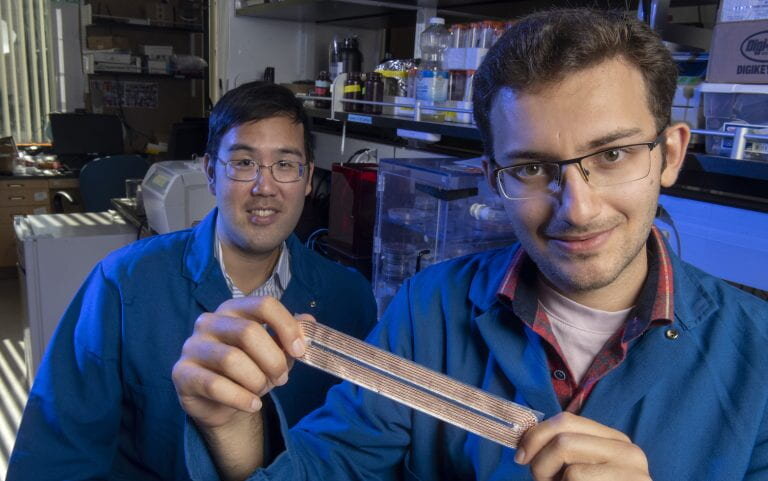
An 8-bit pneumatic RAM chip used to help a soft robot control its movements. (William Grover)

“Airhead” robot uses pneumatic RAM to play piano. Engineers at UC Riverside have unveiled an air-powered computer memory that can be used to control soft robots. The innovation overcomes one of the biggest obstacles to advancing soft robotics: the fundamental mismatch between pneumatics and electronics. The work is published in the open-access journal, PLOS One.

Pneumatic soft robots use pressurized air to move soft, rubbery limbs and grippers and are superior to traditional rigid robots for performing delicate tasks. They are also safer for humans to be around. Baymax, the healthcare companion robot in the 2014 animated Disney film, Big Hero 6, is a pneumatic robot for good reason.

Read More

Researchers discover a new Inorganic Material with Lowest Thermal Conductivity ever reported

A collaborative research team, led by the University of Liverpool, has discovered a new inorganic material with the lowest thermal conductivity ever reported. This discovery paves the way for the development of new thermoelectric materials that will be critical for a sustainable society.

Reported in the journal Science, this discovery represents a breakthrough in the control of heat flow at the atomic scale, achieved by materials design. It offers fundamental new insights into the management of energy. The new understanding will accelerate the development of new materials for converting waste heat to power and for the efficient use of fuels.

The research team, led by Professor Matt Rosseinsky at the University’s Department of Chemistry and Materials Innovation Factory and Dr...

Read More

Tamarind Shells Converted into an Energy Source for Vehicles

A representation of the experimental process, as well as photographs of the
tamarind shell at every step

A team of scientists has found a way to process tamarind shells which are rich in carbon, converting the waste material into carbon nanosheets, which are a key component of supercapacitors – energy storage devices that are used in automobiles, buses, electric vehicles, trains, and elevators.

Shells of tamarind, a tropical fruit consumed worldwide, are discarded during food production. As they are bulky, tamarind shells take up a considerable amount of space in landfills where they are disposed as agricultural waste.

The study reflects NTU’s commitment to address humanity’s grand challenges on sustainability as part of its 2025 strategic plan, which seeks to accelerate the trans...

Read More