Category Technology/Electronics

Dark Excitons hit the spotlight

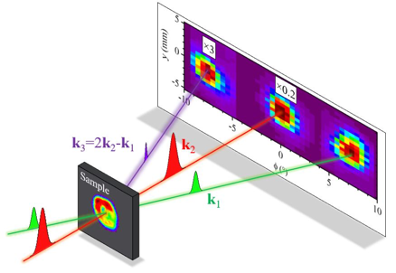
The instrument used an initial pump pulse of light to excite electrons and generate excitons. This was rapidly followed by a second pulse of light that used extreme ultraviolet photons to kick the electrons within excitons out of the material and into the vacuum of an electron microscope. The electron microscope then measured the energy and angle that the electrons left the material.

Heralding the end of a decade-long quest, in a promising new class of extremely thin, two-dimensional semiconductors, scientists have for the first time directly visualized and measured elusive particles, called dark excitons, that cannot be seen by light.

The powerful technique, described in leading journal Science, could revolutionize research into two-dimensional semiconductors and excitons, with pro...

Read More

A Shapeshifting material based on Inorganic matter

Schematic showing difference between the two states
Differences between the two states

By embedding titanium-based sheets in water, a group led by scientists from the RIKEN Center for Emergent Matter Science has created a material using inorganic materials that can be converted from a hard gel to soft matter using temperature changes.

Science fiction often features inorganic life forms, but in reality, organisms and devices that respond to stimuli such as temperature changes are nearly always based on organic materials, and hence, research in the area of “adaptive materials” has almost exclusively focused on organic substances. However, there are advantages to using inorganic materials such as metals, including potentially better mechanical properties.

Considering this, the RIKEN-led group decided to attempt to recreate the behavi...

Read More

Air-filled Fiber Cables capable of Outperforming standard Optical fibers

Air-filled fiber cables capable of outperforming standard optical fibers
“Hollow core optical fibres with comparable attenuation to silica fibres between 600 and 1100 nm” has been published in Nature Communications with DOI 10.1038/s41467-020-199107

The next generation of optical fiber could be a step closer as a new study has shown that fibers with a hollowed out center, created in Southampton, could reduce loss of power currently experienced in standard glass fibers.

The COVID-19 crisis has seen people all over the world rapidly move their work and social lives online and communities have never relied on the internet more. The ever-increasing number of Zoom calls and webinars has highlighted the need to keep advancing the technology that has made this possible.

For over 50 years, optical fibers made of silica glass have been the transmission med...

Read More

An Improved Technique for Wireless Power Transfer technology

An improved technique for wireless power transfer technology
Image: Pixabay

Going beyond the anti-laser may enable long-range wireless power transfer. Charging a smartphone wirelessly nowadays is not a big deal. You have to put your smartphone on a charging pad. But usable long-range wireless power transfer, like from one room to another or even across the building, is still in progress.

Most of the development methods involve focusing narrow beams of energy and aiming them at their intended target. These methods have had some success but are, so far, not very efficient. And having focused electromagnetic beams flying around through the air is unsettling.

Scientists from the University of Maryland (UMD), in collaboration with a colleague at Wesleyan University in Connecticut, have developed an improved technique for wireless power transfer...

Read More