Category Technology/Electronics

Researchers Record World’s Fastest Internet Speed from a Single Optical Chip

Credit: CC0 Public Domain

Researchers from Monash, Swinburne and RMIT universities have successfully tested and recorded Australia’s fastest internet data speed, and that of the world, from a single optical chip—capable of downloading 1000 high definition movies in a split second.

Published in the prestigious journal Nature Communications, these findings have the potential to not only fast-track the next 25 years of Australia’s telecommunications capacity, but also the possibility for this home-grown technology to be rolled out across the world.

In light of the pressures being placed on the world’s internet infrastructure, recently highlighted by isolation policies as a result of COVID-19, the research team led by Dr...

Read More

‘One-Way’ Electronic Devices enter the Mainstream

Microphotograph of the Columbia Engineering single-chip circulator with watt-level power handling.

Engineers are the first to build a high-performance non-reciprocal device on a compact chip with a performance 25 times better than previous work. The new chip, which can handle several watts of power (enough for cellphone transmitters that put out a watt or so of power), was the leading performer in a DARPA SPAR program to miniaturize these devices and improve performance metrics.

Waves, whether they are light waves, sound waves, or any other kind, travel in the same manner in forward and reverse directions — this is known as the principle of reciprocity...

Read More

Scientists use Light to Accelerate Supercurrents, access Forbidden Light, Quantum World

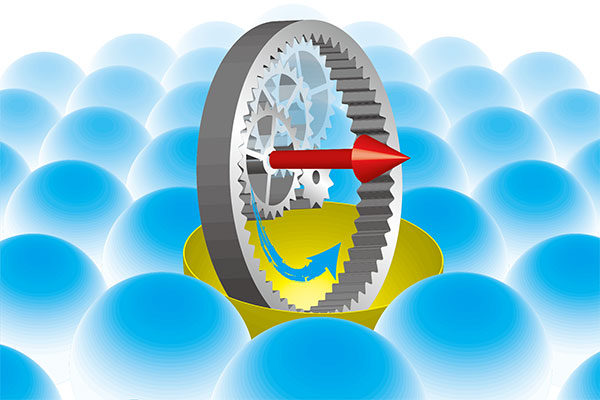
This illustration shows light wave acceleration of supercurrents, which gives researchers access to a new class of quantum phenomena. That access could chart a path forward for practical quantum computing, sensing and communicating applications. Larger image. Image courtesy of Jigang Wang.

Scientists are using light waves to accelerate supercurrents and access the unique properties of the quantum world, including forbidden light emissions that one day could be applied to high-speed, quantum computers, communications and other technologies.

The scientists have seen unexpected things in supercurrents – electricity that moves through materials without resistance, usually at super cold temperatures – that break symmetry and are supposed to be forbidden by the conventional laws of physic...

Read More

Observation of Intervalley Transitions can boost Valleytronic Science and Technology

Multipath Optical Recombination of Intervalley Dark Excitons and Trions in Monolayer WSe2. Physical Review Letters, 2020; 124 (19) DOI: 10.1103/PhysRevLett.124.196802

An international research team led by scientists at the University of California, Riverside, has observed light emission from a new type of transition between electronic valleys, known as intervalley transmissions. The research provides a new way to read out valley information, potentially leading to new types of devices.

Current semiconductor technology uses electronic charge or spin to store and process information; the associated technologies are called electronics and spintronics, respectively...

Read More