Category Technology/Electronics

3D Printers saving the lives of Coronavirus victims

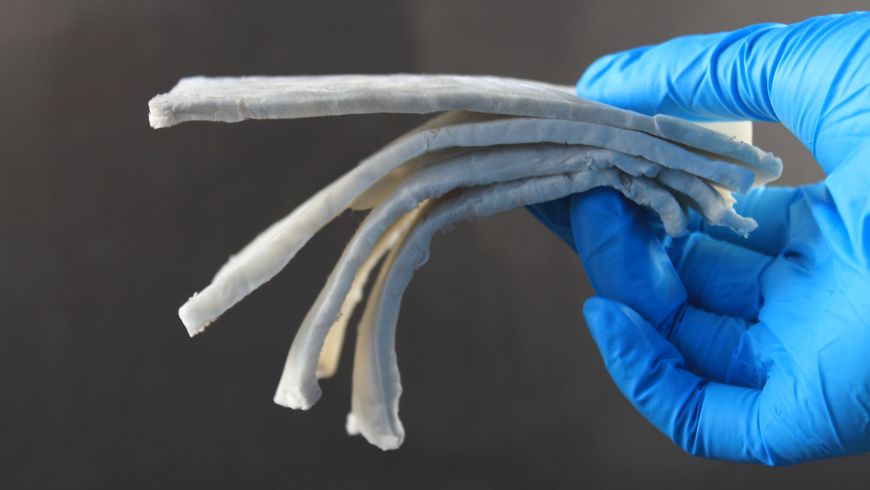
The original valve (left) and its 3-D printed twin. Credit: Cristian Fracassi

Medical valves manufactured with portable 3D printers are saving the lives of coronavirus victims at a hospital located in what is considered Italy’s Ground Zero for the deadly viral infection.

When the founder of Issanova, a startup 3D printing firm with a staff of 14 learned that a local hospital was running short of critical breathing devices used to help hospital patients suffering from the deadly virus, he sprang into action. He consulted with a fellow engineering expert and the two raced to the desperate hospital located in the small town of Chiari. There, they examined the medical device, called a Venturi valve.

That was on Friday the 13th...

Read More

Scalable System for Producing promising 2D Material

ransmission electron microscopic image of a type of MXene material made via a new method that does not include water.

For more than a decade, two-dimensional nanomaterials, such as graphene, have been touted as the key to making better microchips, batteries, antennas and many other devices. But a significant challenge of using these atom-thin building materials for the technology of the future is ensuring that they can be produced in bulk quantities without losing their quality. For one of the most promising new types of 2D nanomaterials, MXenes, that’s no longer a problem. Researchers at Drexel University and the Materials Research Center in Ukraine have designed a system that can be used to make large quantities of the material while preserving its unique properties.

Proving th...

Read More

The Ink of the Future in Printed Electronics

The Polymer ink. The blue one is the donor polymer solution, while the red one is the acceptor polymer solution. Both pristine polymers are non-conductive because there are no free moving charges inside the polymers. When they meet each other, electrons from the donor polymer will automatically be transferred to the acceptor polymer, leaving free moving charges on both polymers.THOR BALKHED

Ground-state electron transfer in all-polymer donor-acceptor heterojunctions. A research group led by Simone Fabiano at the Laboratory of Organic Electronics, Linköping University, has created an organic material with superb conductivity that doesn’t need to be doped. They have achieved this by mixing two polymers with different properties.

In order to increase the conductivity of polymers, ...

Read More

Drones can now Scan Terrain and Excavations without Human Intervention

Measuring and documenting gravel and limestone quarries, cliff faces and similar natural and man-made formations is often done using drones that photograph the area. New research may make the pilots superfluous. (NB: The vertical rod on top of the drone carries a wind detector for test purposes, and it is not present on the final version of the drone.) Photo: Erdal Kayacan.

Drone pilots may become superfluous in the future. New research from Aarhus University has allowed artificial intelligence to take over control of drones scanning and measuring terrain.

A research project at Aarhus University (AU) in collaboration with the Technical University of Denmark (DTU) aims to make measuring and documenting gravel and limestone quarries much faster, cheaper and easier in the future.

Read More