Category Technology/Electronics

Robotic Neck Brace dramatically Improves Functions of ALS patients

A study participant wearing the neck brace.

Comfortable brace incorporates both sensors and actuators to restore roughly 70% of the active range of motion. A novel neck brace, which supports the neck during its natural motion, was designed by Columbia engineers. This is the first device shown to dramatically assist patients suffering from Amyotrophic Lateral Sclerosis (ALS) in holding their heads and actively supporting them during range of motion. This advance would result in improved quality of life for patients, not only in improving eye contact during conversation, but also in facilitating the use of eyes as a joystick to control movements on a computer, much as scientist Stephen Hawkins famously did.

A team of engineers and neurologists led by Sunil Agrawal, professor of mecha...

Read More

Supercapacitors Turbocharged by Laxatives

Illustration of detergent-like ionic liquids on an electrode surfaceXianwen Mao/Massachusetts Institute of Technology

An international team of scientists, including a professor of chemistry from the University of Bristol, has worked out a way to improve energy storage devices called supercapacitors, by designing a new class of detergents chemically related to laxatives. Their paper, published in the journal Nature Materials, explains why these detergents, called ionic liquids, are better electrolytes than current materials and can improve supercapacitors.

Currently, aqueous and organic electrolytes are used, but more recently, researchers and manufacturers have been testing ionic liquids instead to boost performance...

Read More

This Designer Clothing Lets Users turn on Electronics while Turning Away Bacteria

fabric innovation
Purdue waterproof, breathable and antibacterial self-powered clothing is based on omniphobic triboelectric nanogenerators. 

New rainproof, stainproof technology turns clothing into self-powered remotes. Purdue University researchers have developed a new fabric innovation that allows wearers to control electronic devices through clothing.

“It is the first time there is a technique capable to transform any existing cloth item or textile into a self-powered e-textile containing sensors, music players or simple illumination displays using simple embroidery without the need for expensive fabrication processes requiring complex steps or expensive equipment,” said Ramses Martinez, an assistant professor in the School of Industrial Engineering and in the Weldon School of Biomedical Engine...

Read More

New Perovskite Material shows Early Promise as an Alternative to Silicon

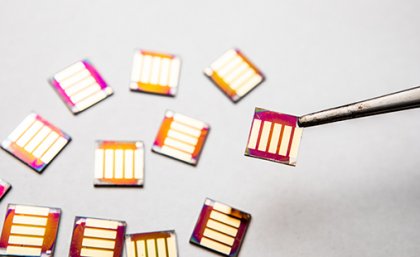
Perovskite materials are gaining popularity in the photovoltaic world due to their high efficiency and low cost. Light excites electrons in the material that can then flow as electricity. “Dancing atoms in perovskite materials provide insight into how solar cells work” by SLAC National Accelerator Laboratory is licensed under CC BY-NC-SA 2.0.

CsPbI3 is an inorganic perovskite, a group of materials gaining popularity in the solar world due to their high efficiency and low cost. This configuration is noteworthy as stabilizing these materials has historically been a challenge.

Silicon dominates solar energy products – it is stable, cheap, and efficient at turning sunlight into electricity. Any new material taking on silicon must compete, and win, on those grounds...

Read More