Category Technology/Electronics

Faster Method to Read Quantum Memory

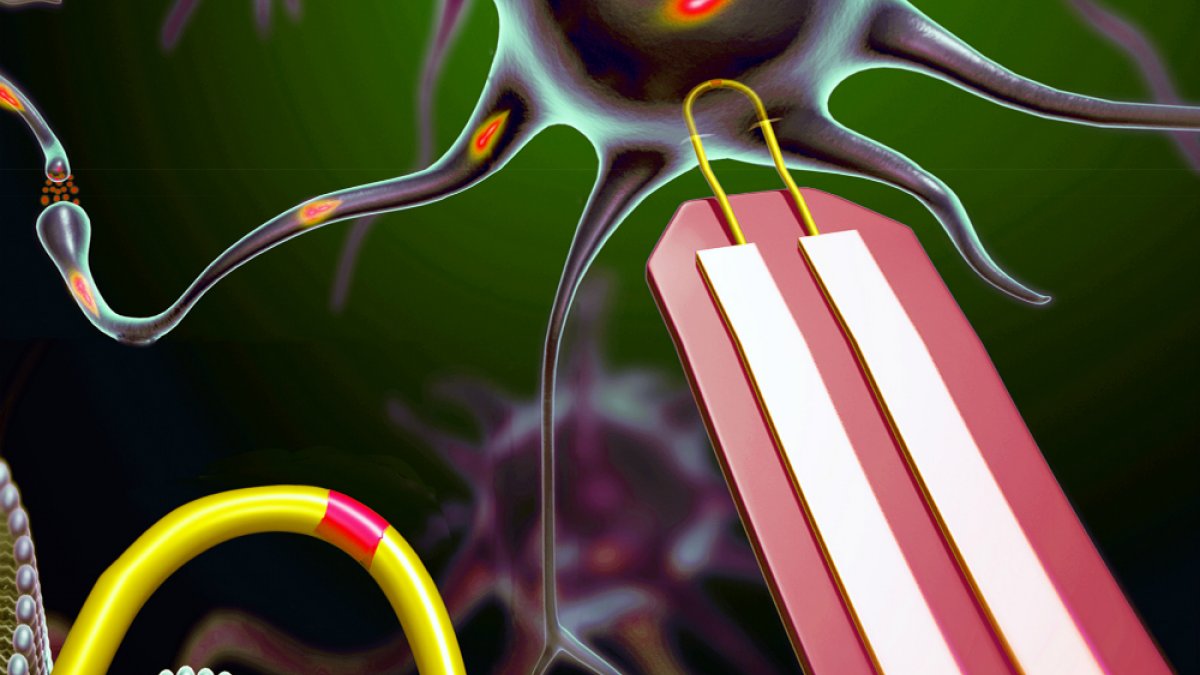
Artistic impression of qubit (blue chip) readout using the quantum states of a resonator (blue and red jets). Figure credit: Heikka Valja.

Scientists have developed a faster way to read information out of qubits, the basic building blocks of a quantum computer. The potential computing revolution that quantum computers have long promised is based on their weird property called superposition. Namely, qubits can take both logical states 0 and 1 simultaneously, on top of any value in between. By mastering superpositions of the whole quantum memory, quantum computers can quickly solve problems that would require too much computing time from regular computers working with simply 0s and 1s.

However, qubits are sensitive, and currently hold quantum information for less than a millisecond ...

Read More

Researchers Engineer a Tougher Fiber

NC State University researchers created fibers consisting of a gallium metal core surrounded by an elastic polymer sheath. When placed under stress, the fiber has the strength of the metal core. But when the metal breaks, the fiber doesn’t fail – the polymer sheath absorbs the strain between the breaks in the metal and transfers the stress back to the metal core.
Credit: Michael Dickey, NC State University

North Carolina State University researchers have developed a fiber that combines the elasticity of rubber with the strength of a metal, resulting in a tougher material that could be incorporated into soft robotics, packaging materials or next-generation textiles.

“A good way of explaining the material is to think of rubber bands and metal wires,” says Michael Dickey, correspondin...

Read More

Quantum Dots can Spit out Clone-like Photons

Scanning Transmission Electron Microscope image (STEM) of single perovskite quantum dots. New study shows that single perovskite quantum dots could be a fundamental building block for quantum-photonic technologies for computing or communications.
Credit: Image courtesy of the authors

Researchers have produced coherent single photon emitters, a key component for future quantum computers and communications systems. The study, which involves using a family of materials known as perovskites to make light-emitting particles called quantum dots, appears today in the journal Science. The paper is by MIT graduate student in chemistry Hendrik Utzat, professor of chemistry Moungi Bawendi, and nine others at MIT and at ETH in Zurich, Switzerland.

The ability to produce individual photons with...

Read More

Dose of Vitamin C helps Gold Nanowires Grow

Gold nanowires grown in the Rice University lab of chemist Eugene Zubarev promise to provide tunable plasmonic properties for optical and electronic applications. The wires can be controllably grown from nanorods, or reduced.
Credit: Zubarev Research Group/Rice University

Scientists discover a method to turn stubby gold nanorods into gold nanowires of impressive length. The metal wires could be valuable for sensing, diagnostic, imaging and therapeutic applications. A boost of vitamin C helped Rice University scientists turn small gold nanorods into fine gold nanowires.

Common, mild ascorbic acid is the not-so-secret sauce that helped the Rice lab of chemist Eugene Zubarev grow pure batches of nanowires from stumpy nanorods without the drawbacks of previous techniques.

“There’s n...

Read More