

Additive manufacturing has revolutionized manufacturing by enabling customized, cost-effective products with minimal waste. However, with the majority of 3D printers operating on open-loop systems, they are notoriously prone to failure...
Read More

February 4, 2026,
 Physics, Technology/Electronics
Additive manufacturing has revolutionized manufacturing by enabling customized, cost-effective products with minimal waste. However, with the majority of 3D printers operating on open-loop systems, they are notoriously prone to failure...
Read More
February 4, 2026,
Physics, Technology/Electronics

A Sydney Ph.D. student has recreated a tiny piece of the universe inside a bottle in her laboratory, producing cosmic dust from scratch. The results shed new light on how the chemical building blocks of life may have formed long before Earth existed. Linda Losurdo, a Ph.D. candidate in materials and plasma physics in the School of Physics, used a simple mix of gases—nitrogen, carbon dioxide and acetylene—to mimic the harsh and dynamic environments around stars and supernova remnants.
By subjecting these gases to intense electrical energy, she generated carbon-rich “cosmic dust” similar to the material found drifting between stars and embedded in comets, asteroids and meteor...
Read More
February 2, 2026,
Physics, Technology/Electronics

A team of researchers from the University of Stuttgart and the Julius-Maximilians-Universität Würzburg led by Prof. Stefanie Barz (University of Stuttgart) has demonstrated a source of single photons that combines on-demand operation with record-high photon quality in the telecommunications C-band—a key step toward scalable photonic quantum computation and quantum communication. “The lack of a high-quality on-demand C-band photon source has been a major problem in quantum optics laboratories for over a decade—our new technology now removes this obstacle,” says Prof. Stefanie Barz.
The key: Identical photons on demand
In everyday ...
February 1, 2026,
Physics, Technology/Electronics
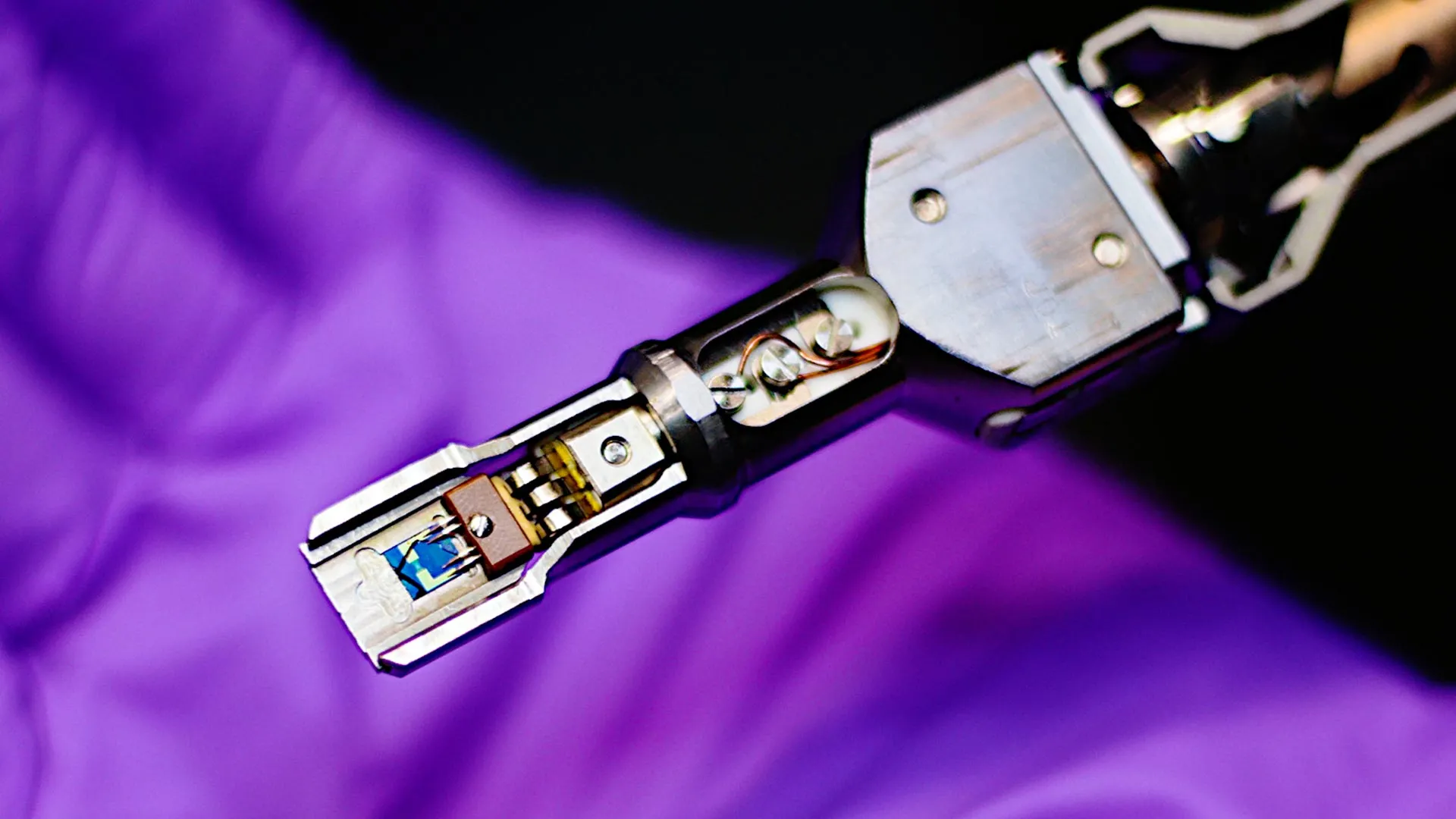
When a crystal is just one atom thick, melting gets weird — and scientists have finally caught it on camera.
When materials become just one atom thick, melting no longer follows the familiar rules. Instead of jumping straight from solid to liquid, an unusual in-between state emerges, where atomic positions loosen like a liquid but still keep some solid-like order. Scientists at the University of Vienna have now captured this elusive “hexatic” phase in real time by filming an ultra-thin silver iodide crystal as it melted inside a protective graphene sandwich.
When ice t...
Read More
Recent Comments