Category Technology/Electronics

Quantum computer outperforms supercomputers in approximate optimization tasks

quantum computing
Credit: AI-generated image

A quantum computer can solve optimization problems faster than classical supercomputers, a process known as “quantum advantage” and demonstrated by a USC researcher in a paper recently published in Physical Review Letters.

The study shows how quantum annealing, a specialized form of quantum computing, outperforms the best current classical algorithms when searching for near-optimal solutions to complex problems.

“The way quantum annealing works is by finding low-energy states in quantum systems, which correspond to optimal or near-optimal solutions to the problems being solved,” said Daniel Lidar, corresponding author of the study and professor of electrical and computer engineering, chemistry, and physics and astronomy at the USC Viterbi School of Engi...

Read More

A shortcut to AI computation: In-memory computing overcomes data transfer bottlenecks

A schematic representation of in-memory computing using electrochemical memory devices (ECRAMs) arranged in a cross-point array structure, mimicking the way synapses in the brain process information. When voltage is applied to the device, ions move within the channel, enabling simultaneous computation and data storage. This study reveals how ions and electrons behave under applied voltage, uncovering the device’s internal operational dynamics. Credit: POSTECH

As artificial intelligence (AI) continues to advance, researchers at POSTECH (Pohang University of Science and Technology) have identified a breakthrough that could make AI technologies faster and more efficient.

Professor Seyoung Kim and Dr...

Read More

Ferroelectric RAM performs calculations within memory

New ferroelectric device performs calculations within memory
A demonstration of how ferroelectric domain switching is used to perform differential computations. Credit: Prof. Bobo Tian

In a new Nature Communications study, researchers have developed an in-memory ferroelectric differentiator capable of performing calculations directly in the memory without requiring a separate processor.

The proposed differentiator promises energy efficiency, especially for edge devices like smartphones, autonomous vehicles, and security cameras.

Traditional approaches to tasks like image processing and motion detection involve multi-step energy-intensive processes. This begins with recording data, which is transmitted to a memory unit, which further transmits the data to a microcontroller unit to perform differential operations.

Since differential opera...

Read More

Material? Robot? It’s a metabot

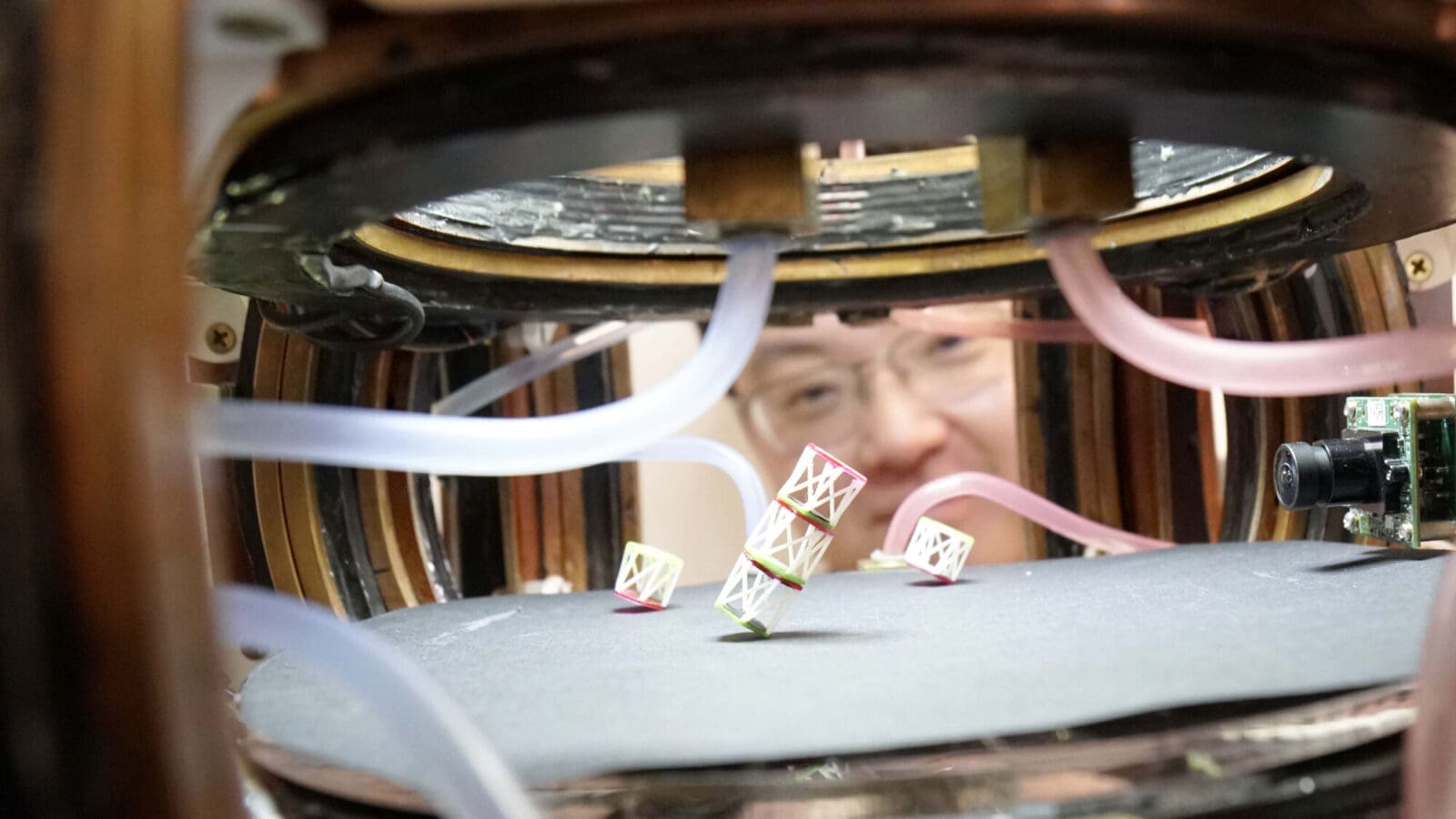
A researcher observes a metabot inside a magnetic chamber

In an experiment reminiscent of the Transformers movie franchise, engineers at Princeton University have created a type of material that can expand, assume new shapes, move and follow electromagnetic commands like a remotely controlled robot even though it lacks any motor or internal gears.

“You can transform between a material and a robot, and it is controllable with an external magnetic field,” said researcher Glaucio Paulino, the Margareta Engman Augustine Professor of Engineering at Princeton.

In an article published April 23 in the journal Nature, the researchers describe how they drew inspiration from the folding art of origami to create a structure that blurs the lines between robotics and materials...

Read More