Category Technology/Electronics

Novel technique overcomes spurious correlations problem in AI

ai
Credit: Unsplash/CC0 Public Domain

AI models often rely on “spurious correlations,” making decisions based on unimportant and potentially misleading information. Researchers have now discovered these learned spurious correlations can be traced to a very small subset of the training data and have demonstrated a technique that overcomes the problem. The work has been published on the arXiv preprint server.

“This technique is novel in that it can be used even when you have no idea what spurious correlations the AI is relying on,” says Jung-Eun Kim, corresponding author of a paper on the work and an assistant professor of computer science at North Carolina State University.

“If you already have a good idea of what the spurious features are, our technique is an efficient and effective...

Read More

Programmable photonic chip uses light to accelerate AI training and cut energy use

Penn engineers first to train AI at lightspeed
Postdoctoral fellow Tianwei Wu (left) and Professor Liang Feng (right) in the lab, demonstrating some of the apparatus used to develop the new, light-powered chip. Credit: Sylvia Zhang.

Penn Engineers have developed the first programmable chip that can train nonlinear neural networks using light—a breakthrough that could dramatically speed up AI training, reduce energy use and even pave the way for fully light-powered computers.

While today’s AI chips are electronic and rely on electricity to perform calculations, the new chip is photonic, meaning it uses beams of light instead. Described in Nature Photonics, the chip reshapes how light behaves to carry out the nonlinear mathematics at the heart of modern AI.

“Nonlinear functions are critical for training deep neural networks,”...

Read More

Google’s AI Dreamer learns how to self-improve over time by mastering Minecraft

Google's AI Dreamer learns how to self-improve over time by mastering Minecraft
Training process of Dreamer. Credit: Nature (2025). DOI: 10.1038/s41586-025-08744-2

A trio of AI researchers at Google’s Google DeepMind, working with a colleague from the University of Toronto, report that the AI algorithm Dreamer can learn to self-improve by mastering Minecraft in a short amount of time. In their study published in the journal Nature, Danijar Hafner, Jurgis Pasukonis, Timothy Lillicrap and Jimmy Ba programmed the AI app to play Minecraft without being trained and to achieve an expert level in just nine days.

Over the past several years, computer scientists have learned a lot about how deep learning can be used to train AI applications to conduct seemingly intelligent activities such as answering questions...

Read More

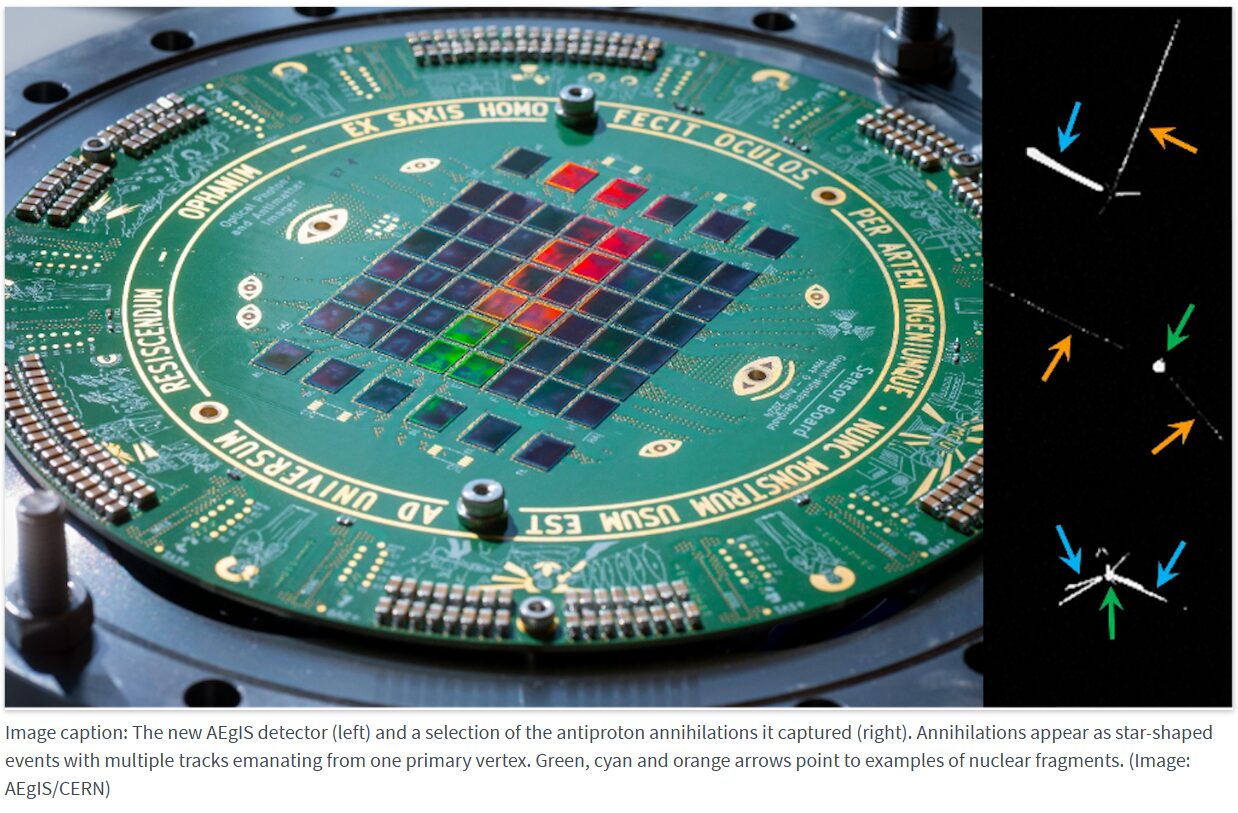
Repurposed smartphone camera sensors create real-time, high-resolution imaging of antiproton annihilations

Did you know that the camera sensor in your smartphone could help unlock the secrets of antimatter? The AEgIS collaboration, led by Professor Christoph Hugenschmidt’s team from the research neutron source FRM II at the Technical University of Munich (TUM), has developed a detector using modified mobile camera sensors to image, in real time, the points where antimatter annihilates with matter.

This new device, described in a paper published in Science Advances, can pinpoint antiproton annihilations with a resolution of about 0.6 micrometers, a 35-fold improvement over previous real-time methods.

AEgIS and other experiments at CERN’s Antimatter Factory, such as ALPHA and GBAR, are on a mission to measure the free-fall of antihydrogen within Earth’s gravitational field with high pr...

Read More