Category Technology/Electronics

Butterfly-inspired Method for Robot Wing Movement Works Without Electronics or Batteries

Robotics taking wings thanks to butterflies - Study develops method for movement without electronics and batteries

Researchers at the Technical University of Darmstadt and the Helmholtz Center Dresden-Rossendorf have developed flexible robot wings that are moved by magnetic fields. Inspired by the efficiency and adaptability of the wings of the monarch butterfly, they enable precise movements without electronics or batteries.

This bio-inspired development could fundamentally change environmental monitoring, rescue operations and biomedical applications.

Monarch butterflies are known for their outstanding endurance and adaptability. Every year, they cover thousands of kilometers on their migrations between Canada and Mexico. The key to this feat lies in their unique wings, which allow the insects to fly energy-efficiently through a combination of active movement and passive bending.

These ...

Read More
Harnessing Electromagnetic Waves and Quantum Materials to Improve Wireless Communication Technologies

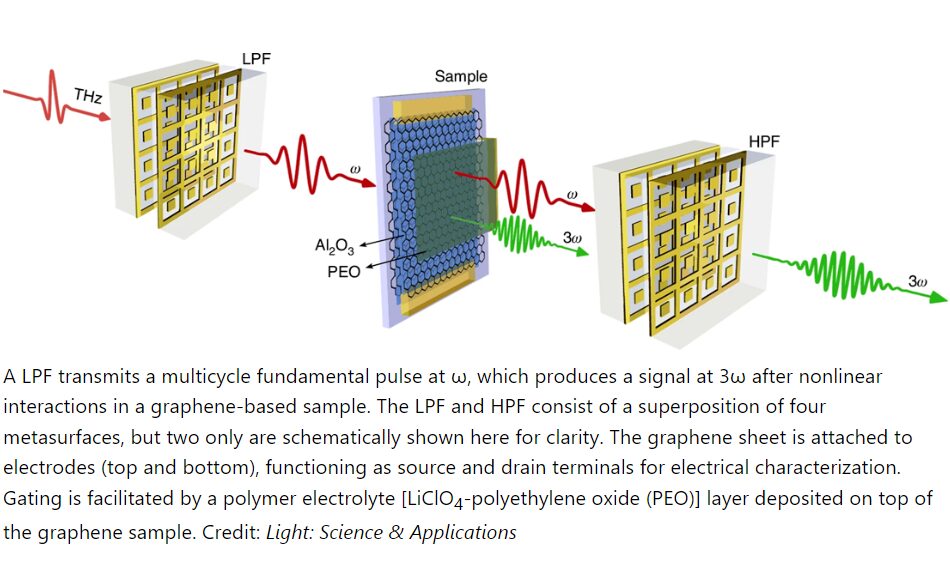
A team of researchers from the University of Ottawa has developed innovative methods to enhance frequency conversion of terahertz (THz) waves in graphene-based structures, unlocking new potential for faster, more efficient technologies in wireless communication and signal processing.

THz waves, located in the far-infrared region of the electromagnetic spectrum, can be used to perform non-invasive imaging through opaque materials for security and quality control applications. Additionally, these waves hold great promise for wireless communication.

Advances in THz nonlinear optics, which can be used to change the frequency of electromagnetic waves, are essential for the development of high-speed wireless communication and signal processing systems for 6G technologies and beyond.

...Read More

Next Generation Computers: New Wiring Material could Transform Chip Technology

Credit: Pixabay/CC0 Public Domain

The rapid technological advancements of our world have been enabled by our capacity to design and fabricate ever smaller electronic chips. These underpin computers, mobile phones and every smart device deployed to date.

One of the many challenges is that electronic components generate increasingly more heat as they are miniaturized. A significant issue lies in making the wires which connect the transistors on the chip thinner while ensuring that the minimum amount of heat is released.

These interconnects are typically made from copper, and as we start to scale them down to nano-scale thicknesses, their electrical resistance increases rapidly because the electrons moving along the wires have a higher probability of colliding into the surface of th...

Read More

A New Optical Memory Platform for Super Fast Calculations

Bright colors and different shapes meant to illustrate a photonic array
Photo Credit
Brian Long
Artist’s concept illustration of a photonic memory array

For decades there has been near constant progress in reducing the size, and increasing the performance, of the circuits that power computers and smartphones. But Moore’s Law is ending as physical limitations – such as the number of transistors that can fit on a chip and the heat that results from packing them ever more densely – are slowing the rate of performance increases. Computing capacity is gradually plateauing, even as artificial intelligence, machine learning and other data-intensive applications demand ever greater computational power.

Novel technologies are needed to address this challenge...

Read More