
Category Technology/Electronics

Physicists Demonstrate First Metro-Area Quantum Computer Network in Boston

A simple internet with significant possibilities
Map showing path of two-node quantum network through Cambridge and Boston, Massachusetts. Credit: Can Knaut via OpenStreetMap

It’s one thing to dream up a quantum internet that could send hacker-proof information around the world via photons superimposed in different quantum states. It’s quite another to physically show it’s possible.

That’s exactly what Harvard physicists have done, using existing Boston-area telecommunication fiber, in a demonstration of the world’s longest fiber distance between two quantum memory nodes to date. Think of it as a simple, closed internet between point A and B, carrying a signal encoded not by classical bits like the existing internet, but by perfectly secure, individual particles of light.

The groundbreaking work, titled “Entanglement of nanopho...

Read More

AI Systems are Already Skilled at Deceiving and Manipulating Humans, study shows

Many artificial intelligence (AI) systems have already learned how to deceive humans, even systems that have been trained to be helpful and honest. In a review article published in the journal Patterns on May 10, researchers describe the risks of deception by AI systems and call for governments to develop strong regulations to address this issue as soon as possible.

“AI developers do not have a confident understanding of what causes undesirable AI behaviors like deception,” says first author Peter S. Park, an AI existential safety postdoctoral fellow at MIT. “But generally speaking, we think AI deception arises because a deception-based strategy turned out to be the best way to perform well at the given AI’s training task. Deception helps them achieve their goals.”

Park and coll...

Read More

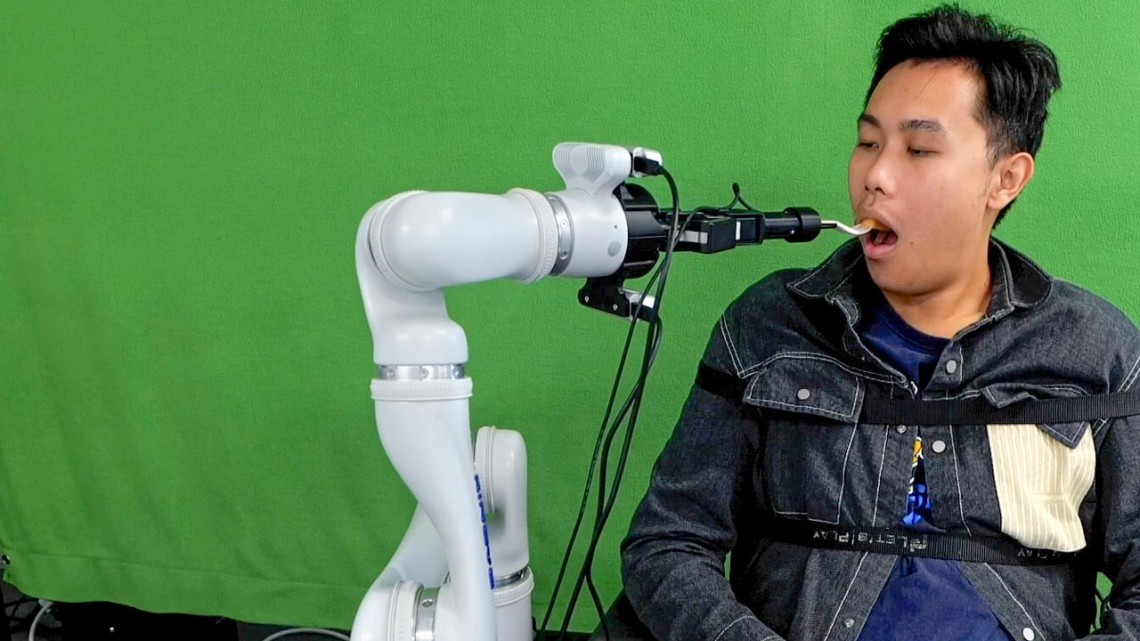
Robotic System Feeds People with Severe Mobility Limitations

A robotic system developed by Cornell researchers feeds a student participant during a lab demonstration.

Cornell researchers have developed a robotic feeding system that uses computer vision, machine learning and multimodal sensing to safely feed people with severe mobility limitations, including those with spinal cord injuries, cerebralpalsy and multiple sclerosis.

“Feeding individuals with severe mobility limitations with a robot is difficult, as many cannot lean forward and require food to be placed directly inside their mouths,” said Tapomayukh “Tapo” Bhattacharjee, assistant professor of computer science in the Cornell Ann S. Bowers College of Computing and Information Science and senior developer behind the system...

Read More

New Machine Learning Algorithm Promises Advances in Computing

Scientists are working toward deploying a new of edge computing  hardware.
Scientists are working toward deploying a new class of edge computing hardware.
Photo: Getty Images

Digital twin models may enhance future autonomous systems

Systems controlled by next-generation computing algorithms could give rise to better and more efficient machine learning products, a new study suggests.

Using machine learning tools to create a digital twin, or a virtual copy, of an electronic circuit that exhibits chaotic behavior, researchers found that they were successful at predicting how it would behave and using that information to control it.

Many everyday devices, like thermostats and cruise control, utilize linear controllers — which use simple rules to direct a system to a desired value...

Read More