Category Technology/Electronics

Compact Quantum Light Processing – A leap forward in optical quantum computing

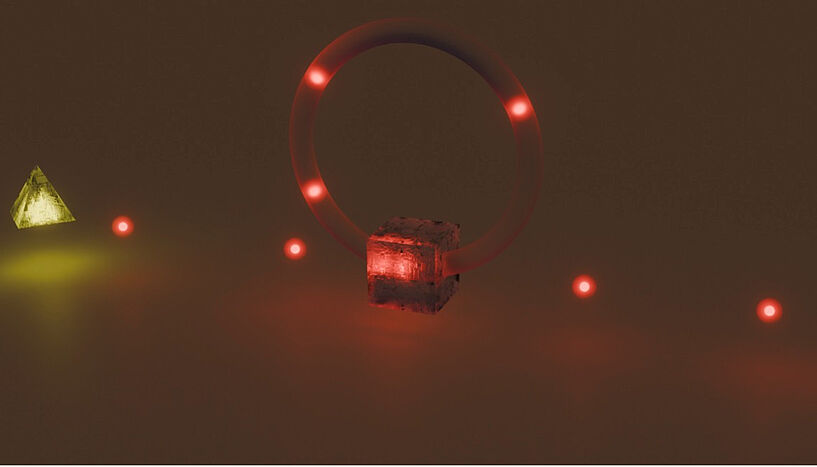
Fig. 1: Resource-efficient multi-photon processor based on an optical fiber loop.
Fig. 1: Resource-efficient multi-photon processor based on an optical fiber loop. C: Marco Di Vita

An international collaboration of researchers, led by Philip Walther at University of Vienna, have achieved a significant breakthrough in quantum technology, with the successful demonstration of quantum interference among several single photons using a novel resource-efficient platform. The work published in the journal Science Advances represents a notable advancement in optical quantum computing that paves the way for more scalable quantum technologies.

Interference among photons, a fundamental phenomenon in quantum optics, serves as a cornerstone of optical quantum computing.

It involves harnessing the properties of light, such as its wave-particle duality, to induce interference...

Read More
Researchers Develop Energy-Efficient Probabilistic Computer by Combining CMOS with Stochastic Nanomagnet

Researchers develop energy-efficient computer by combining CMOS with stochastic nanomagnet
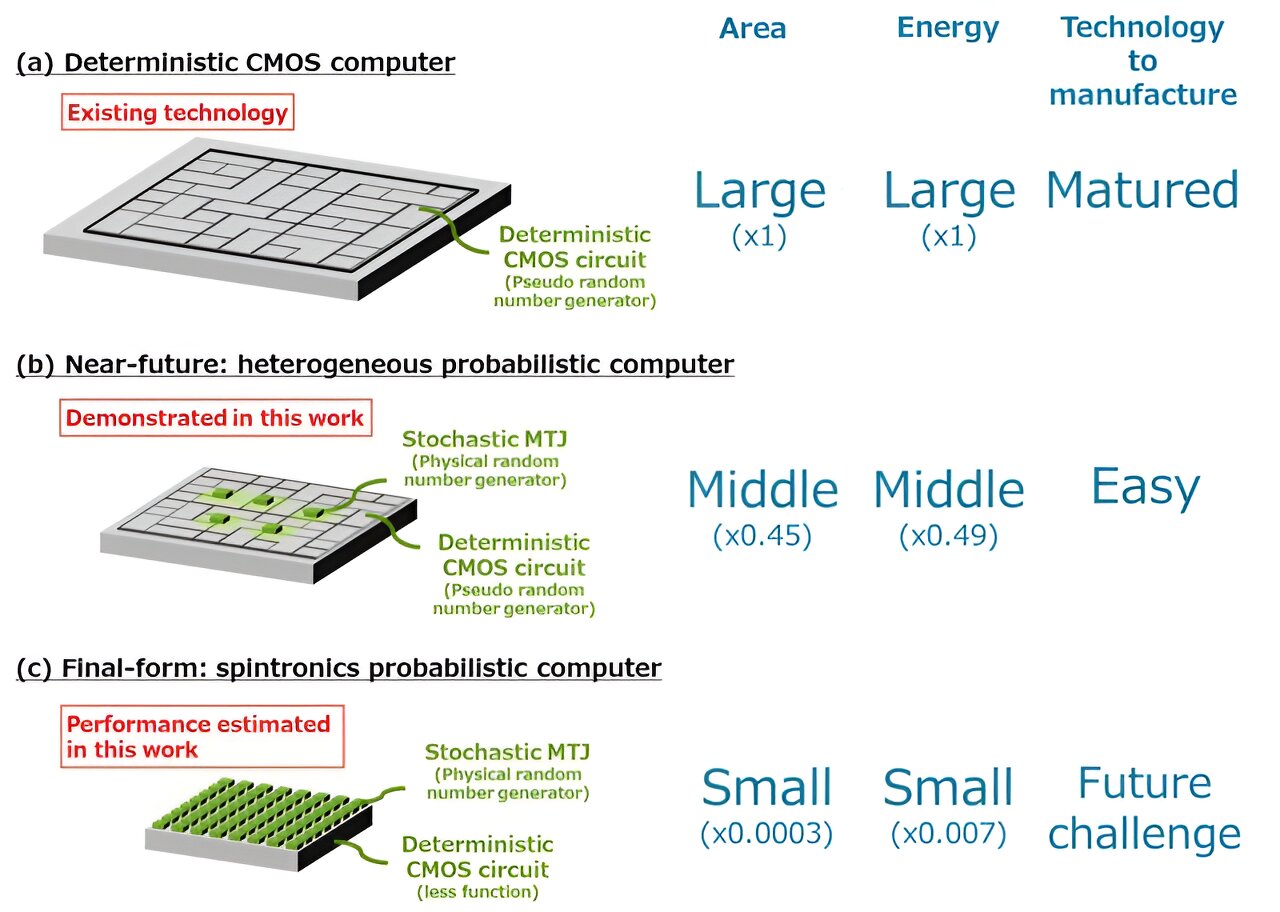
A schematic illustrating the difference in the current deterministic CMOS computer (a), near-future heterogeneous version of the probabilistic computer, and (c) the final form of the probabilistic computer fully based on the spintronics technology. The table on the right side represents the comparison between them in terms of the chip area, energy consumption, and manufacturability. Credit: Shunsuke Fukami and Kerem Camsari

Researchers at Tohoku University and the University of California, Santa Barbara, have unveiled a probabilistic computer prototype. Manufacturable with a near-future technology, the prototype combines a complementary metal-oxide semiconductor (CMOS) circuit with a limited number of stochastic nanomagnets, creating a heterogeneous probabilistic computer.

Developin...

Read More

Metasurface Antenna could enable Future 6G Communications Networks

Metasurface antenna could enable future 6G communications networks
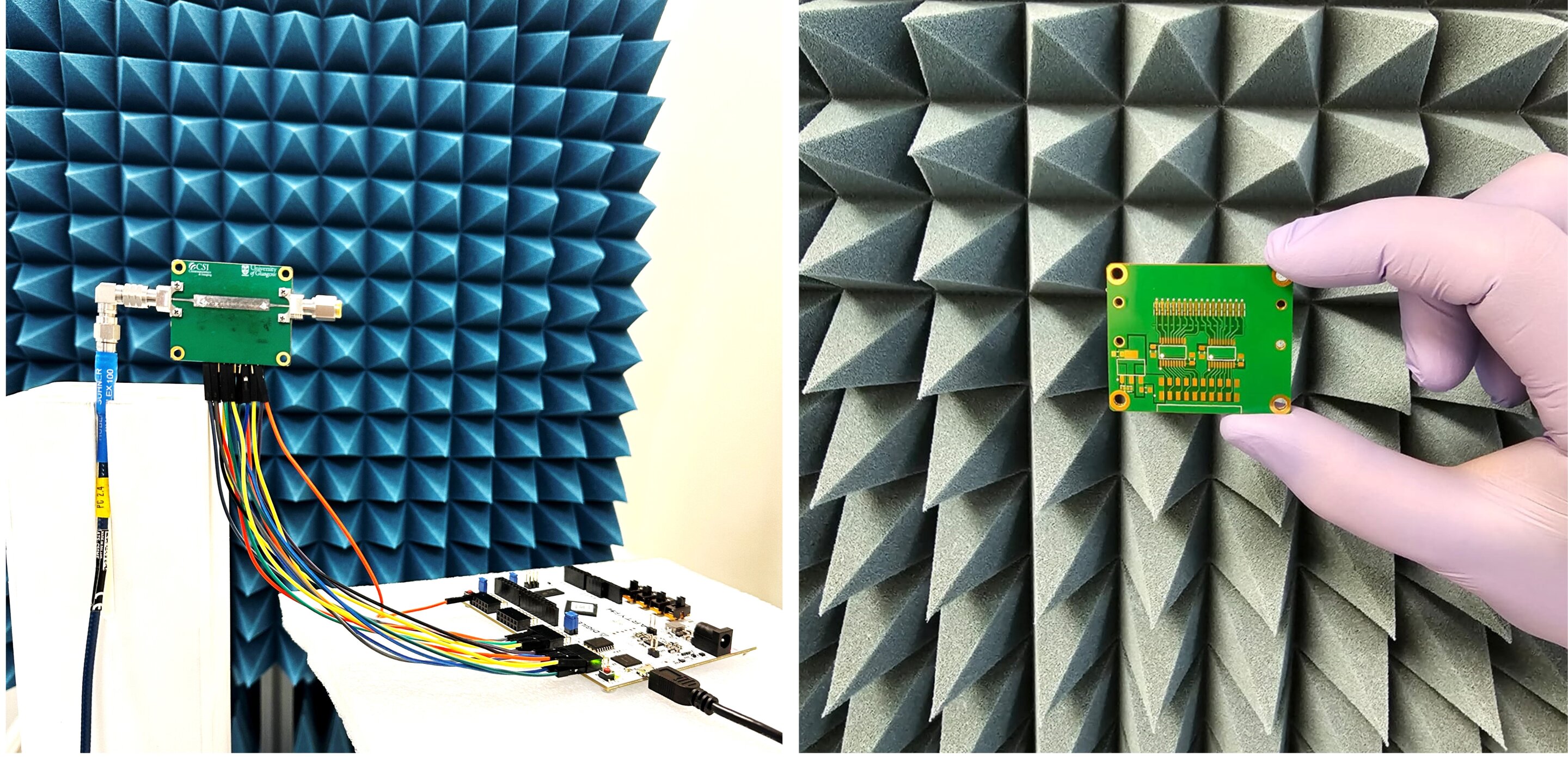
DMA prototype 1. Credit: University of Glasgow

A team led by researchers from the University of Glasgow has developed an innovative wireless communications antenna that combines the unique properties of metamaterials with sophisticated signal processing to deliver a new peak of performance.

In a paper published in the IEEE Open Journal of Antennas and Propagation, titled “60 GHz Programmable Dynamic Metasurface Antenna (DMA) for Next-Generation Communication, Sensing, and Imaging Applications: From Concept to Prototype,” the researchers showcase their development of a prototype digitally coded dynamic metasurface antenna, or DMA, controlled through high-speed field-programmable gate array (FPGA).

Their DMA is the first in the world designed and demonstrated at the operating frequ...

Read More

Scientists use Wearable Technology to Detect Stress Levels During Sleep

Scientists use wearable technology to detect stress levels during sleep

What if changes in a person’s stress levels could be detected while they sleep using wearable devices? A new study by University of Vermont researchers published in PLOS Digital Health is the first to find changes in perceived stress levels reflected in sleep data—an important step towards identifying biomarkers that may help flag individuals in need of support.

Given how critical sleep is to physical and mental health, the research team suspected signals might exist in sleep data, says Laura Bloomfield, a research assistant professor of mathematics and statistics and lead author of the study. “Changes in stress are visible.”

When parsing baseline sleep data, the researchers found “consistent associations” between people’s perceived stress scores and factors such as total slee...

Read More