



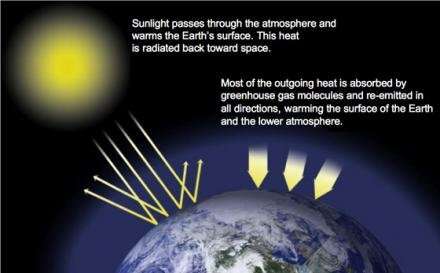
Very high atmospheric CO2 levels can explain the high temperatures on the still young Earth three to four billion years ago. At the time, our Sun shone with only 70 to 80 percent of its present intensity. Nevertheless, the climate on the young Earth was apparently quite warm because there was hardly any glacial ice. This phenomenon is known as the ‘paradox of the young weak Sun.” Without an effective greenhouse gas, the young Earth would have frozen into a lump of ice. Whether CO2, methane, or an entirely different greenhouse gas heated up planet Earth is a matter of debate among scientists.
New research by Dr. Daniel Herwartz of the University of Cologne, Professor Dr. Andreas Pack of the University of Göttingen, and Professor Dr. Thorsten Nagel of the University of Aarhus (Denmark) now suggests that high CO2 levels are a plausible explanation. This would also solve another geoscientific problem: ocean temperatures that were apparently too high. The article “A CO2 greenhouse efficiently warmed the early Earth and decreased seawater 18O/16O before the onset of plate tectonics” appears in the Proceedings of the National Academy of Sciences.
A much-debated question in earth science concerns the temperatures of the early oceans. There is evidence that they were very hot. Measurements of oxygen isotopes on very old limestone or siliceous rocks, which serve as geothermometers, indicate seawater temperatures above 70°C. Lower temperatures would only have been possible if the seawater had changed its oxygen isotope composition. However, this was long considered unlikely.
Models from the new study show that high CO2 levels in the atmosphere may provide an explanation, since they would also have caused a change in the ocean’s composition. “High CO2 levels would thus explain two phenomena at once: first, the warm climate on Earth, and second, why geothermometers appear to show hot seawater. Taking into account the different oxygen isotope ratio of seawater, we would arrive at temperatures closer to 40°C,” said Daniel Herwartz of the University of Cologne. It is conceivable that there was also a lot of methane in the atmosphere. But that would not have had any effect on the composition of the ocean. Thus, it would not explain why the oxygen geothermometer indicates temperatures that are too high. “Both phenomena can only be explained by high levels of CO2,” Herwartz added. The authors estimate the total amount of CO2 to have totalled approximately one bar. That would be as if today’s entire atmosphere consisted of CO2.


Recent Comments