



Salk scientists computationally reconstructed brain tissue in the hippocampus to study the sizes of connections (synapses). The larger the synapse, the more likely the neuron will send a signal to a neighboring neuron. The team found that there are actually 26 discrete sizes that can change over a span of a few minutes, meaning that the brain has a far great capacity at storing information than previously thought. Pictured here is a synapse between an axon (green) and dendrite (yellow). Credit: Salk Institute
The brain’s memory capacity is in the petabyte range, as much as entire Web. The new work answers a longstanding question as to how the brain is so energy efficient and could help engineers build computers that are incredibly powerful but also conserve energy.
“This is a real bombshell in the field of neuroscience,” says Terry Sejnowski, Salk professor. “We discovered the key to unlocking the design principle for how hippocampal neurons function with low energy but high computation power. Our new measurements of the brain’s memory capacity increase conservative estimates by a factor of 10 to at least a petabyte, in the same ballpark as the World Wide Web.”
Each neuron can have thousands of these synapses with thousands of other neurons. Synapses are still a mystery, though their dysfunction can cause a range of neurological diseases. Larger synapses -with more surface area and vesicles of neurotransmitters- are stronger, making them more likely to activate their surrounding neurons than medium or small synapses.
The Salk team, while building a 3D reconstruction of rat hippocampus tissue, noticed something unusual. In some cases, a single axon from one neuron formed 2 synapses reaching out to a single dendrite of a second neuron, signifying that the first neuron seemed to be sending a duplicate message to the receiving neuron.
At first, the researchers didn’t think much of this duplicity, which occurs about 10% of the time in the hippocampus. But Tom Bartol had an idea: if they could measure the difference between 2 very similar synapses such as these, they might glean insight into synaptic sizes, which so far had only been classified in the field as small, medium and large. They used advanced microscopy and computational algorithms they had developed to image rat brains and reconstruct the connectivity, shapes, volumes and surface area of the brain tissue down to a nanomolecular level.
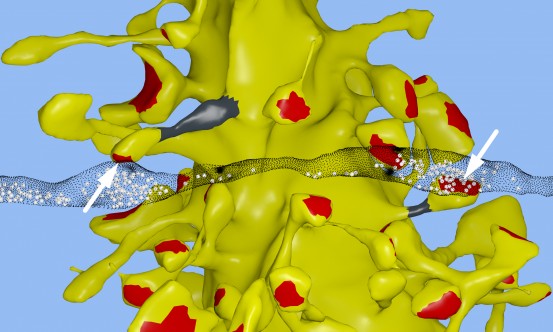
In a computational reconstruction of brain tissue in the hippocampus, Salk scientists and UT-Austin scientists found the unusual occurrence of two synapses from the axon of one neuron (translucent black strip) forming onto two spines on the same dendrite of a second neuron (yellow). Separate terminals from one neuron’s axon are shown in synaptic contact with two spines (arrows) on the same dendrite of a second neuron in the hippocampus. The spine head volumes, synaptic contact areas (red), neck diameters (gray) and number of presynaptic vesicles (white spheres) of these two synapses are almost identical. Credit: Salk Institute
The scientists expected the synapses would be roughly similar in size, but were surprised to discover the synapses were nearly identical, just 8% difference in size. Because the memory capacity of neurons is dependent upon synapse size, this difference turned out to be a key number the team could then plug into their algorithmic models of the brain to measure how much information could potentially be stored in synaptic connections.
Armed with the knowledge that synapses of all sizes could vary in increments as little as 8% between sizes within a factor of 60, the team determined there could be about 26 categories of sizes of synapses, rather than just a few. “Our data suggests there are 10 times more discrete sizes of synapses than previously thought,” says Bartol. In computer terms, 26 sizes of synapses correspond to about 4.7 “bits” of information. Previously, it was thought that the brain was capable of just 1-2 bits for short and long memory storage in the hippocampus.
What makes this precision puzzling is that hippocampal synapses are notoriously unreliable. When a signal travels from 1 neuron to another, it typically activates that 2nd neuron only 10 – 20% of the time. “We had often wondered how the remarkable precision of the brain can come out of such unreliable synapses,” says Bartol. One answer, it seems, is in the constant adjustment of synapses, averaging out their success and failure rates over time. They calculated that for the smallest synapses, about 1,500 events cause a change in their size/ability (20 minutes) and for the largest synapses, only a couple hundred signaling events (1 to 2 minutes) cause a change.
“This means that every 2 or 20 minutes, your synapses are going up or down to the next size. The synapses are adjusting themselves according to the signals they receive,” says Bartol.
The findings also offer a valuable explanation for the brain’s surprising efficiency. The waking adult brain generates only about 20 watts of continuous power- as much as a very dim light bulb. The Salk discovery could help computer scientists build ultraprecise, but energy-efficient, computers, particularly ones that employ “deep learning” and artificial neural nets -techniques capable of sophisticated learning and analysis, such as speech, object recognition and translation.”Using probabilistic transmission turns out to be as accurate and require much less energy for both computers and brains.”
http://www.salk.edu/news-release/memory-capacity-of-brain-is-10-times-more-than-previously-thought/


Recent Comments