



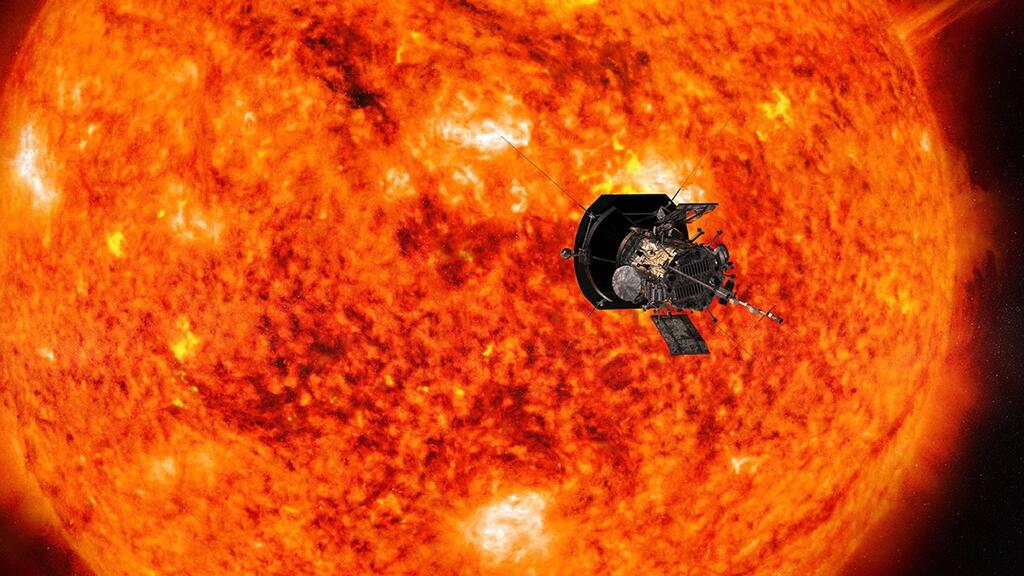
A Southwest Research Institute-led study found that protons and heavy ions react differently to solar magnetic reconnection events, revealing a more complex magnetic engine powering the solar wind. Magnetic reconnection converts magnetic energy into explosive kinetic energy, powering solar events and causing space weather that impacts Earth. Magnetic reconnection energizes protons and heavy ions, sending them shooting out from the sun at high speeds.
Current models assume all these particles react the same way, but new data obtained by NASA’s Parker Solar Probe shows distinct differences in particle acceleration. While heavy ions shoot out straight like a laser beam, protons create waves that scatter subsequent particles in a dispersed pattern, more like a flashlight.
“This new data rewrites our understanding of reconnection,” said SwRI’s Dr. Mihir Desai, lead author of a new paper about this research. “Protons and heavy ions show distinct spectra that contradict current models. Protons generate waves that scatter them more efficiently, while the heavy ions stay beam-like and retain their accelerated spectral shapes.”
The work is published in The Astrophysical Journal.
Magnetic reconnection is a ubiquitous phenomenon in the universe, where magnetic field lines converge, break apart and reconnect. At the sun, the explosive physical process energizes particles and generates high-speed flows, driving space weather events such as solar flares and coronal mass ejections. Space weather drives disturbances in Earth’s space environment, producing spectacular auroras, but can also disrupt operations of electrical power grids, satellite-based communication and navigation systems. Understanding how magnetic reconnection works is critical for predicting hazardous events and protecting life and technological assets on Earth and in space.
“What we are learning is that the sun’s ‘magnetic engine’ is far more complex than we imagined,” Desai said. “This is incredibly exciting because it demonstrates that our own star acts as a local, accessible laboratory for the same high-energy physics—like particle acceleration and magnetic snapping—that powers the most violent and mysterious phenomena in the universe, from black holes to supernovae.”
Parker Solar Probe’s record-breaking proximity to the sun collects unique measurements as it flies through the corona three times a year. Developed as part of NASA’s Living With a Star program, Parker explores aspects of the sun-Earth system that directly affect life and society. The Living With a Star program is managed by the agency’s Goddard Space Flight Center in Greenbelt, Maryland, for NASA’s Science Mission Directorate in Washington. The Johns Hopkins University Applied Physics Laboratory designed, built, and operates the spacecraft and manages the mission for NASA. https://www.swri.org/newsroom/press-releases/swri-led-research-indicates-more-complex-sun-s-magnetic-engine


Recent Comments