



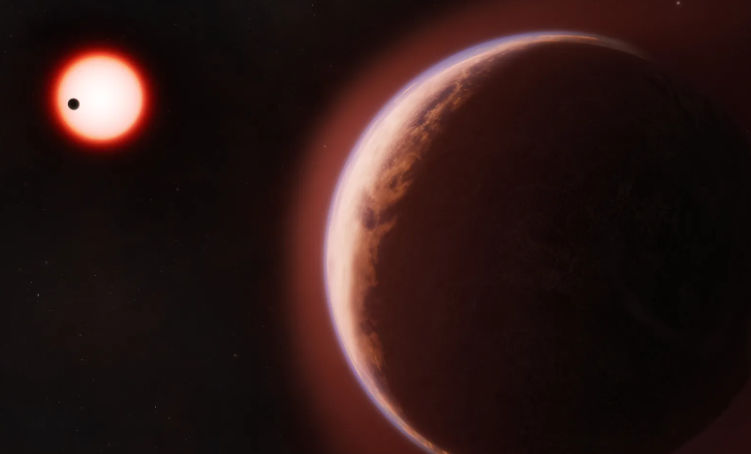
Nearly a decade after the discovery of LHS 1140b, a rocky exoplanet in the habitable zone of a nearby low-mass star, a new study reveals that the object may have its own atmosphere.
University of Florida Assistant Professor of Astronomy Jason Dittmann first discovered the planet in 2016. Now, he is a co-author of the new study, published in Science, that uses helium escape to explain a potential atmosphere.
“The exciting part about this paper, and why I think it was accepted into Science, was that this is the first time that we’re seeing a rocky, Earth-like planet that could still have an atmosphere,” Dittmann said.
How the planet was found
The Magellan Clay telescope at Las Campanas Observatory in Chile showed evidence of helium escaping from the planet. However, the planet’s age suggests it would have run out of helium unless it was replenishing its own supply, pointing to the potential of an atmosphere.
In 2016, Dittmann used ground-based surveys to search for stars whose light briefly dimmed as orbiting planets passed in front of them.
However, observing from the ground allows Earth’s atmosphere to confuse this process. To determine whether the stars were dimming because of wispy clouds or humidity blowing through on Earth, he trained a machine learning algorithm to decipher which signals were caused by Earth’s weather and which were caused by a passing planet.
The method helped Dittmann find LHS 1140b. The planet’s orbit meant it could be observed only a few times a year, so he tried to make the most of the limited opportunities he had to study it.
An outlier among rocky worlds
Considering the type of star it orbits, Dittmann said the planet’s temperature should be similar to Earth’s. It is made of rock rather than gas and is approximately 40 light-years away. There is also a second planet in the system, LHS 1140c, which is located outside the system’s habitable zone.
Other rocky planets discovered within the past decade or so lost their atmospheres over time. Considering the age of LHS 1140b and the lack of atmospheres on similar planets, Dittmann and the team did not expect to find helium.
LHS 1140b was different.
“We were getting to the point in the field where maybe all of these planets don’t have an atmosphere, and we need to look at ones around sun-like stars instead of smaller stars,” Dittmann said. “And then finally here is actually one with an atmosphere, and it happens to be the one that I had spent so many hours working on.”
Why the helium persisted
After originally discovering the planet, Dittmann quickly requested X-ray data from the planetary system. This gave him the energy input from the star to the planet, which became key to interpreting the helium signal years later.
The Magellan Clay telescope later revealed helium escaping from the planet, a process that also occurs on Earth. The X-ray data explained the rate at which the planet lost its helium because of X-ray radiation from the host star. Therefore, the X-ray data proved the rocky object must be replenishing its supply of helium; if it was not, there would be no helium remaining.
JWST will test the atmosphere
The team started by asking for helium observations because helium is easiest to spot. But now that there is potential evidence of an atmosphere, the group of scientists can start looking at carbon dioxide and water to further test the planet’s conditions.
LHS 1140b is one of the current selected targets under the Rocky Worlds Director’s Discretionary Time (DDT) Program. Rocky Worlds DDT is a joint program for the James Webb Space Telescope and the Hubble Space Telescope dedicated to finding evidence of atmospheres on rocky exoplanets orbiting dwarf stars.
Dittmann said the Rocky Worlds DDT Program should be able to prove or disprove an atmosphere on LHS 1140b in the next four to five years.
“Because there’s helium there, and because the helium is escaping, the question is: Is it a bare rock with no atmosphere that sometimes burps up some gas that then immediately escapes, or is there a steady-state atmosphere there that will leak out stuff like the Earth does from time to time?” Dittmann said. “JWST data over the next four to five years will look for water, and if there’s water in the atmosphere, then it’s probably a stable atmosphere that will persist.”
https://phys.org/news/2026-07-quantum-teleportation-photon-loss-distance.html



Recent Comments