



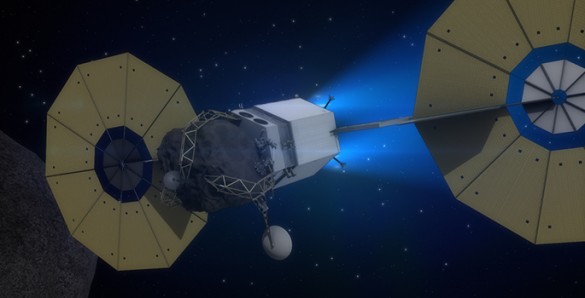
Concept of an asteroid redirect mission (NASA)
The grizzled asteroid miner was a stock character in science fiction. Now, a couple of recent events – one legal and the other technological – have brought asteroid mining a step closer to reality. The legal step was taken when the Senate Commerce, Science and Transportation Committee passed a bill titled H.R. 2262–SPACE Act of 2015. The bill has a number of measures designed to facilitate commercial space development, including a provision that gives individuals or companies ownership of any material that they mine in outer space, a trillion-dollar market.
The technological development is a new generation of gamma-ray spectroscope that appears perfectly suited for detecting veins of gold, platinum, rare earths and other valuable material hidden within the asteroids, moons and other airless objects floating around the solar system – just the type of “sensor” that will be needed by asteroid miners to sniff out these valuable materials. The concept was developed by a team of scientists from Vanderbilt and Fisk Universities, NASA’s Jet Propulsion Laboratory and the Planetary Science Institute.

Prototype of a CubeSat version of the gamma-ray spectrometer built from off-the-shelf components that weighs only one pound and consumes about three watts of electricity yet can do the job of a full lab system that weighs 200 pounds and fills ten cubic feet of space. (Burger Lab / Fisk University)
Planetary gamma-ray spectroscopy takes advantage of the fact that all of the objects in the solar system are continually bombarded by cosmic rays which strike the exposed surfaces at relativistic velocities, smashing apart atoms in the top layers and producing a secondary shower of particles, including neutrons >> collide repeatedly with the atoms in the material, producing gamma rays as they go. The decay of long-lived radioactive elements is a secondary source of gamma rays.

Flawless two-inch strontium iodide crystal that can be used to fabricate efficient and highly sensitive gamma-ray spectrometers. (Burger Lab / Fisk University)
A gamma-ray spectroscope records the intensity and wavelengths of the gamma rays coming from a surface. This spectrum can be analyzed to determine the concentration of a number of important, rock-forming elements, including oxygen, magnesium, silicon and iron…not to mention precious metals like gold and valuable crystals like diamonds.
“Space missions to the Moon, Mars, Mercury and the asteroid Vesta among others have included low-resolution spectrometers, but it has taken months of observation time and great expense to map their elemental surface compositions from orbit,” said Prof Keivan Stassun. “With our proposed system it should be possible to measure sub-surface elemental abundances accurately, and to do it much more cheaply because our sensors weigh less and require less power to operate. That is good news for commercial ventures where cost, power and launch weight are all at a premium.”
The key to the new instrument is a recently discovered material, europium-doped strontium iodide (SrI2). This is a transparent crystal that can act as an extremely efficient gamma-ray detector. It registers the passage of gamma rays by giving off flashes of light that can be detected and recorded.
“The gold standard for gamma-ray spectroscopy is the high purity germanium (HPGe) detector,” said Fisk Professor of Physics Arnold Burger, who developed the SrI2 detector. “However, it requires cryogenic cooling so it is very bulky. It also needs vacuum-tube technology so it consumes too much energy to run on batteries. SrI2 isn’t quite as good HPGe, but it is more than adequate to do the job and it is compact enough and its power requirements low enough so that it can be used in spacecraft and even placed on robotic landers.”
The first commercial missions to nearby asteroids could launch as early as 2020, but it will be decades before asteroid mining begins in earnest. In the meantime, the new spectroscopic technology promises to provide planetary scientists with new details about the chemical composition of the asteroids, comets, moons and minor planets in the solar system: information that is certain to improve our understanding of how the solar system formed. In addition, it could become an important tool in the planetary defense arsenal because it can determine whether objects crossing Earth’s orbit are made from rock or ice. http://news.vanderbilt.edu/2015/11/new-detector-perfect-for-asteroid-mining/


Recent Comments