



Over the past few decades, electronics engineers have developed increasingly sophisticated implantable medical devices. Reliably powering some of these devices, however, can be challenging, particularly when they are based on stretchable materials that move along with the body.
Researchers at the Institute for Basic Science (IBS), Seoul National University and other institutions in South Korea recently developed a new wireless power system that could provide energy to soft implantable devices, even when they are stretching or moving. The new system, introduced in a paper published in Nature Electronics, was initially used to develop a cardiac pacemaker, a medical device that uses electrical pulses to control heartbeats.
“This work began with a practical question: How can we reliably power a wireless implant in a body that is constantly moving?” Dae-Hyeong Kim, senior author of the paper, told Tech Xplore. “Advances in soft electronics have enabled implants to conform to living tissues and accommodate their natural motion, helping reduce mechanical stress and maintain stable contact. However, as these implants move and even stretch within the body, changes in their position and shape can disrupt wireless power delivery.”
A two-part wireless power system
Kim and his colleagues wanted to overcome the limitations of some existing systems for remotely providing energy to medical implants. Their goal was to develop an adaptive wireless power system that could accommodate deformations and changes in shape, enabling the reliable operation of soft implants when they are inside the body and not in carefully controlled laboratory conditions.
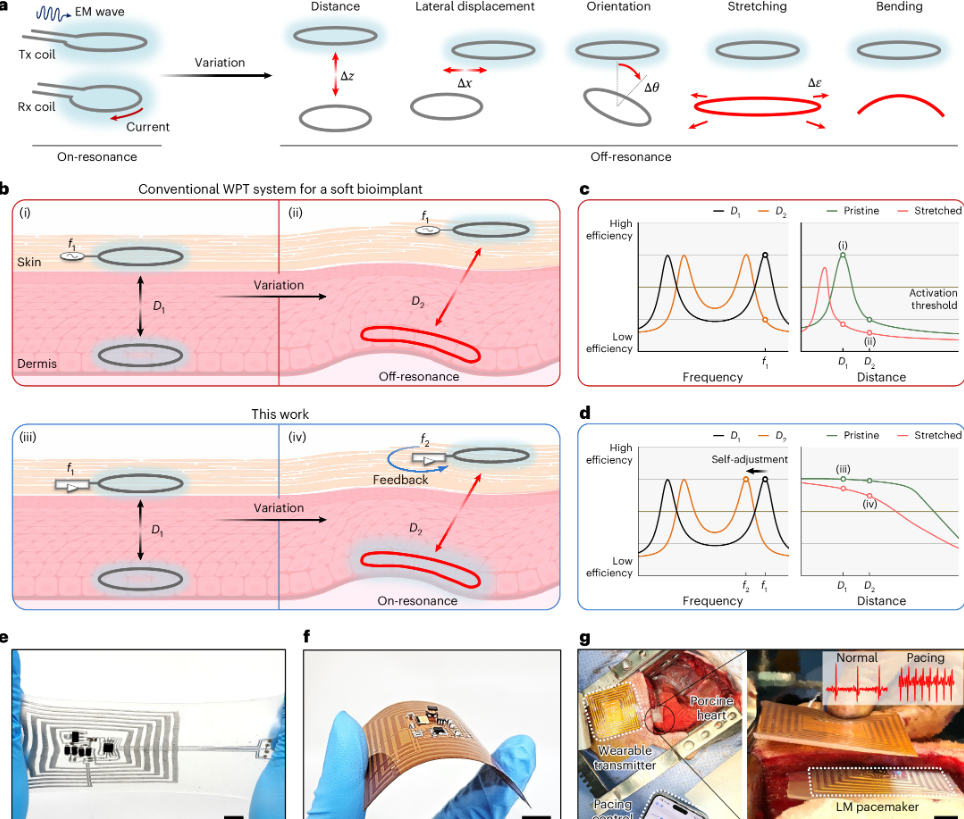
“Our system builds on parity–time (PT) symmetry, a concept from quantum physics now applied in optical and electronic systems,” explained Kim. “In wireless power transfer, this principle enables stable energy transfer by balancing energy supplied by the transmitter with energy consumed by the receiver. We implement this using an amplifier and feedback circuit in the transmitter, allowing the system to automatically adapt its operating frequency as the coupling with the receiver changes.”
The team’s power system has two key components: a wearable transmitter that is meant to be worn outside the body and a stretchable receiver integrated into an implant. Energy passes between these two components wirelessly, without a wire connecting them.
“We developed an intrinsically stretchable liquid-metal receiver that maintains high electrical conductivity during deformation,” said Kim. “Paired with the adaptive transmitter, it enabled reliable wireless powering even when stretching and misalignment occurred simultaneously.”
To assess the potential of their wireless power system, the researchers used it to develop a cardiac pacemaker. This pacemaker was tested in experiments with pigs, showing potential for use in freely moving subjects. The team found that the resulting implant operated reliably, effectively controlling the pigs’ heartbeats.
“We integrated the receiver with stimulation circuitry and electrodes to create a wirelessly powered cardiac pacemaker,” said Kim. “In animal models, we demonstrated cardiac pacing and termination of rapid abnormal heart rhythms and confirmed that pacing remained reliable despite deformation and changes in alignment.”
Toward more reliable wireless medical implants
In initial tests with live animals, the team’s wearable-to-implant power link achieved promising results. Before it can be used in health care settings, however, it will need to be assessed in more tests, including human clinical trials.
“Many existing wireless systems require the transmitter and receiver to remain within a tightly controlled spatial arrangement, limiting how freely they can move or deform,” said Kim. “Our approach relaxes these constraints and enables a wearable transmitter, which could take the form of a skin-attachable patch, to reliably power a soft implant under more dynamic conditions. Beyond cardiac pacing, this could help advance wireless monitoring and stimulation systems from controlled demonstrations toward practical devices that accommodate everyday movement.”
In the future, the power system created by Kim and his colleagues could be combined with different components to create other implantable devices. Meanwhile, the researchers plan to continue improving their device and broadening its functionality.
“Our next goal is to build on this reliable power link to develop implants that can both monitor physiological signals and deliver therapy,” added Kim. “We are exploring how PT symmetry can support data transmission alongside wireless powering, allowing the implant to send information back to an external wearable while receiving power. This could enable closed-loop systems that adjust stimulation in response to the signals they record.” https://techxplore.com/news/2026-10-wireless-power-medical-implants.html



Recent Comments