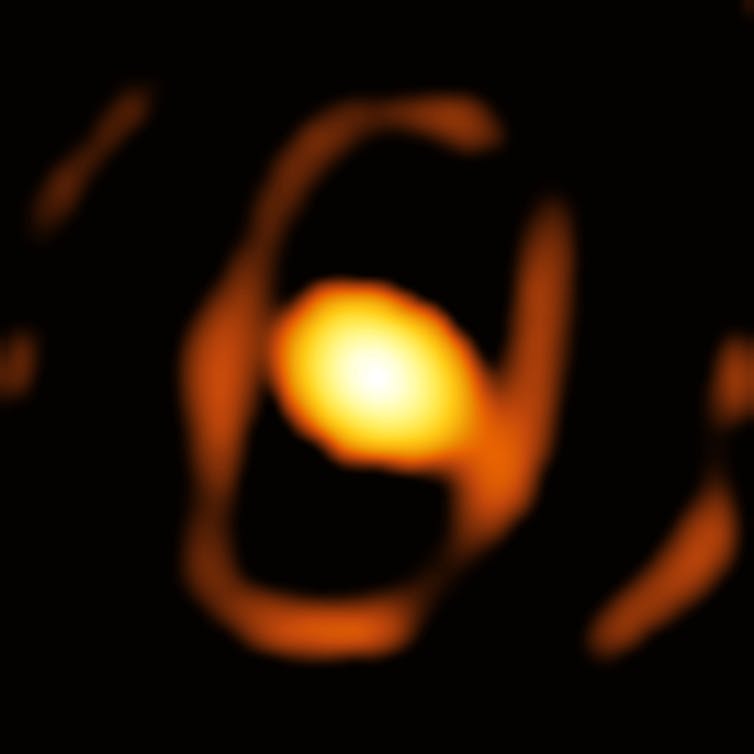
Astronomers spot a rare planet-stripping eruption on a nearby star

Artist’s impression of an explosion on another star

Scientists have finally confirmed a powerful coronal mass ejection from another star, using LOFAR radio data paired with XMM-Newton’s Xray insights. The eruption blasted into space at extraordinary speeds, strong enough to strip atmospheres from close-orbiting worlds. This suggests planets around active red dwarfs may be far less hospitable than hoped.

Astronomers working with the European Space Agency’s XMM-Newton observatory and the LOFAR radio telescope have obtained clear evidence of a violent burst of material hurled into space by a distant star. The outflow was strong enough that any nearby planet in its path would likely have its atmosphere stripped away.

This burst was identified as a coronal mass ejection (CME), a typ...

Read More

Hidden weakness makes prostate cancer self-destruct

Hidden Weak Spot May Help Defeat Prostate Cancer
Scientists have identified a major weakness in prostate cancer cells by uncovering two enzymes, PDIA1 and PDIA5, that help the disease survive and resist treatment. Blocking these enzymes destabilizes the androgen receptor, the main driver of prostate cancer, causing tumor shrinkage and cell death. Credit: Shutterstock

Scientists found a hidden flaw in prostate cancer’s survival system. Researchers have discovered that prostate cancer depends on two key enzymes, PDIA1 and PDIA5, to survive and resist therapy. When blocked, these enzymes cause the androgen receptor to collapse, killing cancer cells and enhancing the effects of drugs like enzalutamide. They also disrupt the cancer’s energy system, striking it on multiple fronts...

Read More

Self-adapting LLMs behave more like students to absorb new knowledge

Self-adapting LLMs behave more like students to absorb new knowledge
Credit: AI-generated image

In an MIT classroom, a professor lectures while students diligently write down notes they will reread later to study and internalize key information ahead of an exam.

Humans know how to learn new information, but large language models can’t do this in the same way. Once a fully trained LLM has been deployed, its “brain” is static and can’t permanently adapt itself to new knowledge.

This means that if a user tells an LLM something important today, it won’t remember that information the next time this person starts a new conversation with the chatbot.

Now, a new approach developed by MIT researchers enables LLMs to update themselves in a way that permanently internalizes new information...

Read More

Nearby super-Earth may be our best chance yet to find alien life

an illustration of a planet and a star
An international team of scientists, including researchers at Penn State, dubbed the exoplanet, named GJ 251 c, a “super-Earth” as data suggest it has a rocky composition similar to Earth and is almost four times as massive.  Credit: Illustration by University of California Irvine . All Rights Reserved.

A nearby super-Earth may be one of the best chances yet to search for life beyond our solar system. A newly detected super-Earth just 20 light-years away is giving scientists one of the most promising chances yet to search for life beyond our solar system. The discovery of the exoplanet orbiting in the habitable zone of its star was made possible by advanced spectrographs designed at Penn State and by decades of observations from telescopes around the world.

A possible “supe...

Read More