





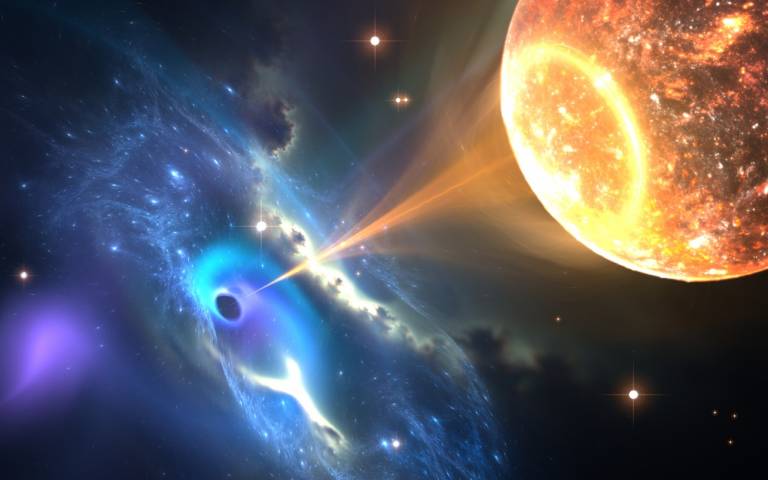
A new study simulated 25,000 scenarios of black holes and neutron stars colliding, aiming to see how many would likely be detected by instruments on Earth in the mid- to late-2020s. The researchers found that, by 2030, instruments on Earth could sense ripples in space-time caused by up to 3,000 such collisions, and that for around 100 of these events, telescopes would also see accompanying explosions of light.
Studying the violent collisions of black holes and neutron stars may soon provide a new measurement of the Universe’s expansion rate, helping to resolve a long-standing dispute, suggests a new simulation study led by researchers at UCL (University College London).
Our two current best ways of estimating the Universe’s rate of expansion – measuring the brightness and speed ...
Read More


Recent Comments