To raise new questions, new possibilities, to regard old problems from a new angle, requires creative imagination and marks real advance in science.
~Albert Einstein
Read More
Old Newtonian physics claimed that things have an objective reality separate from our perception of them. Quantum physics, and particularly Heisenberg's Uncertainty Principle, reveal that, as our perception of an object changes, the object itself literally changes.
~Marianne Williamson
Read More
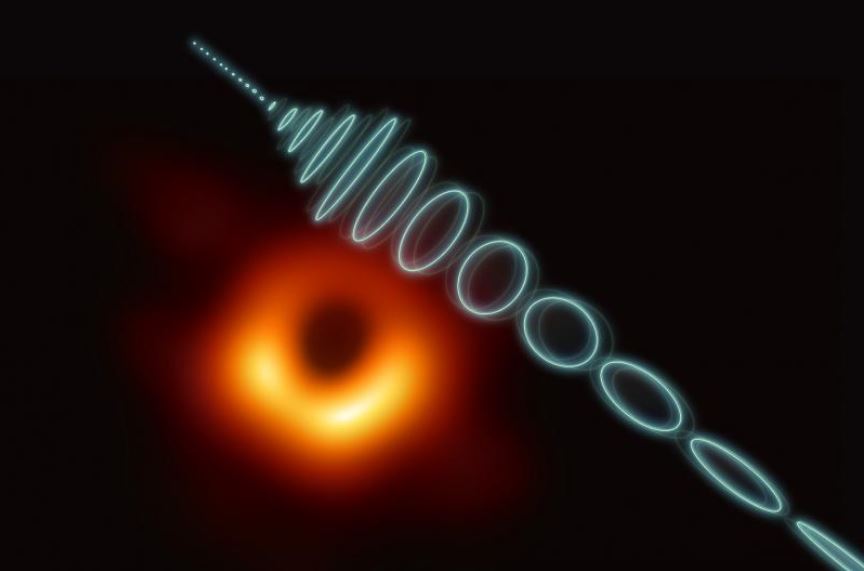
An artist’s impression of a “string” passing near a black hole. As the string approaches the black hole, it is gradually stretched. Then, as it moves past the black hole, it begins to vibrate. The image to the left, which was captured by the Event Horizon Telescope, represents the shadow of the supermassive black hole at the center of the galaxy M87, including the ring of light around it. (Credit: EHT Collaboration; Kavli IPMU (Kavli IPMU modified EHT’s original image)).
A paper by the Kavli Institute for the Physics and Mathematics of the Universe (Kavli IPMU) Director Ooguri Hirosi and Project Researcher Matthew Dodelson on the string theoretical effects outside the black hole photon sphere has been selected for the “Editors’ Suggestion” of the journal Physical Review D...
A pilot human clinical trial conducted by researchers at Baylor College of Medicine reveals that supplementation with GlyNAC — a combination of glycine and N-acetylcysteine as precursors of the natural antioxidant glutathione — could improve many age-associated defects in older humans to improve muscle strength and cognition, and promote healthy aging.
Published in the journal Clinical and Translational Medicine, the results of this study show that older humans taking GlyNAC for 24 weeks saw improvements in many characteristic defects of aging, including glutathione deficiency, oxidative stress, mitochondrial dysfunction, inflammation, insulin resistance, endothelial dysfunction, body fat, genomic toxicity, muscle strength, gait speed, exercise capacity and cognitive function...
Rice scientists optimized a process to turn rubber from discarded tires into turbostratic flash graphene. Courtesy of the Tour Research Group
Optimized flash process could reduce carbon emissions. Rice University scientists have optimized a process to convert waste from rubber tires into graphene that can, in turn, be used to strengthen concrete.
The environmental benefits of adding graphene to concrete are clear, chemist James Tour said. “Concrete is the most-produced material in the world, and simply making it produces as much as 9% of the world’s carbon dioxide emissions,” Tour said. “If we can use less concrete in our roads, buildings and bridges, we can eliminate some of the emissions at the very start.”
Recycled tire waste is already used as a component of Portland cement, ...
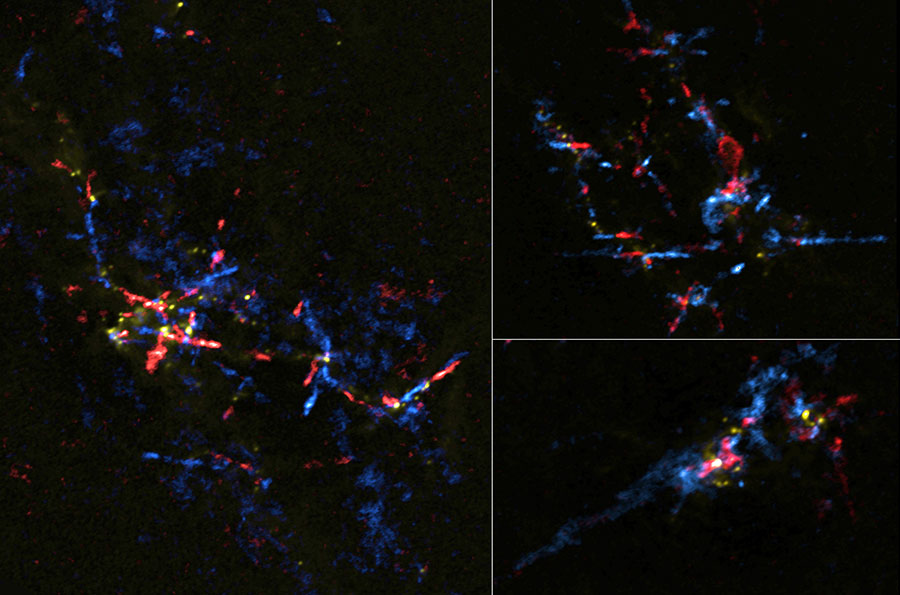
ALMA pseudo-color composite image of the gas outflows from stellar eggs in the Galactic Center region. Gas moving toward us is shown in blue and gas moving away from us is shown in red. Credit: ALMA (ESO/NAOJ/NRAO), Lu et al
Astronomers found a number of stellar eggs containing baby stars around the center of the Milky Way using the Atacama Large Millimeter/submillimeter Array (ALMA). Previous studies had suggested that the environment there is too harsh to form stars. These findings indicate that star formation is more resilient than researchers thought.
Stars form in stellar eggs, cosmic clouds of gas and dust which collapse due to gravity. If something interferes with the gravity driven contraction, star formation will be suppressed...













Recent Comments