



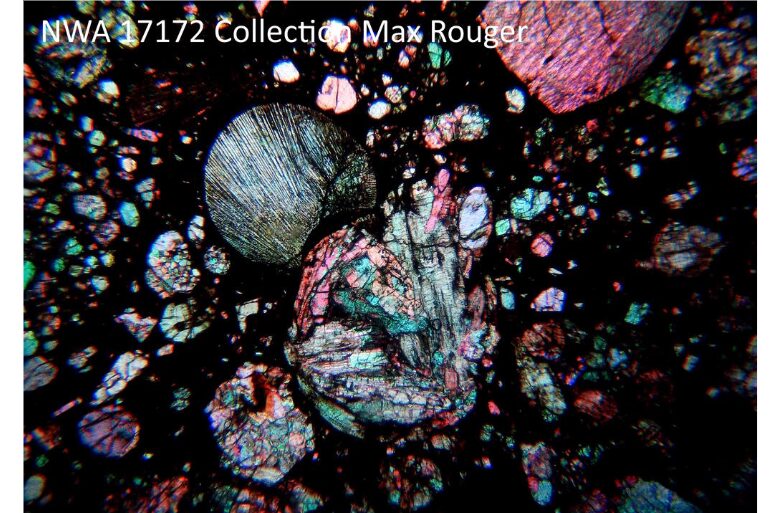
A new Southwest Research Institute-led study proposes a solution to a longstanding puzzle in planetary science: What caused the concentration, assembly, and preservation of millimeter-sized, spherical mineral grains within the parent bodies of the most common meteorites? The work is published in the journal Science Advances.
Chondritic asteroids are ancient bodies that orbit the sun, while a chondrite meteorite is a rocky fragment that falls to Earth. Both contain primitive materials. Chondrite meteorites are largely made of chondrules—tiny, once-molten droplets of rock—embedded in a fine-grained matrix.
“While several mechanisms may have created the chondrules themselves, I have always been surprised by how homogeneous the chondritic asteroids seem to be,” said SwRI’s Hal Levison, first author of a new paper outlining this research. “We were looking for a process that corrals these small droplets into asteroid-sized bodies.”
Collisions build debris disks
The new research indicates that the answer may lie in the chaotic final stages of terrestrial planet formation, when planetary embryos—moon- to Mars-sized bodies—frequently collide. Using numerical simulations, the team investigated giant-impact scenarios between planetary embryos that generate sheets of molten and solid ejecta. Some of these materials remain gravitationally bound and settle into a dense, rotating debris disk around the impacted embryo.
“This circum-embryo disk orbits a growing protoplanetary embryo, accumulating into larger bodies and forming asteroid-sized satellites. This process parallels the formation of Mars’s moons, Phobos and Deimos,” Levison said. “The resulting asteroid-sized satellites are composed almost entirely of material from the original impact and are comparable in size and bulk composition to chondritic asteroids.”
Former moons escape into solar orbit
Crucially, the study finds that some of these satellites can be dynamically liberated from their orbits around the planetary embryo and placed into independent orbits around the sun. These escaped satellites then become the parent bodies of chondritic asteroids—the source of the chondrite meteorites found on Earth.
Rather than treating chondrule production and chondrite assembly as separate problems, the model connects them through the dynamics of planet formation. Giant impacts generate the material, and then the circum-embryo disks concentrate and confine it, forming satellites. Ultimately, orbital liberation turns these concentrated swarms into the meteorite-producing asteroids seen today.
“As such, chondritic asteroids are not leftover random rubble from the solar nebula,” said Kevin Walsh, third author of the paper.
“They are escaped satellites—former moons-in-the-making—that carry within them a detailed record of the violent processes that built the terrestrial planets,” added Rogerio Deienno, second author of the work. https://www.swri.org/newsroom/press-releases/swri-study-found-primordial-mini-moons-may-explain-meteorite-composition


Recent Comments