To raise new questions, new possibilities, to regard old problems from a new angle, requires creative imagination and marks real advance in science.
~Albert Einstein
Read More
Old Newtonian physics claimed that things have an objective reality separate from our perception of them. Quantum physics, and particularly Heisenberg's Uncertainty Principle, reveal that, as our perception of an object changes, the object itself literally changes.
~Marianne Williamson
Read More
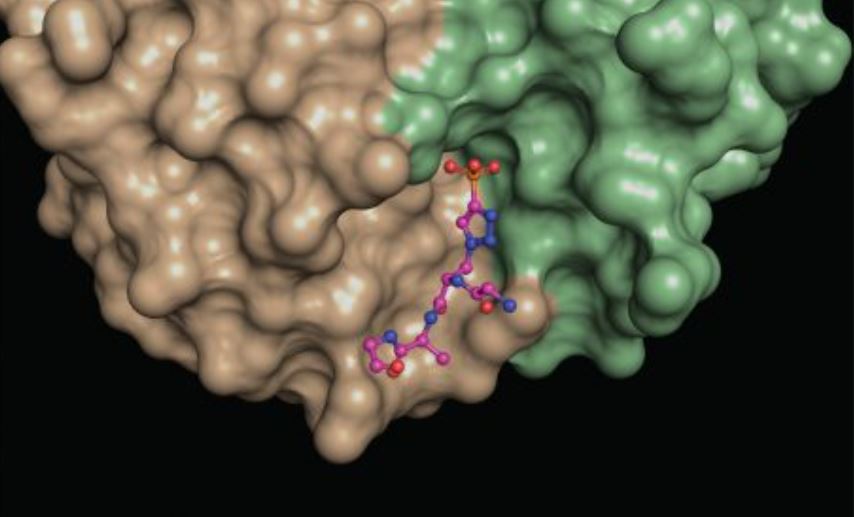
A structural snapshot of a phosphohistidine analogue (ball and stick model) nestled at the interface between different areas (green, brown) of a phosphohistidine antibody. Such structures provide insights into the molecular properties of the antibodies, which makes them useful for revealing elusive phosphohistidine-containing proteins in cells. Credit: Salk Institute
Xray crystallography and recombinant antibodies uncover workings of an elusive molecule central to human health. In structural biology, some molecules are so unusual they can only be captured with a unique set of tools...
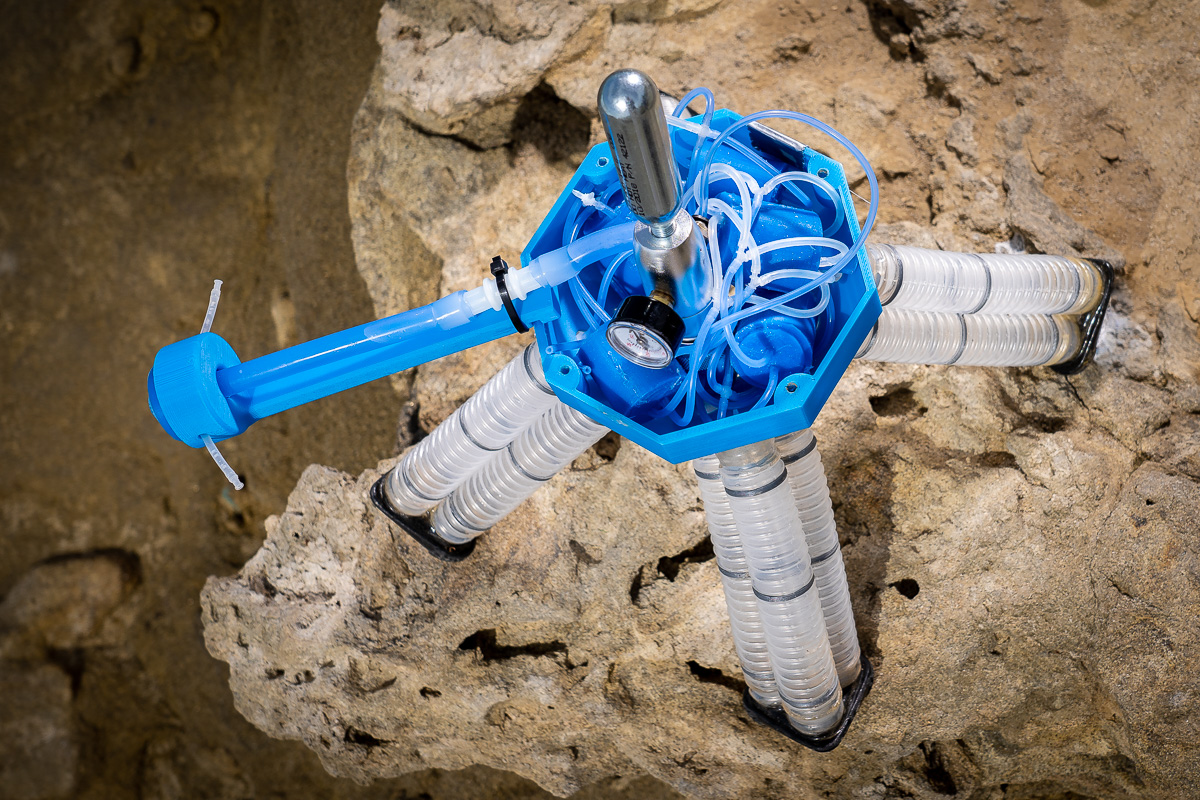
The robot’s walking process is driven by a series of valves.
Walking quadruped is controlled and powered by Pressurized Air. Engineers at the University of California San Diego have created a four-legged soft robot that doesn’t need any electronics to work. The robot only needs a constant source of pressurized air for all its functions, including its controls and locomotion systems.
The team, led by Michael T. Tolley, a professor of mechanical engineering at the Jacobs School of Engineering at UC San Diego, details its findings in the Feb. 17, 2021 issue of the journal Science Robotics.
“This work represents a fundamental yet significant step towards fully-autonomous, electronicsfree walking robots,” said Dylan Drotman, a Ph.D...
Members of NASA’s Perseverance Mars rover team watch in mission control as the first images arrive moments after the spacecraft successfully touched down on Mars, Thursday, Feb. 18, 2021, at NASA’s Jet Propulsion Laboratory in Pasadena, California. A key objective for Perseverance’s mission on Mars is astrobiology, including the search for signs of ancient microbial life. The rover will characterize the planet’s geology and past climate, pave the way for human exploration of the Red Planet, and be the first mission to collect and cache Martian rock and regolith. Credits: NASA/Bill Ingalls
The largest, most advanced rover NASA has sent to another world touched down on Mars Thursday, after a 203-day journey traversing 293 million miles (472 million kilometers)...
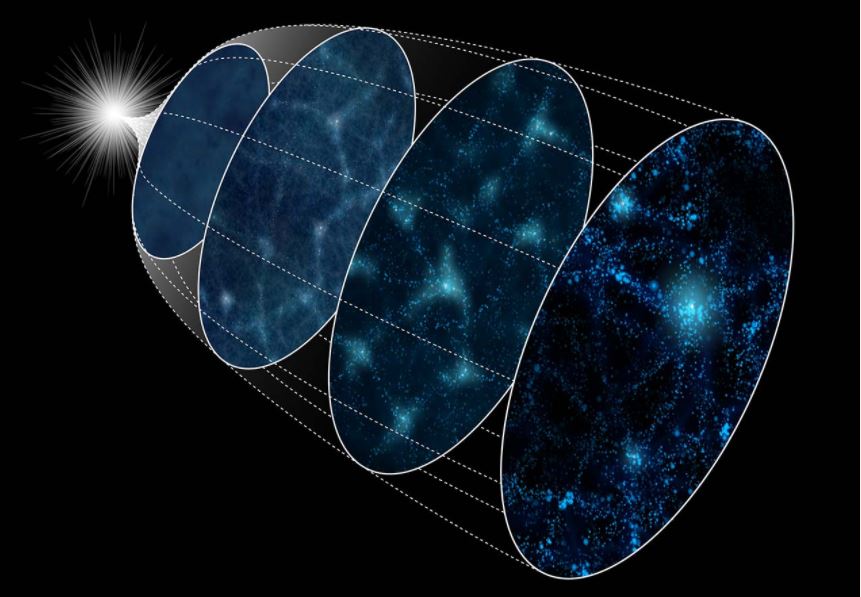
Schematic diagram of the evolution of the Universe from the inflation (left) to the present (right). The “reconstruction method” winds back the evolution from right to left on this illustration to reproduce the primordial density fluctuations from the current galaxy distribution. (Credit: The Institute of Statistical Mathematics)
Astronomers have tested a method for reconstructing the state of the early Universe by applying it to 4000 simulated universes using the ATERUI II supercomputer at the National Astronomical Observatory of Japan (NAOJ). They found that together with new observations the method can set better constraints on inflation, one of the most enigmatic events in the history of the Universe...












Recent Comments