Trigger that leads to Faster Nerve Healing

New research shows how scientists could foster the biological process that accelerates nerve regeneration.

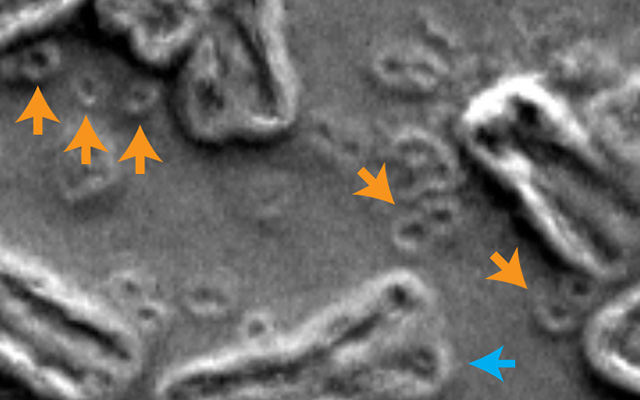
A new study published in Current Biology identifies the biological triggers that promote quicker nerve regeneration. From their previous studies, the researchers knew that damaged nerves regrow more quickly when “stress granules” in the site of the nerve injury are broken apart. Now they know what causes those stress granules to disassemble through a process called protein phosphorylation.

“The important thing is that we identified the protein that drives that process and showed how that’s regulated,” Jeff Twiss, a UofSC biology professor and co-author on the paper, said.

“It actually opens something new,” Pabitra Sahoo, the paper’s lead author, said...

Read More

Solar-Powered system Extracts Drinkable Water from ‘Dry’ Air

prototype of water harvesting system
A prototype of the new two-stage water harvesting system (center right), was tested on an MIT rooftop. The device, which was connected to a laptop for data collection and was mounted at an angle to face the sun, has a black solar collecting plate at the top, and the water it produced flowed into two tubes at bottom.
Credits:Image: Alina LaPotin

Engineers have made their initial design more practical, efficient, and scalable. Researchers at MIT and elsewhere have significantly boosted the output from a system that can extract drinkable water directly from the air even in dry regions, using heat from the sun or another source.

The system, which builds on a design initially developed three years ago at MIT by members of the same team, brings the process closer to something that could be...

Read More

Star Clusters are only the Tip of the Iceberg

Alpha Persei star cluster
A panoramic view of the nearby Alpha Persei star cluster and its corona. The member stars in the corona are invisible. These are only revealed thanks to the combination of precise measurements with the ESA Gaia satellite and innovative machine learning tools (© Stefan Meingast, made with Gaia Sky)

Finding lost star siblings. Star clusters have been part of the Imaginarium of human civilization for millennia. The brightest star clusters to Earth, like the Pleiades, are readily visible to the naked eye. A team has now revealed the existence of massive stellar halos, termed coronae, surrounding local star clusters.

“Clusters form big families of stars that can stay together for large parts of their lifetime...

Read More

Studies offer New Evidence for possible link between Blood Type and COVID-19 susceptibility

Adjusted cumulative incidence plots for mechanical ventilation, CRRT, and ICU discharge. Adjusted cumulative incidence of requiring mechanical ventilation (A) or CRRT (B) during hospital stay by group. (C) Cumulative incidence of being discharged from the ICU by group. Cumulative incidence models were created with death as a competing risk and are adjusted for age, sex, and the presence of ≥1 comorbidity status (binary, yes/no). sHR ratio >1 indicates an increased probability of an event occurring during the study period, whereas a ratio <1 indicates a decreased probability. *Statistically significant P value for a difference between groups.
Adjusted cumulative incidence plots for mechanical ventilation, CRRT, and ICU discharge. Adjusted cumulative incidence of requiring mechanical ventilation (A) or CRRT (B) during hospital stay by group. (C) Cumulative incidence of being discharged from the ICU by group. Cumulative incidence models were created with death as a competing risk and are adjusted for age, sex, and the presence of ≥1 comorbidity status (binary, yes/no). sHR ratio >1 indicates an increased probability of an event occurring during the study period, whereas a ratio <1 indicates a decreased probability. *Statistically significant P value for a difference between groups.

Individuals with blood type O may have lowest risk of infection; individuals with A and AB may have increased risk of severe clinical outcomes...

Read More