

Credit: Chenyoung Shi, Chinese Academy of Sciences
New instrument could one day help surgeons more easily pinpoint cancerous tissue...
Read More


Until we recognize the essential role of biology, our attempts to truly unify the universe will remain a train to nowhere. ~Robert Lanza Read More

Good health is not something we can buy. However, it can be an extremely valuable savings account. ~Anne Wilson Schaef Read More

The only way forward, if we are going to improve the quality of the environment, is to get everybody involved. ~Richard Rogers Read More

To raise new questions, new possibilities, to regard old problems from a new angle, requires creative imagination and marks real advance in science. ~Albert Einstein Read More

Old Newtonian physics claimed that things have an objective reality separate from our perception of them. Quantum physics, and particularly Heisenberg's Uncertainty Principle, reveal that, as our perception of an object changes, the object itself literally changes. ~Marianne Williamson Read More

Astronomy compels the soul to look upwards and leads us from this world to another. ~ Read More
December 23, 2020,
 Health/Medical, Biology/Biotechnology
New instrument could one day help surgeons more easily pinpoint cancerous tissue...
Read More
December 23, 2020,
Astronomy/Space
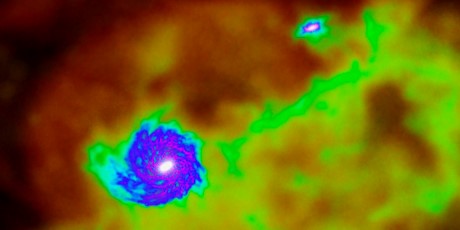
How stars form in galaxies remains a major open question in astrophysics. A new study sheds new light on this topic with the help of a data-driven re-analysis of observational measurements. The star-formation activity of typical, nearby galaxies is found to scale proportionally with the amount of gas present in these galaxies. This points to the net gas supply from cosmic distances as the main driver of galactic star formation.
Stars are born in dense clouds of molecular hydrogen gas that permeates interstellar space of most galaxies...
Read More
December 22, 2020,
Health/Medical, Biology/Biotechnology

Researchers have developed a novel type of nanoparticle that efficiently and selectively kills cancer cells, thus opening up new therapeutic options for the treatment of tumors. Many chemotherapeutic agents used to treat cancers are associated with side-effects of varying severity, because they are toxic to normal cells as well as malignant tumors. This has motivated the search for effective alternatives to the synthetic pharmaceuticals with which most cancers are currently treated...
Read More
December 22, 2020,
Physics, Technology/Electronics

Maximizing the efficiency of renewable energy technology is dependent on creating nanoparticles with ideal dimensions and density, new simulations have shown. Scientists in Australia have developed a process for calculating the perfect size and density of quantum dots needed to achieve record efficiency in solar panels.
Quantum dots, human-made nanocrystals 100,000 times thinner than a sheet of paper, can be used as light sensitisers, absorbing infrared and visible light and transferring it to other molecules.
This could enable new types of solar panels to capture more of the light spectrum and generate more electrical current, through a process of ‘light fusion’ known as photochemical upconversion.
The researchers, from the ARC Centre of Excellence in Exciton Science, used l...
Read More
Recent Comments