To raise new questions, new possibilities, to regard old problems from a new angle, requires creative imagination and marks real advance in science.
~Albert Einstein
Read More
Old Newtonian physics claimed that things have an objective reality separate from our perception of them. Quantum physics, and particularly Heisenberg's Uncertainty Principle, reveal that, as our perception of an object changes, the object itself literally changes.
~Marianne Williamson
Read More
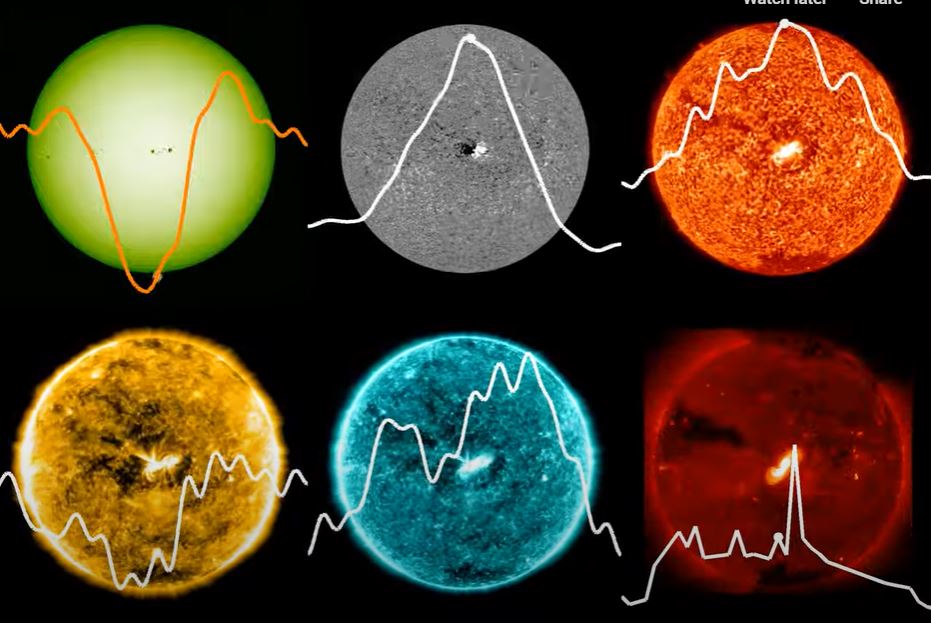
Scientists created light curves using the high-resolution images of the Sun to understand what a sunspot would look like on a distant star. They studied different layers of the Sun from the visible surface to the outer atmosphere using 14 different wavelengths, including the six shown here (top left to right: photosphere, magnetic flux of the photosphere, ultraviolet 304 angstroms; bottom left to right: ultraviolet 171 angstroms, ultraviolet 131 angstroms, x-ray). Credits: NASA/SDO/JAXA/NAOJ/Hinode
NASA’s extensive fleet of spacecraft allows scientists to study the Sun extremely close-up — one of the agency’s spacecraft is even on its way to fly through the Sun’s outer atmosphere. But sometimes taking a step back can provide new insight.
Working with California mice, UC Davis researches showed that the “love hormone” oxytocin can sometimes have antisocial effects depending on where in the brain it is made. (Mark Chappell/UC Riverside)
Finding a better route to treating social anxiety disorder may lie in another part of the brain, researchers suggest. The findings of the study show that oxytocin produced in the BNST increases stress-induced social anxiety behaviors in mice. This may provide an explanation as to why oxytocin can sometimes have antisocial effects.
Studies have long suggested that oxytocin – a hormone that can also act as a neurotransmitter – regulates prosocial behavior such as empathy, trust and bonding, which led to its popular labeling as the “love hormone...
Checkerboard design of solar panel Credit: Dr Davide Zecca
Designing solar panels in checkerboard lines increases their ability to absorb light by 125%, a new study says. Researchers say the breakthrough could lead to the production of thinner, lighter and more flexible solar panels that could be used to power more homes and be used in a wider range of products.
The study — led by researchers from the University of York and conducted in partnership with NOVA University of Lisbon (CENIMAT-i3N) — investigated how different surface designs impacted on the absorption of sunlight in solar cells, which put together form solar panels.
Scientists found that the checkerboard design improved diffraction, which enhanced the probability of light being absorbed which is then used to create el...
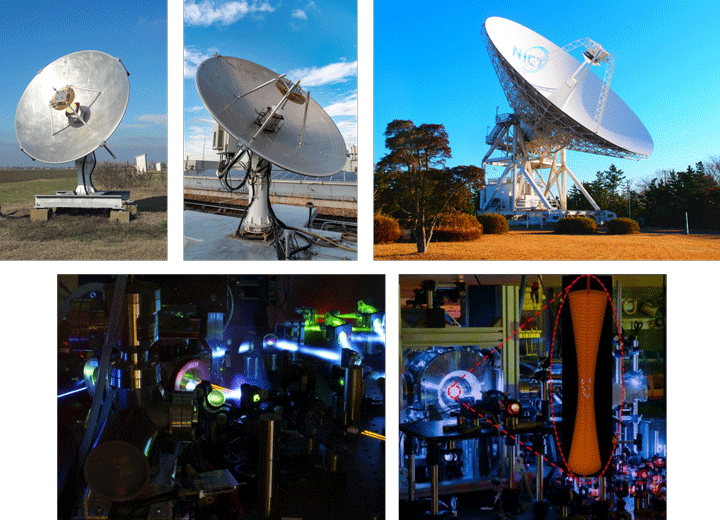
Antennas and optical lattice clocks used in the measurements
Upper left: Transportable 2.4 m antenna installed at the INAF radio observatory in Medicina, Italy. Upper middle: Transportable 2.4 m antenna installed at NICT in Koganei, Japan. Upper right: 34 m antenna located at NICT in Kashima, Japan. Bottom left: The ytterbium optical lattice clock IT-Yb1, operated at INRIM in Torino, Italy. Bottom right: The strontium optical lattice clock NICT-Sr1, located at NICT in Koganei, Japan.
Transportable radio telescopes could provide global high-precision comparisons of the best atomic clocks. Using radio telescopes observing distant stars, scientists have connected optical atomic clocks on different continents...













Recent Comments