A cosmic mystery: ESO Telescope captures the disappearance of a Massive Star

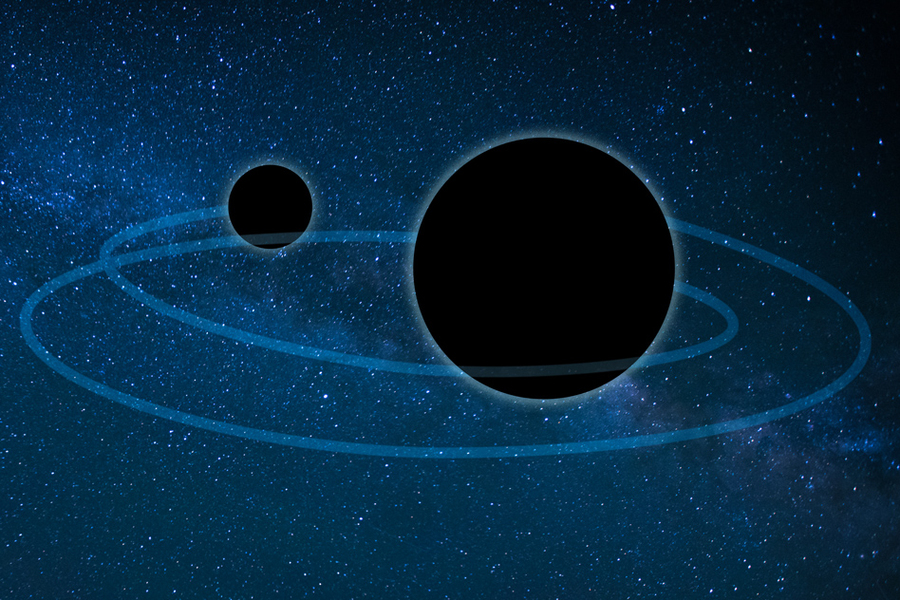
Artist’s impression of the disappearing star
This illustration shows what the luminous blue variable star in the Kinman Dwarf galaxy could have looked like before its mysterious disappearance.

Credit:ESO/L. Calçada

Using the European Southern Observatory’s Very Large Telescope (VLT), astronomers have discovered the absence of an unstable massive star in a dwarf galaxy. Scientists think this could indicate that the star became less bright and partially obscured by dust. An alternative explanation is that the star collapsed into a black hole without producing a supernova. “If true,” says team leader and PhD student Andrew Allan of Trinity College Dublin, Ireland, “this would be the first direct detection of such a monster star ending its life in this manner.”

Between 2001 and 2011, various teams of astronomers studied the myster...

Read More

New Eye Drops may prevent a common cause of Blindness

QUASAR J1007+2115, OR PŌNIUĀʻENA
Credit: International Gemini Observatory/NOIRLab/NSF/AURA/P. Marenfeld


Researchers at Columbia University Irving Medical Center have developed eye drops that could prevent vision loss after retinal vein occlusion, a major cause of blindness for millions of adults worldwide.A study, in mice, suggests that the experimental therapy — which targets a common cause of neurodegeneration and vascular leakage in the eye — could have broader therapeutic effects than existing drugs.The study was published in Nature Communications.What is Retinal Vein Occlusion?Retinal vein occlusion occurs when a major vein that drains blood from the retina is blocked, usually due to a blood clot...

Read More

Laser-Welded Sugar: Sweet way to 3D-print blood vessels

A sample of blood vessel templates that Rice University bioengineers 3D-printed using a special blend of powdered sugars. (Photo by B. Martin/Rice University)

Intricate sugar networks dissolve to create pathways for blood in lab-grown tissues. Bioengineers have shown they can keep densely packed cells alive in lab-grown tissues by creating complex networks of branching blood vessels from templates of 3D-printed sugar.

Powdered sugar is the special ingredient in a Rice University recipe for mimicking the body’s intricate, branching blood vessels in lab-grown tissues.

In research published in the journal Nature Biomedical Engineering, Rice bioengineers showed they could keep densely packed cells alive for two weeks in relatively large constructs.

“One of the biggest hurdles to e...

Read More

Monster Black Hole found in the Early Universe

QUASAR J1007+2115, OR PŌNIUĀʻENA
Credit: International Gemini Observatory/NOIRLab/NSF/AURA/P. Marenfeld

The second-most distant quasar ever discovered now has a Hawaiian name. Astronomers have discovered the second-most distant quasar ever found using three Maunakea Observatories in Hawai’i: W. M. Keck Observatory, the international Gemini Observatory, a Program of NSF’s NOIRLab, and the University of Hawai’i-owned United Kingdom Infrared Telescope (UKIRT). It is the first quasar to receive an indigenous Hawaiian name, Poniua’ena, which means “unseen spinning source of creation, surrounded with brilliance” in the Hawaiian language.

Poniua’ena is only the second quasar yet detected at a distance calculated at a cosmological redshift greater than 7...

Read More