ALMA Discovers Massive Rotating Disk in Early Universe

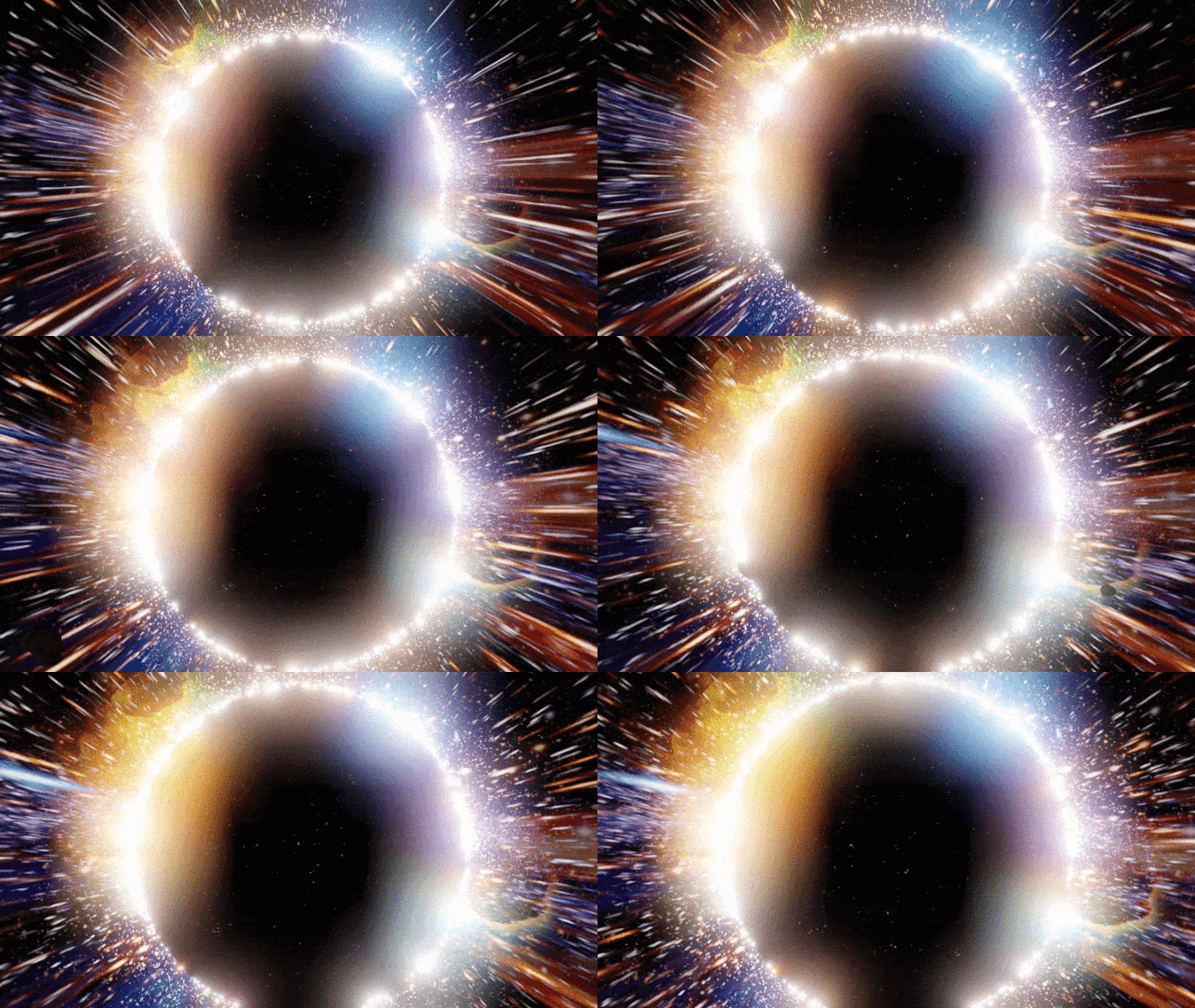
Artist impression of the Wolfe Disk, a massive rotating disk galaxy in the early, dusty universe. The galaxy was initially discovered when ALMA examined the light from a more distant quasar (top left).
Credit: NRAO/AUI/NSF, S. Dagnello

In our 13.8 billion-year-old universe, most galaxies like our Milky Way form gradually, reaching their large mass relatively late. But a new discovery made with the Atacama Large Millimeter/submillimeter Array (ALMA) of a massive rotating disk galaxy, seen when the universe was only ten percent of its current age, challenges the traditional models of galaxy formation. This research appears on 20 May 2020 in the journal Nature.

Galaxy DLA0817g, nicknamed the Wolfe Disk after the late astronomer Arthur M...

Read More

Brain-to-Gut Connections traced

Neuroscientists at the University of Pittsburgh Brain Institute have traced neural pathways that connect the brain to the stomach, providing a biological mechanism to explain how stress can foster ulcer development.

The findings, published this week in the Proceedings of the National Academy of Sciences, build a scientific basis for the brain’s influence over organ function and emphasize the importance of the brain-body connection.

Until now, research exploring the gut-brain interaction has largely focused on the influence of the gut and its microbiome on the brain. But it’s not a one-way street – the brain also influences stomach function.

“Pavlov demonstrated many years ago that the central nervous system uses environmental signals and past experience to generate anti...

Read More

Scientists use Light to Accelerate Supercurrents, access Forbidden Light, Quantum World

This illustration shows light wave acceleration of supercurrents, which gives researchers access to a new class of quantum phenomena. That access could chart a path forward for practical quantum computing, sensing and communicating applications. Larger image. Image courtesy of Jigang Wang.

Scientists are using light waves to accelerate supercurrents and access the unique properties of the quantum world, including forbidden light emissions that one day could be applied to high-speed, quantum computers, communications and other technologies.

The scientists have seen unexpected things in supercurrents – electricity that moves through materials without resistance, usually at super cold temperatures – that break symmetry and are supposed to be forbidden by the conventional laws of physic...

Read More

NASA’s Curiosity Rover finds clues to chilly Ancient Mars buried in Rocks

This graphic depicts paths by which carbon has been exchanged among Martian interior, surface rocks, polar caps, waters and atmosphere, and it also depicts a mechanism by which it is lost from the atmosphere.
Credits: Lance Hayashida/Caltech

By studying the chemical elements on Mars today — including carbon and oxygen — scientists can work backwards to piece together the history of a planet that once had the conditions necessary to support life.

Weaving this story, element by element, from roughly 140 million miles (225 million kilometers) away is a painstaking process. But scientists aren’t the type to be easily deterred...

Read More