Why the Solar Wind is Hotter than Expected

A mirror machine is a linear fusion reactor. It allows scientists to apply research in the machines to an understanding of solar wind phenomena. COURTESY OF CARY FOREST

When the sun expels plasma, the solar wind cools as it expands through space – but not as much as the laws of physics would predict. Physicists now know the reason. University of Wisconsin-Madison physicists provide an explanation for the discrepancy in solar wind temperature. Their findings suggest ways to study solar wind phenomena in research labs and learn about solar wind properties in other star systems.

“People have been studying the solar wind since its discovery in 1959, but there are many important properties of this plasma which are still not well understood,” says Stas Boldyrev, professor of physics and lea...

Read More

Gene Variant Staves off Alzheimer’s in some people

Michael Greicius is the senior author of a study whose findings may help drug developers better identify treatments for Alzheimer’s disease.
Norbert von der Groeben

A substantial fraction of the estimated 15% of Americans carrying the high-risk gene variant of Alzheimer’s are protected to some degree from Alzheimer’s disease by a variant of the other gene. (A gene will often come in a variety of versions, or variants, that can produce different traits.)

The findings also may help drug developers better identify clinical trial participants and treatments for what, despite billions of dollars spent in pursuit of effective therapies, remains a disease without a cure.

About 5 million Americans – including roughly 1 in 10 people age 65 or older and one-third of those age 85 or older – have sy...

Read More

Carbon Nanostructure created that is Stronger than Diamonds

UCI-led team designs carbon nanostructure stronger than diamonds
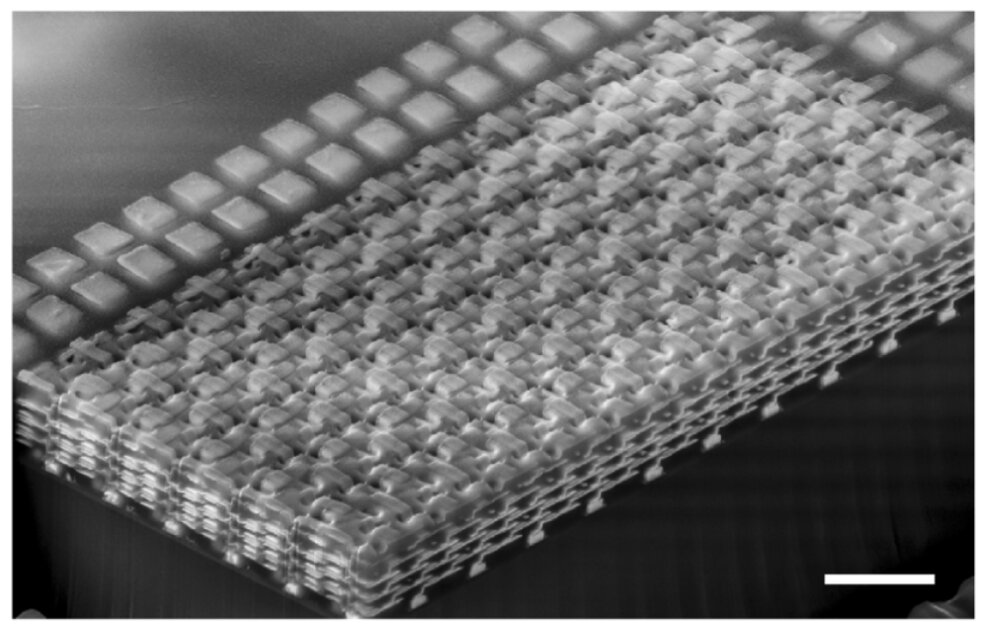
With wall thicknesses of about 160 nanometers, a closed-cell, plate-based nanolattice structure designed by researchers at UCI and other institutions is the first experimental verification that such arrangements reach the theorized limits of strength and stiffness in porous materials. Cameron Crook and Jens Bauer / UCI

Novel plate-cell architecture reaches theoretical limit of performance. Researchers at the University of California, Irvine and other institutions have architecturally designed plate-nanolattices — nanometer-sized carbon structures — that are stronger than diamonds as a ratio of strength to density.

In a recent study in Nature Communications, the scientists report success in conceptualizing and fabricating the material, which consists of closely connected, closed-cell...

Read More

Astronomers detect Most Energetic Outflow from a Distant Quasar

noirlab2009a. The image at left shows an artist’s conception of the central portion of the galaxy that hosts the quasar SDSS J135246.37+423923.5 viewed at optical wavelengths. Thick winds obscure our view, and imprint signatures of the energetic outflow on the SDSS spectrum. The image at right shows the same artist’s view at infrared wavelengths, as seen by the Gemini GNIRS detector. The thick outflow is transparent at infrared wavelengths, giving us a clear line of sight to the quasar. The infrared spectrum yields the quasar redshift, and from that reference frame, we measured the record-breaking outflow velocity. Credit: International Gemini Observatory/NOIRLab/NSF/AURA/P. Marenfeld

Researchers using the Gemini North telescope on Hawai’i’s Maunakea have detected the most energeti...

Read More