






Hot Qubits break one of the biggest constraints to practical Quantum Computers

Henry Yang and Andrew Dzurak
Dr Henry Yang and Professor Andrew Dzurak with a dilution refrigerator designed to keep qubits operating at extremely cold temperatures. Picture: UNSW Sydney

A proof-of-concept study promises warmer, cheaper and more robust quantum computing. And it can be manufactured using conventional silicon chip foundries.

Most quantum computers being developed around the world will only work at fractions of a degree above absolute zero. That requires multi-million-dollar refrigeration and as soon as you plug them into conventional electronic circuits they’ll instantly overheat.

But now researchers led by Professor Andrew Dzurak at UNSW Sydney have addressed this problem...

Read More

ESO Telescope sees Star dance around Supermassive Black Hole, proves Einstein right

undefined
Observations made with ESO’s Very Large Telescope (VLT) have revealed for the first time that a star orbiting the supermassive black hole at the centre of the Milky Way moves just as predicted by Einstein’s general theory of relativity. Its orbit is shaped like a rosette and not like an ellipse as predicted by Newton’s theory of gravity. This long-sought-after result was made possible by increasingly precise measurements over nearly 30 years, which have enabled scientists to unlock the mysteries of the behemoth lurking at the heart of our galaxy.

Observations made with ESO’s Very Large Telescope (VLT) have revealed for the first time that a star orbiting the supermassive black hole at the centre of the Milky Way moves just as predicted by Einstein’s general theory of relativity...

Read More

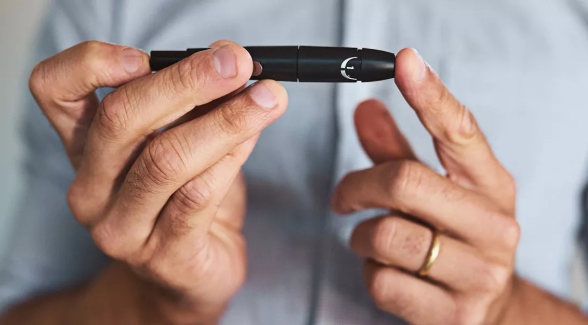
A Non-Invasive way of Monitoring Diabetes

Saliva could be used instead of blood to monitor diabetes in a method proposed in research involving the University of Strathclyde.
The test has been developed as an alternative to the current prevalent practice of monitoring blood glucose, which can be invasive, painful and costly.

Lab tests of the saliva process had an accuracy rate of 95.2%. The research shows promising results for monitoring diabetes, which affects an estimated 425 million people worldwide — around half of them undiagnosed.

The research has been published in the journal PLOS ONE. It also involved partners at the Federal University of Uberlandia in Minas Gerais, Brazil, the University of Vale do Paraíba in Sao Paolo, Brazil and the University of Saskatchewan in Canada.

Dr Matthew Baker, a Reader in Strathc...

Read More

New Photon-Counting Camera captures 3D Images with record Speed and Resolution

Researchers have developed the first megapixel photon-counting camera based on single-photon avalanche diode (SPAD) image sensors. The new camera can capture images in faint light at unprecedented speeds.
Credit: Arianna M. Charbon, Kazuhiro Morimoto, Edoardo Charbon

Researchers have developed the first megapixel photon-counting camera based on new-generation image sensor technology that uses single-photon avalanche diodes (SPADs). The new camera can detect single photons of light at unprecedented speeds, a capability that could advance applications that require fast acquisition of 3D images such as augmented reality and LiDAR systems for autonomous vehicles.

“Thanks to its high resolution and ability to measure depth, this new camera could make virtual reality more realistic and let...

Read More