Chemists Inhibit a Critical Gear of Cell Immortality

scheidt telomerase
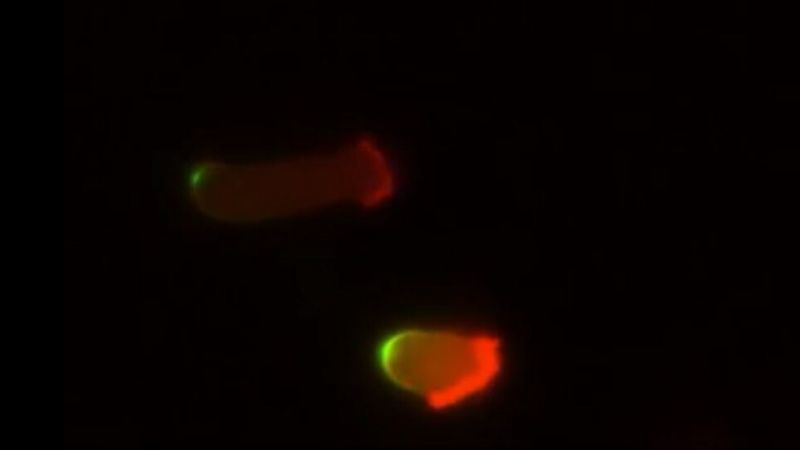
The ends of chromosomes are protected by specific DNA sequences called telomeres, visualized here in red. Credit: National Institutes of Health

A Northwestern University organic chemist and his team now have developed a promising molecular tool that targets and inhibits one of cell immortality’s underlying gears: the enzyme telomerase.

This enzyme is found overexpressed in approximately 90% of human cancer cells and has become an important subject of study for cancer researchers. Normal cells have the gene for telomerase, but it typically is not expressed. “Telomerase is the primary enzyme that allows cancer cells to live forever,” said Karl A. Scheidt, who led the research. “We want to short-circuit this immortality...

Read More

Geologists determine early Earth was a ‘Water World’ by studying exposed ocean crust

Benjamin Johnson of Iowa State University woks at an outcrop in remote Western Australia where geologists are studying 3.2-billion-year-old ocean crust. Larger photo. Photo by Jana Meixnerova. Photos provided by Benjamin Johnson.

The Earth of 3.2 billion years ago was a “water world” of submerged continents, geologists say after analyzing oxygen isotope data from ancient ocean crust that’s now exposed on land in Australia.

And that could have major implications on the origin of life...

Read More

Can’t Sleep? Prebiotics could help

Image result for Better sleep? Prebiotics could help
Researchers suggest that dietary prebiotics could help to improve sleep quality in stressful situations.

Dietary compounds found to influence gut metabolites, buffering stress. Think dietary fiber is just for digestive health? Think again.

Specific fibers known as prebiotics can improve sleep and boost stress resilience by influencing gut bacteria and the potent biologically active molecules, or metabolites, they produce, new University of Colorado Boulder research shows.

The research could ultimately lead to new approaches to treating sleep problems, which affect 70 million Americans.

“The biggest takeaway here is that this type of fiber is not just there to bulk up the stool and pass through the digestive system,” said Robert Thompson, a postdoctoral researcher in the Depa...

Read More

Engineers Zap and Unstick Underwater Smart Glue

Biomedical engineers Bruce Lee and Saleh Akram Bhuiyan test catechol-containing adhesives to make underwater smart glue.

With a small zap of electricity, biomedical engineers at Michigan Technological University take an underwater smart glue prototype from sticky to not in seven seconds.

Turning adhesion on and off is what makes a glue smart. It’s one thing to do this in the open air and quite another under water. Inspired by nature, catechols are synthetic compounds that mimic the -but-still- proteins secreted by mussels and offer promise for smart adhesives that work in water. The technology could help with underwater glue, wound dressings, prosthetic attachments or even making car parts and in other manufacturing.

Bruce Lee, associate professor of biomedical engineering at M...

Read More