

Hydrogen, the lightest element on the periodic table, is a master of escaping almost any container it’s stored in...
Read More


Until we recognize the essential role of biology, our attempts to truly unify the universe will remain a train to nowhere. ~Robert Lanza Read More

Good health is not something we can buy. However, it can be an extremely valuable savings account. ~Anne Wilson Schaef Read More

The only way forward, if we are going to improve the quality of the environment, is to get everybody involved. ~Richard Rogers Read More

To raise new questions, new possibilities, to regard old problems from a new angle, requires creative imagination and marks real advance in science. ~Albert Einstein Read More

Old Newtonian physics claimed that things have an objective reality separate from our perception of them. Quantum physics, and particularly Heisenberg's Uncertainty Principle, reveal that, as our perception of an object changes, the object itself literally changes. ~Marianne Williamson Read More

Astronomy compels the soul to look upwards and leads us from this world to another. ~ Read More
January 6, 2026,
 Physics, Chemistry/Nanotechnology
Hydrogen, the lightest element on the periodic table, is a master of escaping almost any container it’s stored in...
Read More
January 6, 2026,
Astronomy/Space
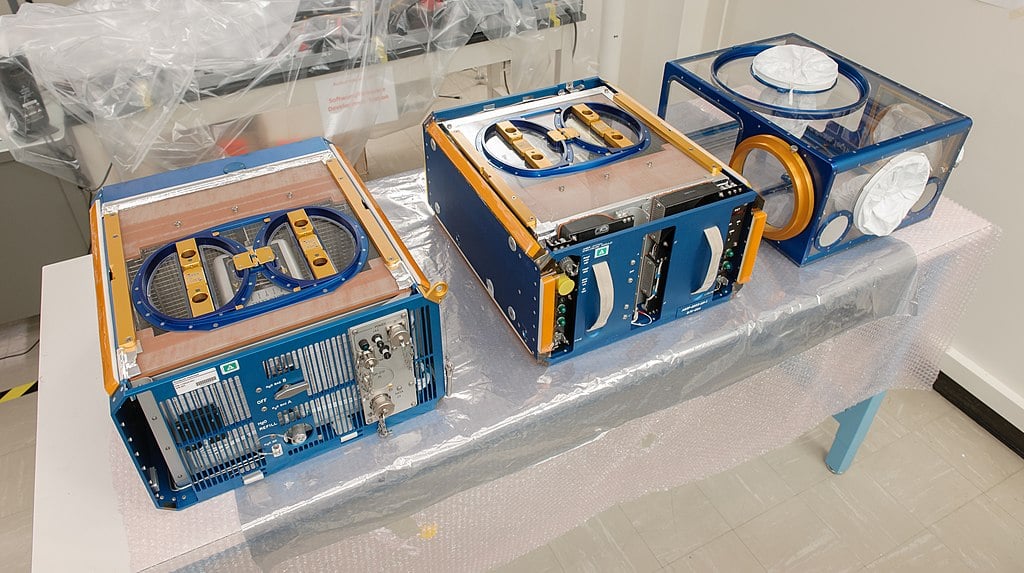
Four mice went to space as astronauts. One came back and became a mother. And that simple fact might matter more than you’d think for humanity’s future beyond Earth.
On 31 October, China launched four mice numbered 6, 98, 154, and 186, aboard the Shenzhou-21 spacecraft to the country’s space station, roughly 400 kilometers above Earth. For two weeks, the rodents lived in microgravity, exposed to space radiation and the peculiar conditions of orbital life. They returned safely on 14 November. Then, on 10 December, one of the females gave birth to nine healthy pups.
In a previous study, sperm from mice that had been in space had been used to fertilize female mice back ...
Read More
January 5, 2026,
Physics, Technology/Electronics

Quantum particles have a social life, of a sort...
Read More
January 5, 2026,
Astronomy/Space

The only way astronomers have been able to detect rogue planets is through microlensing events caused by the slight gravitational effect of an object on background light. This occurs when the light from a distant star suddenly appears magnified to an observer (telescopes on Earth), as if a lens were placed in front of it. The magnification of light lets astronomers know that something has passed in front of the distant star.
Theoretically, microlensing can allow for the calculation of the mass of the object passing in front of the star by analyzing how much the light was bent and thus magnified...
Read More
Recent Comments