
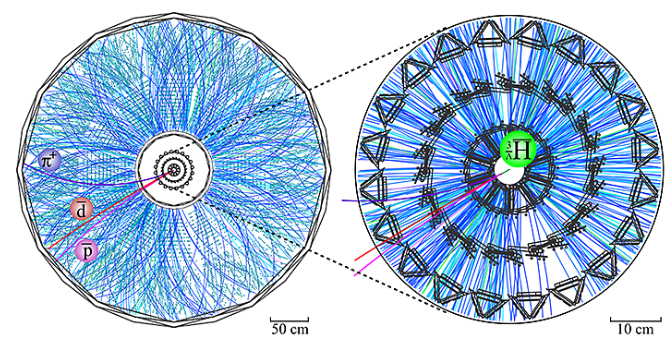
New results from precision particle detectors at the Relativistic Heavy Ion Collider (RHIC) offer a fresh glimpse of the particle...
Read More


Until we recognize the essential role of biology, our attempts to truly unify the universe will remain a train to nowhere. ~Robert Lanza Read More

Good health is not something we can buy. However, it can be an extremely valuable savings account. ~Anne Wilson Schaef Read More

The only way forward, if we are going to improve the quality of the environment, is to get everybody involved. ~Richard Rogers Read More

To raise new questions, new possibilities, to regard old problems from a new angle, requires creative imagination and marks real advance in science. ~Albert Einstein Read More

Old Newtonian physics claimed that things have an objective reality separate from our perception of them. Quantum physics, and particularly Heisenberg's Uncertainty Principle, reveal that, as our perception of an object changes, the object itself literally changes. ~Marianne Williamson Read More

Astronomy compels the soul to look upwards and leads us from this world to another. ~ Read More
New results from precision particle detectors at the Relativistic Heavy Ion Collider (RHIC) offer a fresh glimpse of the particle...
Read More
March 13, 2020,
 Health/Medical, Biology/Biotechnology
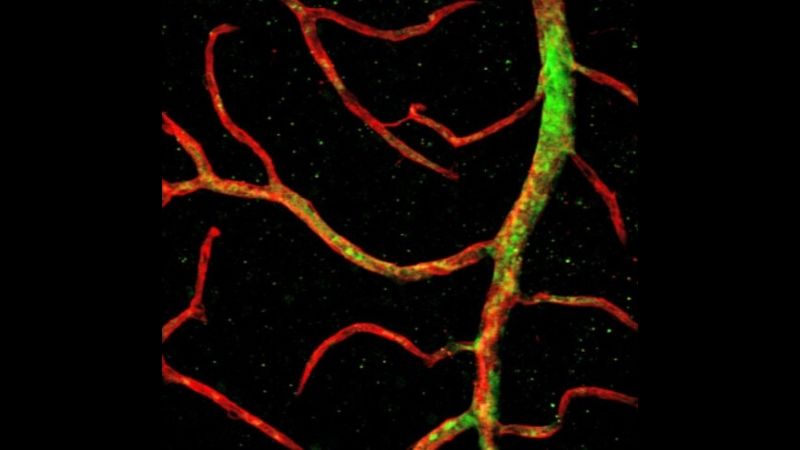
Johns Hopkins Medicine scientists say they have successfully turned back the biological hands of time, coaxing adult human cells in the laboratory to revert to a primitive state, and unlocking their potential to replace and repair damage to blood vessels in the retina caused by diabetes. The findings from this experimental study, they say, advance regenerative medicine techniques aimed at reversing the course of diabetic retinopathy and other blinding eye diseases.
“Our study results bring us a step closer to using stem cells more widely in regenerative medicine, without the historical problems...
Read More
March 12, 2020,
Physics, Technology/Electronics

Drone pilots may become superfluous in the future. New research from Aarhus University has allowed artificial intelligence to take over control of drones scanning and measuring terrain.
A research project at Aarhus University (AU) in collaboration with the Technical University of Denmark (DTU) aims to make measuring and documenting gravel and limestone quarries much faster, cheaper and easier in the future.
Read More
March 12, 2020,
Astronomy/Space

Researchers using ESO’s Very Large Telescope (VLT) have observed an extreme planet where they suspect it rains iron. The ultra-hot giant exoplanet has a day side where temperatures climb above 2400 degrees Celsius, high enough to vaporise metals. Strong winds carry iron vapour to the cooler night side where it condenses into iron droplets.
“One could say that this planet gets rainy in the evening, except it rains iron,” says David Ehrenreich, a professor at the University of Geneva in Switzerland. He led a study, published today in the journal Nature, of this exotic exoplanet. Known as WASP-76b, it is located some 640 light-years away in the constellation of Pisces.
This strange phenomenon happens because the ‘iron rain’ plane...
Read More
Recent Comments