Sub-Neptune sized planet validated with the Habitable-Zone Planet Finder

A signal originally detected by the Kepler spacecraft has been validated as an exoplanet using the Habitable-zone Planet Finder (HPF), an astronomical spectrograph built by a Penn State team and recently installed on the 10m Hobby-Eberly Telescope at McDonald Observatory in Texas. The HPF provides the highest precision measurements to date of infrared signals from nearby low-mass stars, and astronomers used it to validate the candidate planet by excluding all possibilities of contaminating signals to very high level of probability. The details of the findings appear in the Astronomical Journal.

The planet, called G 9-40b, is about twice the size of the Earth, but likely closer in size to Neptune, and orbits its low mass host star, an M dwarf star, only 100 light years from Earth...

Read More

Magnet-controlled Bioelectronic Implant could relieve Pain

Rice introduced the first neural implant that can be programmed and charged remotely with a magnetic field at the International Solid-State Circuits Conference. (Credit: Secure and Intelligent Micro-Systems Lab/Rice University)

Engineer’s MagNI can be wirelessly charged and programmed with magnetic fields

A team of Rice University engineers has introduced the first neural implant that can be both programmed and charged remotely with a magnetic field. Their breakthrough may make possible embedded devices like a spinal cord-stimulating unit with a battery-powered magnetic transmitter on a wearable belt.

The integrated microsystem, called MagNI (for magnetoelectric neural implant), incorporates magnetoelectric transducers...

Read More

New World Record for Conversion of Solar Energy to Electricity using Quantum Dots

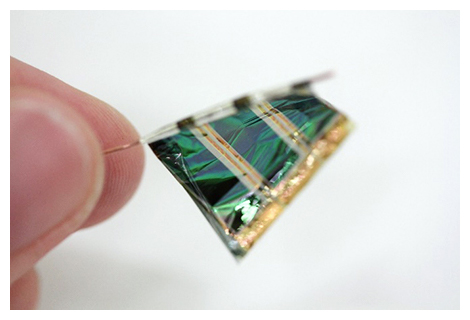
A UQ team have developed quantum dot solar cells that can be made into thin, flexible films and used to generate electricity even in low-light conditions

Researchers have set a world record for the conversion of solar energy to electricity via the use of tiny nanoparticles called ‘quantum dots’. The technology has a huge range of potential applications, including the possibility to use it as a flexible, transparent skin to power cars, planes, homes and wearable technology.

The development of next generation solar power technology that has potential to be used as a flexible ‘skin’ over hard surfaces has moved a step closer, thanks to a significant breakthrough at The University of Queensland.

UQ researchers set a world record for the conversion of solar energy to electricity via...

Read More

Earth Formed much Faster than previously thought, new study shows

Illustration of protoplanetary disk (stock image). | Credit: (c) Peter Jurik / stock.adobe.com
Illustration of protoplanetary disk (stock image).
Credit: © Peter Jurik / Adobe Stock

By measuring iron isotopes, researchers have shown that our planet originally formed much faster than previously thought. This finding provides new insights on both planetary formation and the likelihood of water and life elsewhere in the universe.

The precursor of our planet, the proto-Earth, formed within a time span of approximately five million years, shows a new study from the Centre for Star and Planet Formation (StarPlan) at the Globe Institute at the University of Copenhagen.

On an astronomical scale, this is extremely fast, the researchers explain.

If you compare the solar system’s estimated 4...

Read More