





Environment-friendly Compound shows promise for solar cell use

Scanning electron microscopy image of a BaZrS3 film deposited on quartz

Relatively inexpensive compound could perform safely and effectively in solar cells. A team of engineers, material scientists, and physicists demonstrated how a new material — a lead-free chalcogenide perovskite — that hadn’t previously been considered for use in solar cells could provide a safer and more effective option than others that are commonly considered.

A widespread transition to solar energy will depend heavily on reliable, safe, and affordable technology like batteries for energy storage and solar cells for energy conversion. At Rensselaer Polytechnic Institute, researchers are focused heavily on both parts of that equation.

In research published today in Advanced Functional Materials, a team of e...

Read More
‘Elegant’ Solution reveals how the universe got its structure

Why is the distribution of structure in the cosmos not uniform? The universe’s first structure originated when some of the material flung outward by the Big Bang overcame its trajectory and collapsed on itself, forming clumps. A team of Carnegie researchers showed that denser clumps of matter grew faster, and less-dense clumps grew more slowly. The group’s data revealed the distribution of density in the universe over the last 9 billion years. (On the illustration, violet represents low-density regions and red represents high-density regions.) Working backward in time, their findings reveal the density fluctuations (far right, in purple and blue) that created the universe’s earliest structure...
Read More

‘Designer Virus’ is first new Oral Polio Vaccine in 50 years

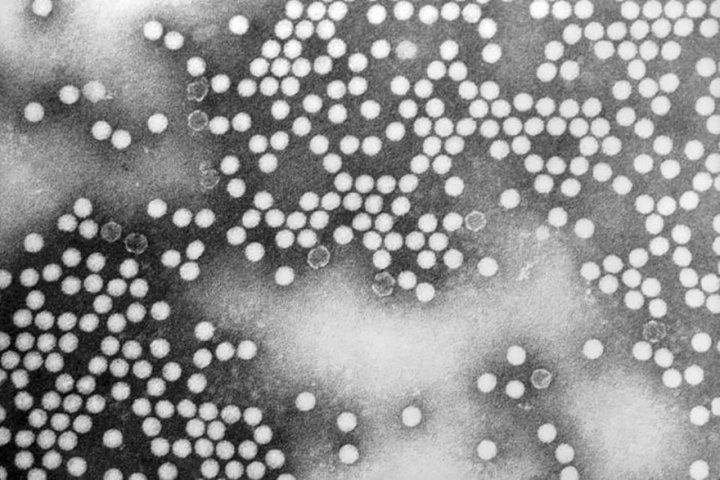
Transmission electron micrograph of poliovirus type 1
Transmission electron micrograph of poliovirus type 1. Image by Centers for Disease Control and Prevention

Phase 1 trial shows promise for completion of stalled eradication effort; offers lessons for COVID-19 vaccine development. Virologists report promising Phase 1 clinical results for the first new oral polio vaccine in 50 years, which they have designed to be incapable of evolving the ability to cause disease in humans.

Before being halted due to the COVID-19 pandemic, a relentless vaccination campaign had nearly succeeded in eradicating polio from the world...

Read More

Quantum Electrodynamics Experiment

Künstlerische Visualisierung
Artistic visualisation: Symmetries constrain the motion of ultracold atoms in the lab. | © Cellule

Researchers see application in future quantum technologies. The fundamental laws of physics are based on symmetries that, among other things, determine the interactions between charged particles. Using ultracold atoms, researchers at Heidelberg University have experimentally constructed the symmetries of quantum electrodynamics. They hope to gain new insights for implementing future quantum technologies that can simulate complex physical phenomena. The results of the study were published in the journal Science.

The theory of quantum electrodynamics deals with the electromagnetic interaction between electrons and light particles...

Read More