






Astronomers reveal rare Double Nucleus in nearby ‘Cocoon Galaxy’

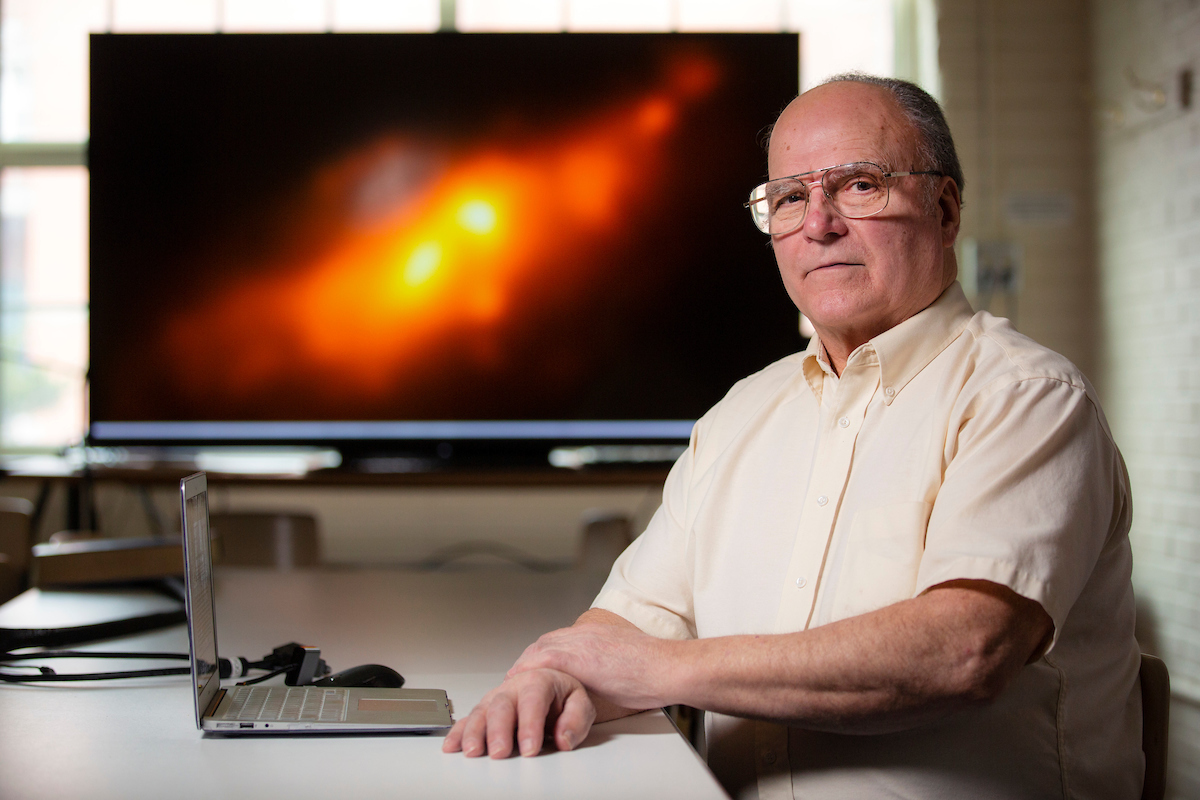
Allen Lawrence, a 77-year-old who earned an Iowa State master’s degree in astrophysics in 2018, is first author of a paper revealing a rare double-nucleus structure in a well-known, nearby galaxy. Larger photo. Photo by Christopher Gannon.

The so-called “Cocoon Galaxy” not only has a unique shape, it has a rare double-nucleus structure, astronomers report in a new paper.

After studying data from optical and radio telescopes based on the ground and in space, a team of astronomers determined that a galaxy known as NGC 4490 (and nicknamed the “Cocoon Galaxy” because of its shape) has “a clear double nucleus structure,” according to their paper.

One nucleus can be seen in optical wavelengths. The other is hidden in dust and can only be seen in infrared and radio wavelengths.

The...

Read More


A New Substance Prevents Vascular Calcification

heating elements covered in limescale
Just as heating elements become covered in limescale, some diseases cause calcification in the soft tissues of the body. (Photograph: Shutterstock)

Researchers at ETH Zurich and ETH spin-off Inositec have developed a new substance to prevent vascular calcification, which affects many patients suffering from chronic kidney disease. As their metabolism is impaired, calcium salts may deposit in soft tissues, such as blood vessels or even the heart valves, causing them to stiffen. This often leads to severe, potentially fatal cardiovascular diseases. However, before patients can benefit from the substance further research and tests must be carried out.

“Calcification occurs when calcium phosphate crystals are deposited in tissue,” explains Jean-Christophe Leroux, Professor of Drug For...

Read More

Controlling Light with Light

picture of computer chip with light
SEAS researchers have developed a new platform for all-optical computing, meaning computations done solely with beams of light. 

Researchers develop a new platform for all-optical computing. The future of computation is bright – literally.

Researchers from the Harvard John A. Paulson School of Engineering and Applied Sciences (SEAS), in collaboration with researchers at McMaster University and University of Pittsburgh, have developed a new platform for all-optical computing, meaning computations done solely with beams of light.

“Most computation right now uses hard materials such as metal wires, semiconductors and photodiodes to couple electronics to light,” said Amos Meeks, a graduate student at SEAS and co-first author of the research...

Read More

Astronomers discover Unusual Monster Galaxy in the Very Early Universe

The three panels show, from top to bottom, what XMM-2599’s evolutionary trajectory might be, beginning as a dusty star-forming galaxy, then becoming a dead galaxy, and perhaps ending up as a “brightest cluster galaxy,” or BCG. (NRAO/AUI/NSF/B. Saxton; NASA/ESA/R. Foley; NASA/StScI)

An international team of astronomers led by scientists at the University of California, Riverside, has found an unusual monster galaxy that existed about 12 billion years ago, when the universe was only 1.8 billion years old.

Dubbed XMM-2599, the galaxy formed stars at a high rate and then died. Why it suddenly stopped forming stars is unclear.

“Even before the universe was 2 billion years old, XMM-2599 had already formed a mass of more than 300 billion suns, making it an ultramassive galaxy,” ...

Read More