This Designer Clothing Lets Users turn on Electronics while Turning Away Bacteria

fabric innovation
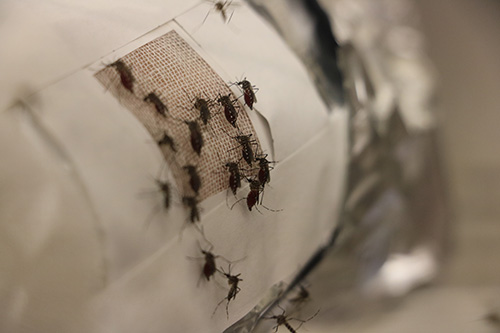
Purdue waterproof, breathable and antibacterial self-powered clothing is based on omniphobic triboelectric nanogenerators. 

New rainproof, stainproof technology turns clothing into self-powered remotes. Purdue University researchers have developed a new fabric innovation that allows wearers to control electronic devices through clothing.

“It is the first time there is a technique capable to transform any existing cloth item or textile into a self-powered e-textile containing sensors, music players or simple illumination displays using simple embroidery without the need for expensive fabrication processes requiring complex steps or expensive equipment,” said Ramses Martinez, an assistant professor in the School of Industrial Engineering and in the Weldon School of Biomedical Engine...

Read More

Dark Matter may be Older than the Big Bang

cosmic inflation model
(Drbogdan/Yinweichen/Wikimedia Commons)

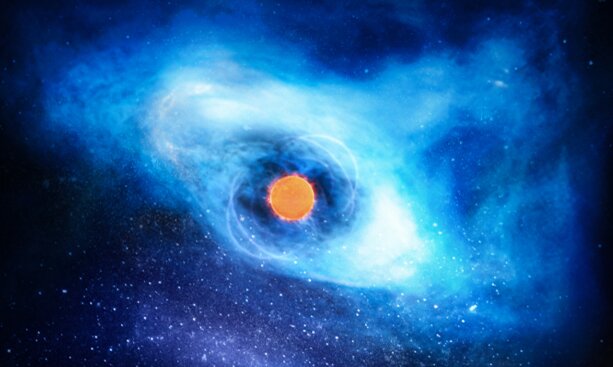
Dark matter, which researchers believe make up about 80% of the universe’s mass, is one of the most elusive mysteries in modern physics. What exactly it is and how it came to be is a mystery, but a new Johns Hopkins University study now suggests that dark matter may have existed before the Big Bang. The study, published August 7 in Physical Review Letters, presents a new idea of how dark matter was born and how to identify it with astronomical observations.

“The study revealed a new connection between particle physics and astronomy. If dark matter consists of new particles that were born before the Big Bang, they affect the way galaxies are distributed in the sky in a unique way...

Read More

New Perovskite Material shows Early Promise as an Alternative to Silicon

Perovskite materials are gaining popularity in the photovoltaic world due to their high efficiency and low cost. Light excites electrons in the material that can then flow as electricity. “Dancing atoms in perovskite materials provide insight into how solar cells work” by SLAC National Accelerator Laboratory is licensed under CC BY-NC-SA 2.0.

CsPbI3 is an inorganic perovskite, a group of materials gaining popularity in the solar world due to their high efficiency and low cost. This configuration is noteworthy as stabilizing these materials has historically been a challenge.

Silicon dominates solar energy products – it is stable, cheap, and efficient at turning sunlight into electricity. Any new material taking on silicon must compete, and win, on those grounds...

Read More

Astronomers Reveal True Colors of Evolving Galactic Beasts

The percentage of both the full colour-selected (filled markers) and the L6μm−z matched (open markers) samples (using the colour scheme in Fig. 2) with different radio morphologies. The fractions are reported in five categories: faint sources detected near the sensitivity limit (Fpeak < 3 mJy), bright compact radio sources, bright extended radio sources, FR II-like systems, and compact FR IIs (small scale lobe-systems); see Table 4 for more details. The error bars correspond to the 1σ binomial uncertainties and the vertical dash lines separate the different categories. Example 2 arcmin × 2 arcmin FIRST images of each morphological are illustrated in the top panel. The white circle represents our cross-matching radius of 10 arcsec. Extended radio emission is found among a similar fraction of all quasars, but red quasars show a surfeit of compact and faint systems.
The percentage of both the full colour-selected (filled markers) and the L6μmz matched (open markers) samples (using the colour scheme in Fig. 2) with different radio morphologies. The fractions are reported in five categories: faint sources detected near the sensitivity limit (Fpeak < 3 mJy), bright compact radio sources, bright extended radio sources, FR II-like systems, and compact FR IIs (small scale lobe-systems); see Table 4 for more details. The error bars correspond to the 1σ binomial uncertainties and the vertical dash lines separate the different categories. Example 2 arcmin × 2 arcmin FIRST images of each morphological class are illustrated in the top panel. The white circle represents our cross-matching radius of 10 arcsec...
Read More