New Perovskite Material shows Early Promise as an Alternative to Silicon

Perovskite materials are gaining popularity in the photovoltaic world due to their high efficiency and low cost. Light excites electrons in the material that can then flow as electricity. “Dancing atoms in perovskite materials provide insight into how solar cells work” by SLAC National Accelerator Laboratory is licensed under CC BY-NC-SA 2.0.

CsPbI3 is an inorganic perovskite, a group of materials gaining popularity in the solar world due to their high efficiency and low cost. This configuration is noteworthy as stabilizing these materials has historically been a challenge.

Silicon dominates solar energy products – it is stable, cheap, and efficient at turning sunlight into electricity. Any new material taking on silicon must compete, and win, on those grounds...

Read More

Astronomers Reveal True Colors of Evolving Galactic Beasts

The percentage of both the full colour-selected (filled markers) and the L6μm−z matched (open markers) samples (using the colour scheme in Fig. 2) with different radio morphologies. The fractions are reported in five categories: faint sources detected near the sensitivity limit (Fpeak < 3 mJy), bright compact radio sources, bright extended radio sources, FR II-like systems, and compact FR IIs (small scale lobe-systems); see Table 4 for more details. The error bars correspond to the 1σ binomial uncertainties and the vertical dash lines separate the different categories. Example 2 arcmin × 2 arcmin FIRST images of each morphological are illustrated in the top panel. The white circle represents our cross-matching radius of 10 arcsec. Extended radio emission is found among a similar fraction of all quasars, but red quasars show a surfeit of compact and faint systems.
The percentage of both the full colour-selected (filled markers) and the L6μmz matched (open markers) samples (using the colour scheme in Fig. 2) with different radio morphologies. The fractions are reported in five categories: faint sources detected near the sensitivity limit (Fpeak < 3 mJy), bright compact radio sources, bright extended radio sources, FR II-like systems, and compact FR IIs (small scale lobe-systems); see Table 4 for more details. The error bars correspond to the 1σ binomial uncertainties and the vertical dash lines separate the different categories. Example 2 arcmin × 2 arcmin FIRST images of each morphological class are illustrated in the top panel. The white circle represents our cross-matching radius of 10 arcsec...
Read More

Why Intense Light can Protect Cardiovascular Health

Figure thumbnail fx1
Highlights
•Intense light-mediated cardioprotection requires endothelial-specific PER2
•Intense light-elicited PER2 transcriptionally reprograms the endothelium
•Endothelial PER2 regulates respiration and barrier function during hypoxia
•Studies of humans reveal intense light activates PER2-dependent metabolism

The light boosts a critical gene that strengthens blood vessels. Researchers at the University of Colorado Anschutz Medical Campus have found that intense light amplifies a specific gene that bolsters blood vessels and offers protection against heart attacks.

“We already knew that intense light can protect against heart attacks, but now we have found the mechanism behind it,” said the study’s senior author Tobias Eckle, MD, PhD, professor of anesthesiology at the University...

Read More

Nanosecond Pulsed Electric fields activate Immune cells

figure3
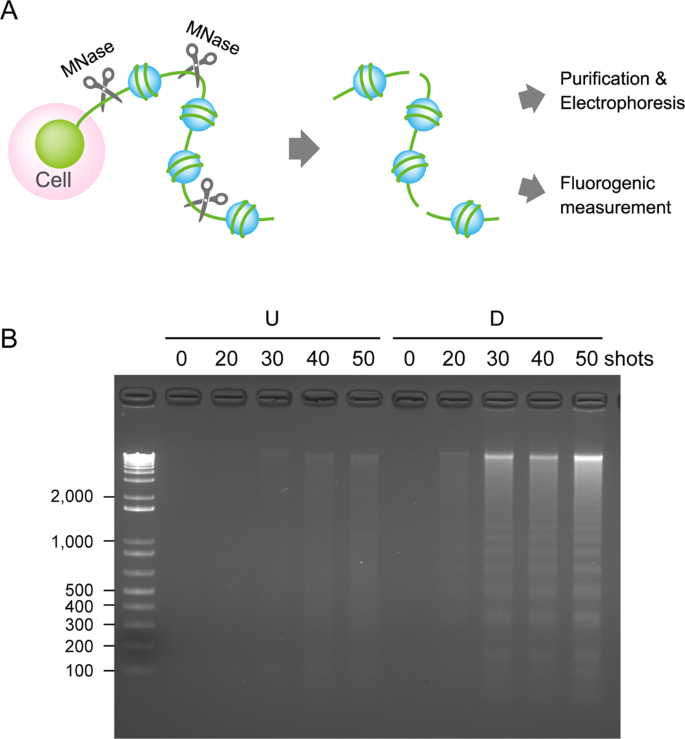
Analysis of extracellular DNA by agarose gel electrophoresis. (A) Schematic representation of MNase treatment for liberation of extruded DNA from cells. MNase digests extracellular chromosomal DNA at its linker regions among nucleosomes, leading to the liberation of extracellular chromosomal DNA from their originating cells. Liberated DNA was separated from cells by brief centrifugation and in turn subjected to either DNA purification followed by agarose gel electrophoresis (B) or direct fluorometric measurement with a SYTOX Green dye (Fig. 4). (B) Analysis of MNase-treated extracellular DNA by agarose gel electrophoresis. Differentiated (D) and undifferentiated cells (U) were exposed to the indicated shot numbers of 20 kV/cm nsPEFs...
Read More