Could Coffee be the Secret to Fighting Obesity?

 Caffeine exposure induces browning features in adipose tissue in vitro and in vivoScientific Reports, 2019; 9 (1) DOI: 10.1038/s41598-019-45540-1

Scientists from the University of Nottingham have discovered that drinking a cup of coffee can stimulate ‘brown fat’, the body’s own fat-fighting defenses, which could be the key to tackling obesity and diabetes.

The pioneering study, published today in the journal Scientific Reports, is one of the first to be carried out in humans to find components which could have a direct effect on ‘brown fat’ functions, an important part of the human body which plays a key role in how quickly we can burn calories as energy.

Brown adipose tissue (BAT), also known as brown fat, is one of two types of fat found in humans and other mammals...

Read More

Astrophysicist announces her Discovery that could Rewrite Story of how Galaxies Die

This artist conception depicts an energetic quasar that has cleared the center of the galaxy of gas and dust, and the winds are now propagating it to the outskirts. Soon, there will be no gas and dust left, and only a luminous blue quasar will remain. Credit: Michelle Vigeant.

A breakthrough finding overturns assumptions about the maturation of galaxies and may represent a phase of every galaxy’s life cycle that was unknown until now. At the annual meeting of the American Astronomical Society in St. Louis, Missouri, Allison Kirkpatrick, assistant professor of physics and astronomy at the University of Kansas, will announce her discovery of “cold quasars” – galaxies featuring an abundance of cold gas that still can produce new stars despite having a quasar at the center.
Her news brie...

Read More

‘Nanoemulsion’ Gels offer new way to Deliver Drugs through the Skin

MIT chemical engineers have devised a way to convert liquid nanoemulsions into solid gels. These gels (red) form almost instantaneously when drops of the liquid emulsion enter warm water.

Novel materials made with FDA-approved components could deliver large payloads of active ingredients. MIT chemical engineers have devised a new way to create very tiny droplets of one liquid suspended within another liquid, known as nanoemulsions. Such emulsions are similar to the mixture that forms when you shake an oil-and-vinegar salad dressing, but with much smaller droplets. Their tiny size allows them to remain stable for relatively long periods of time.

The researchers also found a way to easily convert the liquid nanoemulsions to a gel when they reach body temperature (37 degrees Celsius)...

Read More

Visible Light from 2D Lead Halide Perovskites explained

Jiming Bao
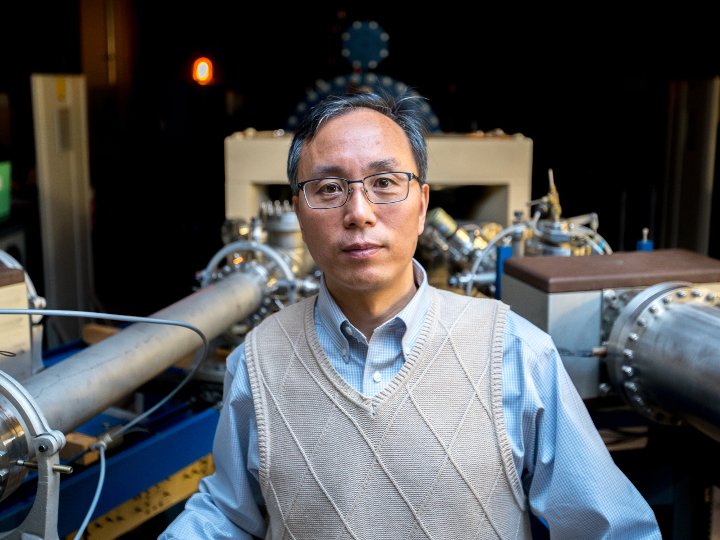
Jiming Bao, associate professor of electrical and computer engineering, led an international group of researchers investigating how a two-dimensional perovskite composed of cesium, lead and bromine was able to emit a strong green light.

Work resolves mystery and offers new path for light-emitting and other devices. Electrical engineers have reported solving a lingering question about how a 2D crystal composed of cesium, lead and bromine emitted a strong green light, opening the door to designing better light-emitting and diagnostic devices.

Crystals that produce light on the green spectrum are desirable because green light, while valuable in itself, can also be relatively easily converted to other forms that emit blue or red light, making it especially important for optical applic...

Read More