

Over the past decade, deep learning has transformed how artificial intelligence (AI) agents perceive and act in digital environments, allowing them to master board games, control simulated robots and reliably tackle various other tasks...
Read More


Until we recognize the essential role of biology, our attempts to truly unify the universe will remain a train to nowhere. ~Robert Lanza Read More

Good health is not something we can buy. However, it can be an extremely valuable savings account. ~Anne Wilson Schaef Read More

The only way forward, if we are going to improve the quality of the environment, is to get everybody involved. ~Richard Rogers Read More

To raise new questions, new possibilities, to regard old problems from a new angle, requires creative imagination and marks real advance in science. ~Albert Einstein Read More

Old Newtonian physics claimed that things have an objective reality separate from our perception of them. Quantum physics, and particularly Heisenberg's Uncertainty Principle, reveal that, as our perception of an object changes, the object itself literally changes. ~Marianne Williamson Read More

Astronomy compels the soul to look upwards and leads us from this world to another. ~ Read More
October 26, 2025,
 Physics, Technology/Electronics
Over the past decade, deep learning has transformed how artificial intelligence (AI) agents perceive and act in digital environments, allowing them to master board games, control simulated robots and reliably tackle various other tasks...
Read More
October 26, 2025,
Astronomy/Space
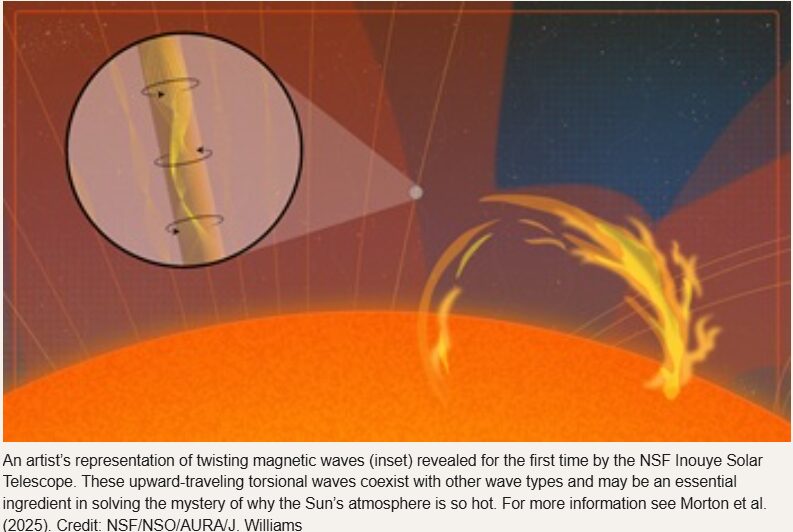
Researchers have achieved a breakthrough in solar physics by providing the first direct evidence of small-scale torsional Alfvén waves in the sun’s corona—elusive magnetic waves that scientists have been searching for since the 1940s.
The discovery, published in Nature Astronomy, was made using unprecedented observations from the world’s most powerful solar telescope, the U.S. National Science Foundation (NSF) Daniel K. Inouye Solar Telescope in Hawaii.
The findings could finally explain one of the sun’s greatest mysteries—how its outer atmosphere, the corona, reaches temperatures of millions of degrees while its surface is only around 5,500°C.
Alfvén waves, named after Nobel Prize winner Hannes Alfvén who predicted their existence in 1942, are magnetic disturbances tha...
Read More
October 25, 2025,
Health/Medical, Biology/Biotechnology

Interval running condenses the powerful effects of regular running into shorter, high-intensity bursts. Research shows it can improve cardiovascular health, regulate blood sugar, and reduce body fat more effectively than longer steady runs. Just a few short sprints per session can deliver major fitness gains.
Running offers a wide range of advantages for both body and mind. It can protect against disease, improve mood, and even slow down the body’s natural aging process.
Yet about 31% of adults still don’t get enough physical activity, including running. The most common reason people give is simple — they don’t have enough time.
That’s where interval running comes in. It promises nearly all the same benefits of regular running, but in a fraction of the time.
What Is Interv...
Read More
October 25, 2025,
Astronomy/Space
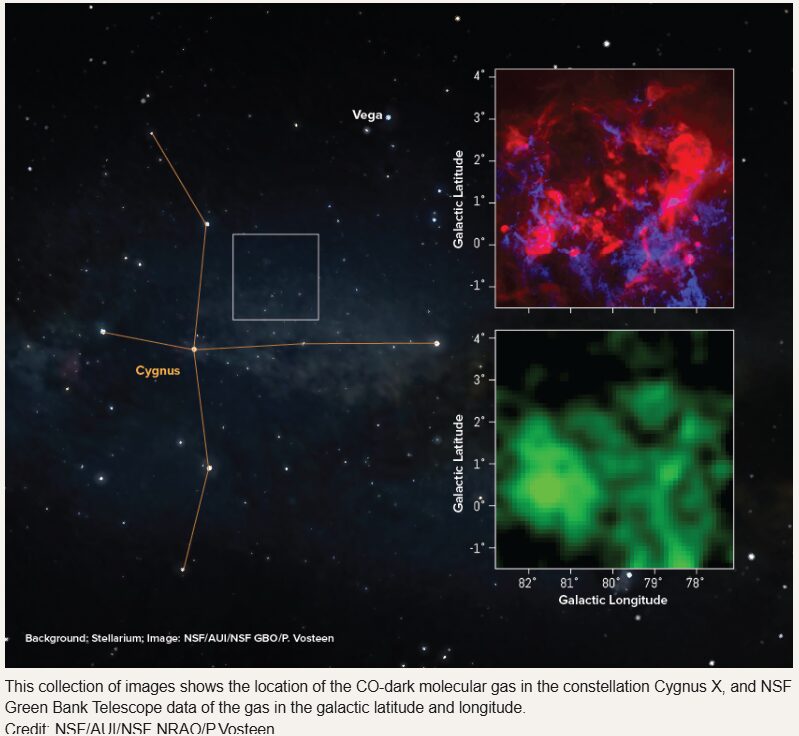
An international team of astronomers has created the first-ever large-scale maps of a mysterious form of matter, known as CO-dark molecular gas, in one of our Milky Way’s most active star-forming neighborhoods, CygnusX. Their findings, using the Green Bank Telescope (GBT), are providing crucial new clues about how stars formed in the Milky Way.
For decades, scientists have known that most new stars are born inside clouds of cold molecular hydrogen gas. Much of this molecular hydrogen is invisible to most telescopes—it doesn’t give off light that can easily be detected.
Traditionally, astronomers have hunted for these clouds by looking for carbon monoxide (CO), a molecule that acts like a flashing sign for star-building regions...
Read More
Recent Comments