






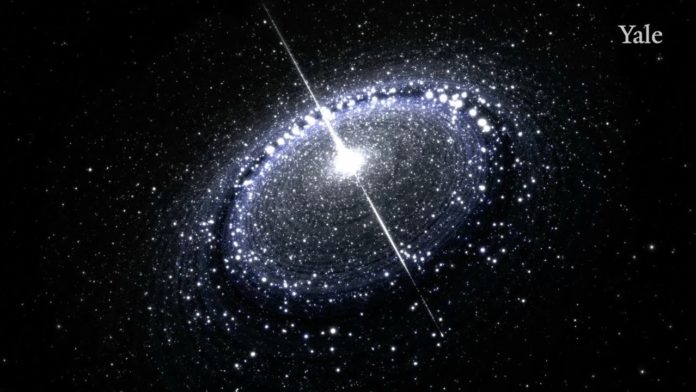
Milky Way’s Supermassive Black Hole may have ‘Unseen’ Siblings

4:04 Kabira (Encore) - Yeh Jawani Hai Deewani (720p FVS) Dhoom Basic Recommended for you 6:41 Lord Shiva| Most Powerful| Mantra | **WARNING** nigga tryna help Recommended for you 5:02 Chimb Bhijlele Title Sara Shrawan. Recommended for you Rajendra Chaturvedi - Man Mohini ( ADAH SHARMA ) Rajendra Chaturvedi Recommended for you Deva Shree Ganesha - Agneepath Full Song Ajay - Atul Ajay Atul Online Recommended for you 45 Years of Service YaleCampus 217 views Microbiome: Translocation of a Gut Pathobiont Drives Autoimmunity YaleCampus 2K views Undergraduate Students Compete in 10th 'Final Cut' Cooking Competition YaleCampus 46 views New Engineering Meets the Arts: Michelangelo's 'David' YaleCampus 750 views Yale Wellness YaleCampus 117 views Pat Kane celebrates 50 years at Yale University YaleCampus 678 views Antibiotics And The Antiviral Response YaleCampus 583 views Yale University Long Service Recognition Dinner YaleCampus 3 views Dan Adler Teaching Award YaleCampus 182 views Paleontologists put the bite on an ancient reptile from New England YaleCampus 2.5K views Milky Way’s supermassive black hole may have ‘unseen’ siblings

Wandering Supermassive Black Holes in Milky-Way-mass Halos. The Astrophysical Journal, 2018; 857 (2): L22 DOI: 10.3847/2041-8213/aabc0a

Astronomers are beginning to understand what happens when black holes get the urge to roam the Milky Way. Typically, a supermassive black hole (SMBH) exists at the core of a massive galaxy. But sometimes SMBHs may “wander” throughout their host galaxy, remaining far from the center in regions such as the stellar halo, a nearly spherical area of stars and gas that surrounds the main section of the galaxy. Astronomers theorize that this phenomenon often occurs as a result of mergers between galaxies in an expanding universe. A smaller galaxy will join with a larger, main galaxy, depositing its own, central SMBH onto a wide orbit within the new host.

In a...

Read More

Uncovering the Secret Law of the Evolution of Galaxy Clusters

(Left) Galaxy cluster MACS J1206 observed with the Subaru Telescope. (Right) Magnified image of the left by the Hubble Space Telescope. Credit: NASA/ESA, Umetsu et al. 2012, ApJ, 755, 56

(Left) Galaxy cluster MACS J1206 observed with the Subaru Telescope. (Right) Magnified image of the left by the Hubble Space Telescope. Credit: NASA/ESA, Umetsu et al. 2012, ApJ, 755, 56

Analysis of gravitational lensing data by an international research team reveals that the evolution of galaxy clusters is dictated by a surprisingly simple law, which clearly shows that they are still growing. Using observational data from the Hubble Space Telescope and the Subaru Telescope, the size and mass of galaxy clusters have precisely been measured. The newfound law will serve as a tool to clarify the evolutionary history of clusters and the universe.

Galaxy clusters are the largest celestial body in the Universe...

Read More

Scientists Unearth Vital Link between Fat, Immunity and Heat Regulation

Immune cells (or gd T cells) swarm around fat cells (adipocytes) in fat tissue to regulate their lipid burning vs storage. Credit: Lydia Lynch, Trinity College Dublin

Immune cells (or gd T cells) swarm around fat cells (adipocytes) in fat tissue to regulate their lipid burning vs storage. Credit: Lydia Lynch, Trinity College Dublin

Scientists have just made a surprising discovery involving fat and special immune cells that live within it – it turns out that ‘gd T cells’ are the key cogs in the biological wheel that regulates our body heat and protects us against cold shock. The discovery thus reveals a peculiar and previously unknown aspect of the immune system – as well as driving our response to infection, it also plays a role in regulating our metabolism. In addition, this discovery has put the spotlight on a potential new target for therapies designed to help individuals either lose or gain weight.

There are two quite distinct types of fat – white a...

Read More

Organic Solar cells reach Record Efficiency, benchmark for Commercialization

2018 EECS Forrest Organic Solar Cell. Credit: Michigan Engineering

2018 EECS Forrest Organic Solar Cell. Credit: Michigan Engineering

In an advance that makes a more flexible, inexpensive type of solar cell commercially viable, University of Michigan researchers have demonstrated organic solar cells that can achieve 15% efficiency. This level of efficiency is in the range of many solar panels, or photovoltaics, currently on the market. “Organic photovoltaics can potentially cut way down on the total solar energy system cost, making solar a truly ubiquitous clean energy source,” said Stephen Forrest, the Peter A. Franken Distinguished University Professor of Engineering and Paul G. Goebel Professor of Engineering, who led the work.

At 15% efficiency and given a 20-year lifetime, researchers estimate organic solar cells could produce electricity at a cost o...

Read More