To raise new questions, new possibilities, to regard old problems from a new angle, requires creative imagination and marks real advance in science.
~Albert Einstein
Read More
Old Newtonian physics claimed that things have an objective reality separate from our perception of them. Quantum physics, and particularly Heisenberg's Uncertainty Principle, reveal that, as our perception of an object changes, the object itself literally changes.
~Marianne Williamson
Read More
Artist’s impression of a black hole star (not to scale). Mysterious tiny pinpoints of light discovered at the dawn of the universe may be giant spheres of hot gas that are so dense they look like the atmospheres of typical nuclear fusion-powered stars; however, instead of fusion, they are powered by supermassive black holes in their center that rapidly pull in matter, converting it into energy and giving off light. Credit: T. Müller/A. de Graaff/Max Planck Institute for Astronomy
Tiny red objects spotted by NASA’s James Webb Space Telescope (JWST) are offering scientists new insights into the origins of galaxies in the universe—and may represent an entirely new class of celestial object: a black hole swallowing massive amounts of matter and spitting out light.
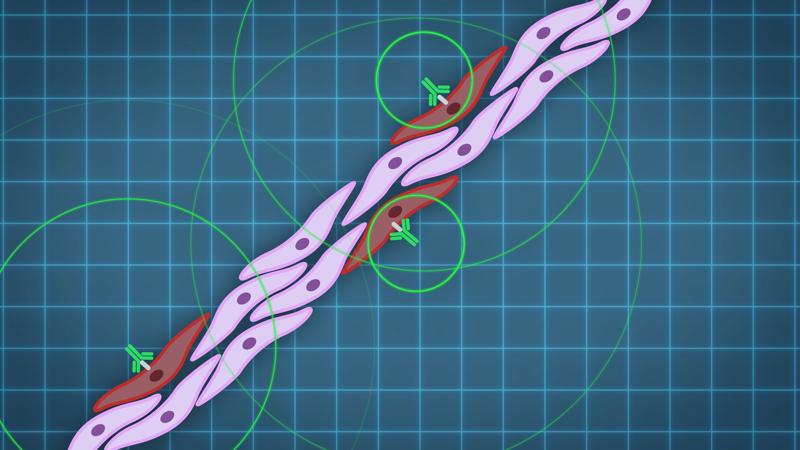
Artist’s representation of non-neutralizing antibodies targeting the flu virus.
An unusual therapy developed at The Jackson Laboratory (JAX) could change the way the world fights influenza, one of the deadliest infectious diseases. In a new study in Science Advances, researchers report that a cocktail of antibodies protected mice—including those with weakened immune systems—from nearly every strain of influenza tested, including avian and swine variants that pose pandemic threats.
Unlike current FDA-approved flu treatments, which target viral enzymes and can quickly become useless as the virus mutates, this therapy did not allow viral escape, even after a month of repeated exposure in animals...
Artists are always looking for new ways to create and express themselves. A growing trend is the use of multiple layers of see-through materials, such as Plexiglas, to create paintings that have real depth, transforming two-dimensional images into three-dimensional illusions that feel more realistic and lifelike. But can these layered works be made even more immersive?
A new study, published in Royal Society Open Science, answers this question by demonstrating a novel process to transform a multilayer acrylic painting into a fullcolor, three-dimensional hologram. In addition to offering a striking way to experience art, this technique provides a novel method for preserving and reproducing valuable works.
The researchers used a painting of a tiger titled “Taxonomy Test 1” by reno...
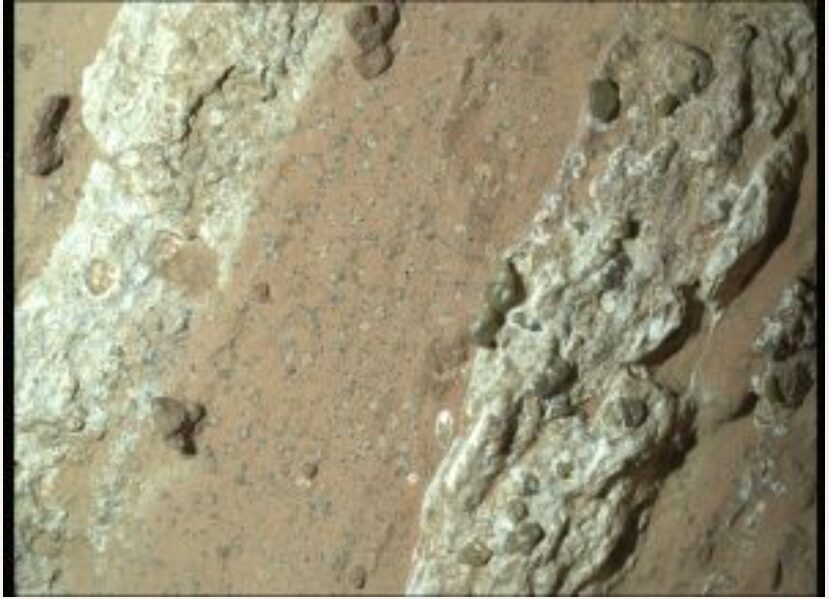
An image of the rock named “Cheyava Falls” in the “Bright Angel formation” in Jezero crater, Mars collected by the WATSON camera onboard the Mars 2020 Perseverance rover. The image shows a rust-colored, organic matter bearing sedimentary mudstone sandwiched between bright white layers of another composition. The small dark blue/green to black colored nodules and ring-shaped reaction fronts that have dark rims, and bleached interiors are proposed to be potential biosignatures. Credit: NASA/JPL-Caltech/MSSS
Data and images from NASA’s Mars Perseverance rover reveals that recently discovered rocks in Jezero crater are organic carbon bearing mudstones...












Recent Comments