In Great Shape: Metamaterial is World’s 1st to Achieve Performance predicted by Theoretical Bounds

The Isomax cell configuration. Credit: UCSB Engineering

The Isomax cell configuration. Credit: UCSB Engineering

Mechanical engineer and materials scientist Jonathan Berger, UCSB Prof. Robert McMeeking and materials scientist Haydn N. G. Wadley from the University of Virginia, prove that the 3D pyramid-and-cross cell geometry Berger conceived is the first of its kind to achieve the performance predicted by theoretical bounds. Its lightness, strength and versatility, according to Berger, lends itself well to a variety of applications, from buildings to vehicles to packaging and transport.

Called Isomax™, the beauty of this solid foam – in this case loosely defined as a combination of a stiff substance and air pockets – lay in the geometry within...

Read More
Waste Silicon Sawdust Recycled into Anode for Lithium-ion battery

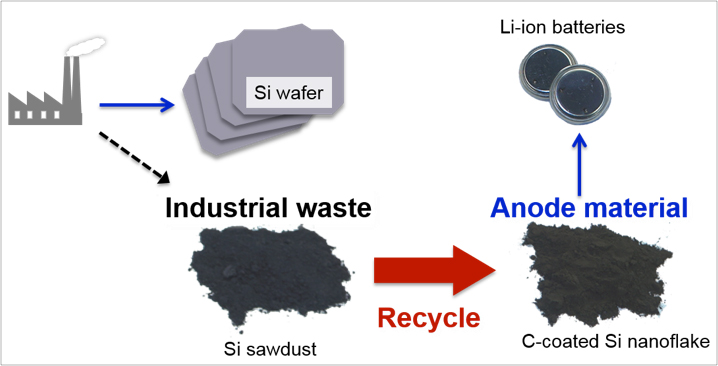
Production process from silicon sawdust to lithium battery anode.

Production process from silicon sawdust to lithium battery anode.

Researchers have created a high performance anode material for lithium-ion batteries (LIBs) using waste silicon (Si) sawdust. It is energy-consuming and expensive to produce Si wafers with high purity (> 99.99%). On top of that, some 50% of Si is actually discarded as industrial waste in the final cutting process. This waste is about 90,000 tons a year worldwide, an amount large enough to meet the global demands for anode materials for LIBs.

To make this happen, under the project of “Dynamic Alliance for Open Innovation Bridging Human, Environment and Materials,” a joint research team from Tohoku University and Osaka University has developed a practical and mass-producible method of recycling the unwanted Si sawdust into a h...

Read More

Possible Dark Matter ties in Andromeda Galaxy

The gamma-ray excess (shown in yellow-white) at the heart of M31 hints at unexpected goings-on in the galaxy's central region. Scientists think the signal could be produced by a variety of processes, including a population of pulsars or even dark matter. Credit: NASA/DOE/Fermi LAT Collaboration and Bill Schoening, Vanessa Harvey/REU program/NOAO/AURA/NSF

The gamma-ray excess (shown in yellow-white) at the heart of M31 hints at unexpected goings-on in the galaxy’s central region. Scientists think the signal could be produced by a variety of processes, including a population of pulsars or even dark matter. Credit: NASA/DOE/Fermi LAT Collaboration and Bill Schoening, Vanessa Harvey/REU program/NOAO/AURA/NSF

NASA’s Fermi Gamma-ray Space Telescope has found a signal at the center of the neighboring Andromeda galaxy that could indicate the presence of dark matter. The gamma-ray signal is similar to one seen by Fermi at the center of our own Milky Way galaxy. Gamma rays are the highest-energy form of light, produced by the universe’s most energetic phenomena...

Read More

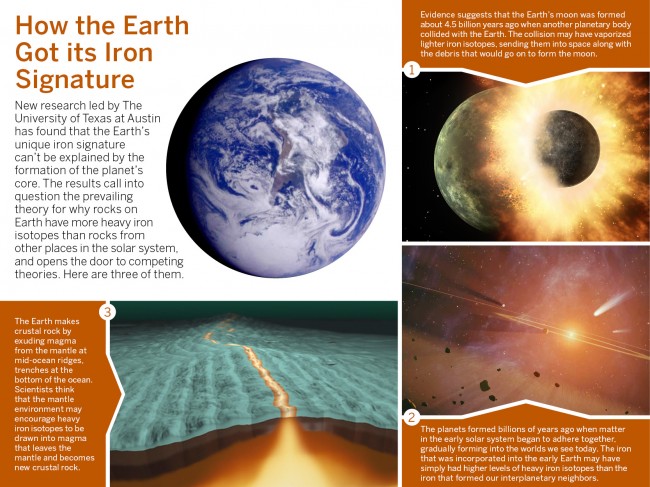
Experiments Call Origin of Earth’s Iron into Question

An infographic describing three theories on how the Earth got its iron signature.Designed by Laura Martin/The University of Texas at Austin Jackson School of Geosciences. Images 1 and 2 from NASA/JPL-Caltech, Image 3 from X-Science, Earth from NASA/JPL.

An infographic describing three theories on how the Earth got its iron signature.Designed by Laura Martin/The University of Texas at Austin Jackson School of Geosciences. Images 1 and 2 from NASA/JPL-Caltech, Image 3 from X-Science, Earth from NASA/JPL.

New research from The University of Texas at Austin reveals that the Earth’s unique iron composition isn’t linked to the formation of the planet’s core, calling into question a prevailing theory about the events that shaped our planet during its earliest years.The research, opens the door for other competing theories about why the Earth, relative to other planets, has higher levels of heavy iron isotopes...

Read More