






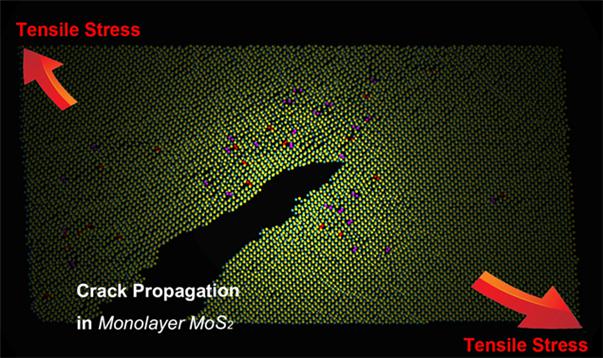
Explaining how 2D Materials Break at the Atomic level

 Schematic representation of the crack propagation in 2D MoS2 at the atomic level. Dislocations shown with red and purple dots are visible at the crack tip zone. Internal tensile stresses are represented by red arrows.

Schematic representation of the crack propagation in 2D MoS2 at the atomic level. Dislocations shown with red and purple dots are visible at the crack tip zone. Internal tensile stresses are represented by red arrows.

Cracks sank the ‘unsinkable’ Titanic; decrease the performance of touchscreens and erode teeth. We are familiar with cracks in 3D objects, but how do thin 2D materials crack? 2D materials, like molybdenum disulfide (MoS2), have emerged as an important asset for future electronic and photoelectric devices. However, the mechanical properties of 2D materials are expected to differ greatly from 3D materials...

Read More

For the 1st time, it is now possible to produce Functional OLED Electrodes from Graphene.

Orange luminous OLED on a graphene electrode. The two-euro coin serves as a comparison of sizes. Credit: © Fraunhofer FEP

Orange luminous OLED on a graphene electrode. The two-euro coin serves as a comparison of sizes. Credit: © Fraunhofer FEP

New OLEDs can, for example, be integrated into touch displays, and graphene promises many other applications for the future. The graphene electrodes have an area of 2 × 1 sq cm. “This was a real breakthrough in research and integration of extremely demanding materials,” says FEP’s project leader Dr. Beatrice Beyer. The process was developed and optimized in the EU-funded project “Gladiator” (Graphene Layers: Production, Characterization and Integration) together with partners from industry and research.

Graphene is light, transparent and extremely hard and has more tensile strength than steel. It is flexible, conductive for heat or electricity. It is only 0...

Read More

Likely Cause – and potential Prevention – of Vision Deterioration in Space

Wendy Hancock and Dr. Lonnie Petersen

Volunteer Wendy Hancock, left, and researcher Dr. Lonnie Petersen hang on to supports during a zero-gravity interval. Credit: UT Southwestern Medical Center

Vision deterioration in astronauts who spend a long time in space is likely due to the lack of a day-night cycle in intracranial pressure. But using a vacuum device to lower pressure for part of each day might prevent the problem, UT Southwestern Medical Center researchers said. A change in vision is the No. 1 health risk for astronauts who spend extended periods of time on the International Space Station. The new research showed that ICP in zero-gravity conditions, such as exists in space, is higher than when people are standing or sitting on Earth, but lower than when people are sleeping on Earth...

Read More

Deep-Space Mission to metal asteroid

Artist rendition of the asteroid Psyche. Credit: Image by Peter Rubin/ASU

Artist rendition of the asteroid Psyche. Credit: Image by Peter Rubin/ASU

Psyche to offer unique look into violent collisions that created Earth, terrestrial planets. Arizona State University’s Psyche Mission, a journey to a metal asteroid, has been selected for flight, marking the first time the school will lead a deep-space NASA mission and the first time scientists will be able to see what is believed to be a planetary core. It will launch in 2023, arriving at the asteroid in 2030, where it will spend 20 months in orbit, mapping it and studying its properties.

It will be part of NASA’s Discovery Program, a series of lower-cost, highly focused robotic space missions that are exploring the solar system. The Psyche project is capped at $450 million...

Read More