Master Regulator of Cellular Aging discovered

TZAP: A telomere-associated protein involved in telomere length control. Science, 2017

TZAP: A telomere-associated protein involved in telomere length control. Science, 2017

Scientists at TSRI have discovered a protein that fine-tunes the cellular clock involved in aging. TZAP binds the ends of chromosomes and determines how long telomeres, the segments of DNA that protect chromosome ends, can be. Understanding telomere length is crucial because telomeres set the lifespan of cells in the body, dictating critical processes such as aging and the incidence of cancer.

“Telomeres represent the clock of a cell,” said TSRI Associate Professor Eros Lazzerini Denchi. “You are born with telomeres of a certain length, and every time a cell divides, it loses a little bit of the telomere. Once the telomere is too short, the cell cannot divide anymore...

Read More

Catching CRISPR in Action: First all-atom Simulation of Genome Editing in action

A visual description of the CRISPR/Cas9 research explored by UNT researchers using TACC supercomputers. Simulations found that Cas9 produces staggered, "sticky" ends, which may make them easier to manipulate for future use. Credit: Jin Liu and Zhicheng Zuo, UNT

A visual description of the CRISPR/Cas9 research explored by UNT researchers using TACC supercomputers. Simulations found that Cas9 produces staggered, “sticky” ends, which may make them easier to manipulate for future use. Credit: Jin Liu and Zhicheng Zuo, UNT

The first all-atom molecular dynamics simulations of Cas9-catalyzed DNA cleavage in action has been performed. The simulations shed light on the process of Cas9 genome editing and helped resolve controversies about specific aspects of the cutting. Originally found as part of the immune system of the Streptococcus pyogenes bacteria, CRISPR associated protein 9 (CAS9), in its native state, recognizes foreign DNA sequences and disables them...

Read More

New Laser based on Unusual Physics phenomenon could improve Telecommunications, Computing

This is a schematic of the BIC laser: a high frequency laser beam (blue) powers the membrane to emit a laser beam at telecommunication frequency (red). Credit: Kanté group, UC San Diego

This is a schematic of the BIC laser: a high frequency laser beam (blue) powers the membrane to emit a laser beam at telecommunication frequency (red). Credit: Kanté group, UC San Diego

UCSD Researchers have demonstrated the world’s first laser based on an unconventional wave physics phenomenon called bound states in the continuum. The technology could revolutionize surface lasers, making them more compact and energy-efficient for communications and computing applications. The new BIC lasers could also be developed as high-power lasers for industrial and defense applications.

“Lasers are ubiquitous in the present day world, from simple everyday laser pointers to complex laser interferometers used to detect gravitational waves...

Read More

Physicists ‘Squeeze’ Light to Cool Microscopic Drum below Quantum Limit

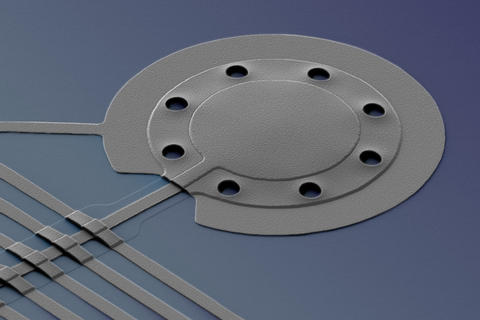
Teufel drum

NIST researchers applied a special form of microwave light to cool a microscopic aluminum drum to an energy level below the generally accepted limit, to just one fifth of a single quantum of energy. Having a diameter of 20 micrometers and a thickness of 100 nanometers, the drum beat 10 million times per second while its range of motion fell to nearly zero. Credit: Teufel/NIST

NIST Physicists have cooled a mechanical object to a temperature lower than previously thought possible, below the”quantum limit.” The new theory and experiments showed that a microscopic mechanical drum – a vibrating aluminum membrane – could be cooled to <1/5 of a single quantum, or packet of energy, lower than ordinarily predicted by quantum physics...

Read More