



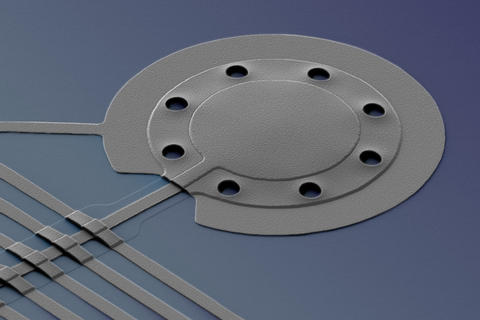
NIST researchers applied a special form of microwave light to cool a microscopic aluminum drum to an energy level below the generally accepted limit, to just one fifth of a single quantum of energy. Having a diameter of 20 micrometers and a thickness of 100 nanometers, the drum beat 10 million times per second while its range of motion fell to nearly zero. Credit: Teufel/NIST
NIST Physicists have cooled a mechanical object to a temperature lower than previously thought possible, below the”quantum limit.” The new theory and experiments showed that a microscopic mechanical drum – a vibrating aluminum membrane – could be cooled to <1/5 of a single quantum, or packet of energy, lower than ordinarily predicted by quantum physics. The new technique theoretically could be used to cool objects to 0K, the temperature at which matter is devoid of nearly all energy and motion.
“The colder you can get the drum, the better it is for any application,” said NIST physicist John Teufel, who led the experiment. “Sensors would become more sensitive. You can store information longer. If you were using it in a quantum computer, then you would compute without distortion, and you would actually get the answer you want.”
The drum, 20 micrometers in diameter and 100 nm thick, is embedded in a superconducting circuit designed so that the drum motion influences the microwaves bouncing inside a hollow enclosure known as an electromagnetic cavity. Microwaves have a longer wavelength and lower frequency than visible light. The microwave light inside the cavity changes its frequency as needed to match the frequency at which the cavity naturally resonates, or vibrates. This is the cavity’s natural “tone”.
NIST scientists previously cooled the quantum drum to its lowest-energy “ground state,” or 1/3 of one quantum. They used a technique called sideband cooling, which involves applying a microwave tone to the circuit at a frequency below the cavity’s resonance. This tone drives electrical charge in the circuit to make the drum beat. The drumbeats generate light particles, or photons, which naturally match the higher resonance frequency of the cavity. These photons leak out of the cavity as it fills up. Each departing photon takes with it one mechanical unit of energy – one phonon – from the drum’s motion. This is the same idea as laser cooling of individual atoms, first demonstrated at NIST in 1978 and now widely used in applications such atomic clocks.
The latest NIST experiment adds a novel twist – the use of “squeezed light” to drive the drum circuit. Squeezing is a quantum mechanical concept in which noise, or unwanted fluctuations, is moved from a useful property of the light to another aspect that doesn’t affect the experiment. These quantum fluctuations limit the lowest temperatures that can be reached with conventional cooling techniques. The NIST team used a special circuit to generate microwave photons that were purified or stripped of intensity fluctuations, which reduced inadvertent heating of the drum.
“Noise gives random kicks or heating to the thing you’re trying to cool,” Teufel said. “We are squeezing the light at a ‘magic’ level – in a very specific direction and amount – to make perfectly correlated photons with more stable intensity. These photons are both fragile and powerful.” The NIST theory and experiments indicate that squeezed light removes the generally accepted cooling limit, Teufel said. This includes objects that are large or operate at low frequencies, which are the most difficult to cool.
The drum might be used in applications such as hybrid quantum computers combining both quantum and mechanical elements, Teufel said. A hot topic in physics research around the world, quantum computers could theoretically solve certain problems considered intractable today. https://www.nist.gov/news-events/news/2017/01/nist-physicists-squeeze-light-cool-microscopic-drum-below-quantum-limit


Recent Comments