

Persistent pain often has no clear cause. However, studies show measurable differences in the structure and activity of the brains of those affected. This might explain why they experience chronic pain...
Read More


Until we recognize the essential role of biology, our attempts to truly unify the universe will remain a train to nowhere. ~Robert Lanza Read More

Good health is not something we can buy. However, it can be an extremely valuable savings account. ~Anne Wilson Schaef Read More

The only way forward, if we are going to improve the quality of the environment, is to get everybody involved. ~Richard Rogers Read More

To raise new questions, new possibilities, to regard old problems from a new angle, requires creative imagination and marks real advance in science. ~Albert Einstein Read More

Old Newtonian physics claimed that things have an objective reality separate from our perception of them. Quantum physics, and particularly Heisenberg's Uncertainty Principle, reveal that, as our perception of an object changes, the object itself literally changes. ~Marianne Williamson Read More

Astronomy compels the soul to look upwards and leads us from this world to another. ~ Read More
August 28, 2026,
 Health/Medical, Biology/Biotechnology
Persistent pain often has no clear cause. However, studies show measurable differences in the structure and activity of the brains of those affected. This might explain why they experience chronic pain...
Read More
August 28, 2026,
Astronomy/Space
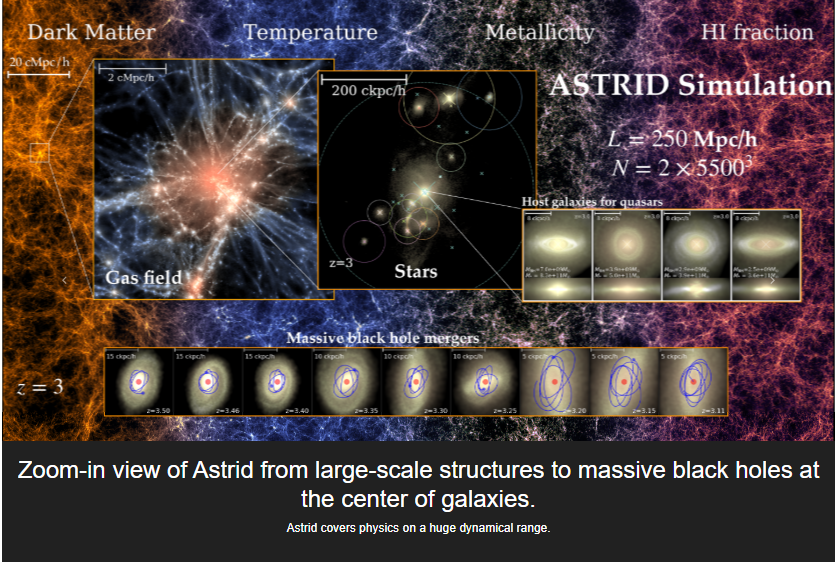
In dark skies at night, distant starlight twinkles and speaks to vast cosmic histories almost as old as time itself. New data from instruments such as NASA’s James Webb Space Telescope are helping astrophysicists probe deep cosmic mysteries, including the evolution of black holes and galaxies.
Using supercomputers to help make sense of the data, researchers from multiple institutions worked together to complete the largest cosmological hydrodynamic simulation, called ASTRID—a mind-boggling computational run that traces the evolution of the universe from its earliest times to the present.
“The most important information about our recent study is that we’ve evolved the ASTRID simulation to z = 0, and that these data are available,” said Yihao Zhou, a Ph.D...
Read More
August 28, 2026,
Physics, Technology/Electronics

Before you prompt AI to answer another question or perform another task, a Wake Forest computer scientist wants you to know it could expose your sensitive data.
Ying Zhang, an assistant professor in Wake Forest University’s Department of Computer Science, studies security in software engineering. Her latest research, “How Your Credentials Are Leaked by LLM Agent Skills,” explores how large language model (LLM) agents make data vulnerable to attacks.
LLM agents are autonomous AI systems that analyze circum...
Read More
August 28, 2026,
Astronomy/Space

The Roman Space Telescope is designed to directly image exoplanets using complex optomechanical systems developed by the Max Planck Institute for Astronomy
The Roman Space Telescope has been under development for about a decade under NASA’s leadership and is scheduled to launch on Aug. 30, 2026, at 7:26 a.m. EDT. The telescope is named after Nancy Grace Roman, who was considered the architect of NASA’s modern science program and, among other efforts, dedicated herself to the success of the Hubble Space Telescope project.
Roman’s destination is the L2 Lagrange point, a specific location 1...
Read More
Recent Comments