
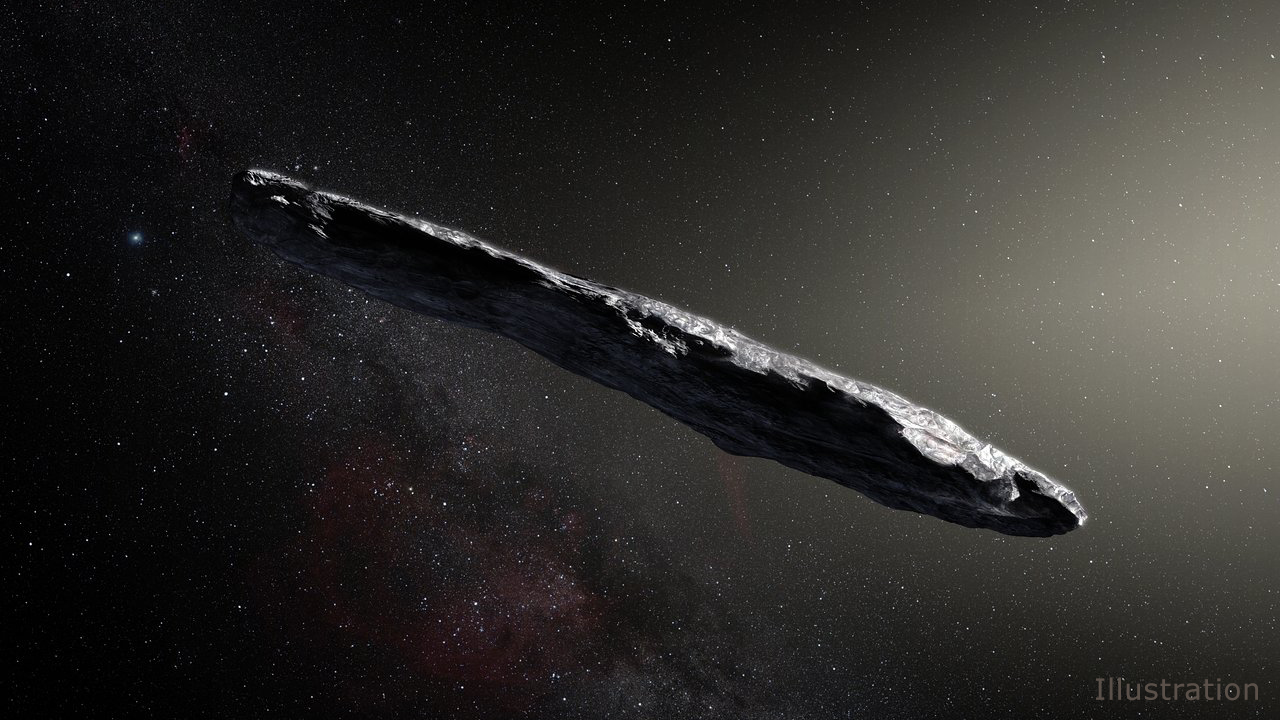
European Southern Observatory / M. Kornmesser
The first dark comet—a celestial object that looks like an asteroid but moves through space like a comet—was reported less than two years ago. Soon after, another six were found...
Read More


Until we recognize the essential role of biology, our attempts to truly unify the universe will remain a train to nowhere. ~Robert Lanza Read More

Good health is not something we can buy. However, it can be an extremely valuable savings account. ~Anne Wilson Schaef Read More

The only way forward, if we are going to improve the quality of the environment, is to get everybody involved. ~Richard Rogers Read More

To raise new questions, new possibilities, to regard old problems from a new angle, requires creative imagination and marks real advance in science. ~Albert Einstein Read More

Old Newtonian physics claimed that things have an objective reality separate from our perception of them. Quantum physics, and particularly Heisenberg's Uncertainty Principle, reveal that, as our perception of an object changes, the object itself literally changes. ~Marianne Williamson Read More

Astronomy compels the soul to look upwards and leads us from this world to another. ~ Read More
December 10, 2024,
 Astronomy/Space
The first dark comet—a celestial object that looks like an asteroid but moves through space like a comet—was reported less than two years ago. Soon after, another six were found...
Read More
December 9, 2024,
Physics, Technology/Electronics

A team of roboticists at the Beijing Institute of Technology, working with a pair of colleagues from the Technical University of Munich, has created a new kind of rat robot—one that was designed to interact in social ways with real rats.
In their paper published in the journal Nature Machine Intelligence, the group describes how they used artificial intelligence to train their robot rat to behave like a real rat...
Read More
December 9, 2024,
Astronomy/Space

December 9, 2024,
Physics, Technology/Electronics

Researchers from Linköping University together with colleagues from Poland and Chile have confirmed a theory that proposes a connection between the complementarity principle and entropic uncertainty. Their study is published in the journal Science Advances.
“Our results have no clear or direct application right now. It’s basic research that lays the foundation for future technologies in quantum information and quantum computers...
Read More
Recent Comments